Oil filters are not all the same size. Height, body diameter, gasket dimensions and cartridge locating features vary, and one matching measurement does not establish a suitable replacement. The important question is which dimensions belong to the filter specified for your engine and housing. A shorter or wider part may be an approved alternative, an updated design or simply the wrong item. Resolve that distinction from application information before installation rather than judging from a photograph.
There is more than one meaning of filter size
A seller might use size to mean the can’s outside diameter, the thread connection, the cartridge’s height or even the shipping box dimensions. Those describe different things. Start by identifying whether you are comparing complete spin-on assemblies or replaceable inserts inside a retained housing. Then ask which physical feature the stated number measures. A measurement without its feature and unit is incomplete information.
A catalog example separates the body from the gasket
MANN-FILTER’s W 917 product page lists a 93 mm outer diameter and an 85 mm height. It separately gives a 62 mm gasket inner diameter and a 71 mm gasket outer diameter. These numbers belong to that specific product. They demonstrate why a 93 mm can does not mean a 93 mm sealing ring, and why measuring the widest part cannot answer every fit question.
Similar height can hide a different body diameter
For comparison, the WIX 51348 catalog page states an 86.5 mm height and a 74.2 mm outside diameter at the top. Its height is close to the W 917 example, while its body diameter differs substantially. This is a dimensional illustration, not a cross-reference or recommendation to swap those parts. Two filters can look similarly tall on a workbench and still occupy different amounts of space.
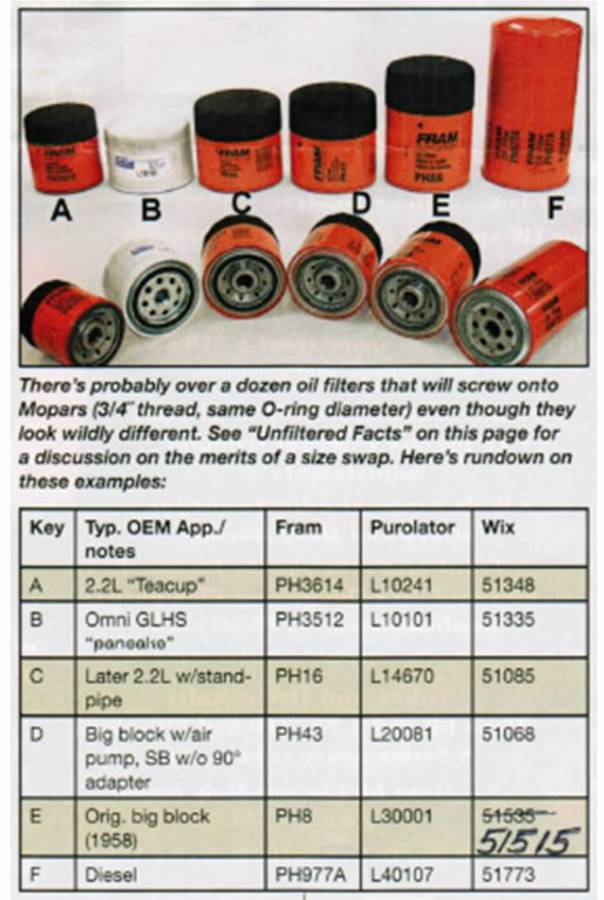
Credit: board.moparts.org
Read the dimensions as separate interfaces
A useful comparison follows the parts that must fit together: the outer assembly and its surroundings, the seal and its seat, and the cartridge and its internal supports. Treat these as separate checks. A filter can pass one and fail another. Manufacturer drawings help identify the relevant measuring points without relying on an approximate visual match.
Body diameter and overall height describe the outer envelope
The outer envelope tells you how much space the assembly occupies. It does not tell you how much filtering material is inside or whether the gasket contacts the intended surface. When reading a drawing, note whether a diameter is taken across the main can, a rolled rim or another feature. Likewise, check what the height includes rather than measuring between convenient but unrelated edges.
Gasket dimensions describe the sealing footprint
For a ring-shaped gasket, inner and outer diameters describe the area intended to contact the mounting surface. Thickness or profile can matter too. Matching the can diameter while ignoring the seal can therefore miss a critical difference. Do not stretch a seal, stack it over an old gasket or add sealant to make an unapproved part appear to fit. Obtain the specified filter and installation instructions.
Cartridge geometry includes more than the pleated cylinder
An insert may have end caps, a central opening, a projecting pin or a locating feature that is essential to its installation. In MAHLE’s February 2016 comparison of OX 404 and OX 813/1, nearly identical-looking elements use different locating arrangements for a closure pin. The bulletin warns that one incorrect combination can assemble without obvious blockage yet fail to close the intended passage. Visual resemblance is particularly weak evidence in that situation.
Use measurements to investigate a discrepancy
Measurements are valuable when the delivered part seems different from the catalog or the removed filter. Their role is to describe the discrepancy clearly. They do not replace the manufacturer’s application decision. Before draining the oil, compare the complete part number and listed vehicle application so you can resolve a mismatch without an unfinished service.
Find the application first, then its dimensional drawing
The MANN-FILTER catalog supports vehicle, product, cross-reference and dimension searches. A dimension search can identify candidates, while the application information establishes where the maker lists them. Use both appropriately. If your vehicle has a different engine or replacement housing, disclose that detail rather than assuming the vehicle’s original filter listing still describes the installed assembly.
Keep units and measuring points consistent
Compare millimeters with millimeters or inches with inches, and retain the catalog’s precision. For example, 3.5 inches equals 88.9 mm; it does not mean 3.5 mm. This arithmetic example is not a filter specification. Rounded figures can differ slightly without proving that the actual products differ. Where a page’s units conflict, obtain the manufacturer’s drawing instead of choosing whichever number seems plausible.
An old filter is a clue, not the design specification
A used gasket may be compressed, an element may be distorted and the previous installer may have chosen incorrectly. Photograph the old part number and relevant features, but do not use its altered shape to overrule current application data. If the new approved part differs, ask whether there is a documented design revision or a housing variation before deciding which measurement is authoritative.
Installed clearance and service access are different checks
A filter must occupy the approved space once installed, but it must also reach that position and remain serviceable. MAHLE’s June 2023 OC 248 bulletin describes converted minibuses where added oil-cooler equipment crowds the filter area and interferes with straight installation. The example concerns those modifications; it is not a suggestion to add a generic adapter whenever a filter is awkward to reach.
Describe the interference before choosing a different part
- During approach: note whether another component prevents the specified filter from being brought squarely to its connection. Forcing it at an angle does not solve a clearance problem.
- Once positioned: identify any contact with a bracket, hose or surrounding assembly. An apparently small interference needs proper assessment rather than moving a hose aside temporarily.
- During removal: check the specified tool and access procedure. A filter that can be installed but cannot later be serviced normally may indicate an unsupported modification or incorrect arrangement.

Credit: allwheeldriveauto.com
Correct seal location matters as much as seal diameter
A package can contain several different rings for different positions. MAHLE’s April 2023 OX 1141D instructions describe two different-diameter O-rings that belong in specific front and rear grooves, with a central indentation that is not the correct seat. Swapping the rings or using that indentation can create an internal leak. This product-specific example shows why “the ring fitted somewhere” is not an adequate installation check.
Do not turn a dimensional concern into extra tightening
A cap that will not seat as expected may indicate the wrong element, an incorrectly located seal or another assembly problem. More force does not identify which one is present. Follow the service procedure’s seating and tightening requirements. If the parts do not behave as the instructions describe, stop and inspect the arrangement before tightening further.
A correct exterior does not establish internal performance
Donaldson’s explanation of lube filtration separates particle-capture efficiency, contaminant-holding capacity and flow resistance. None can be calculated reliably from can height alone. A larger-looking filter does not automatically provide longer service or a performance upgrade. For the broader decision about approved alternatives, use our oil-filter interchangeability guide.
Common questions about oil-filter dimensions
Is wrench size the same as oil-filter size?
No. A tool dimension describes the feature the tool engages, such as a cap’s flats or the end of a spin-on can. It does not specify the filter’s sealing ring, connection or internal element. Choose the tool from the fitting procedure or its exact application listing; a wrench that grips a filter proves only that it grips that feature.
Does a bigger filter mean adding a guessed amount of oil?
Do not estimate the required fill from the outside of a replacement can. Follow the vehicle’s refill quantity and level-check procedure for its approved configuration. The outer envelope includes materials and spaces that a ruler does not distinguish. An oil-system modification needs its own supported filling instructions, rather than a volume guessed from a cylinder calculation.
Can two approved replacements have different dimensions?
They may, when the manufacturer confirms both for the precise application and their differences are accommodated by the installation. Dimensional identity is not the definition of an approved alternative. Conversely, a close dimensional match does not grant approval. If two catalog entries conflict, supply the full references to technical support instead of creating your own tolerance rule.
Should I buy a filter by measuring an unmarked sample?
Measurements can help a specialist investigate an unmarked item, but avoid making them the sole basis of purchase. Identify the engine and housing, then obtain their service requirements. A sample with unknown history could already be wrong. Keep the uncertainty explicit until reliable application information identifies the correct replacement.
Before installation, reconcile the complete assembly
Compare the delivered filter number, included seals and fitting instructions with the verified application. Look for damage or missing components as well as size differences. A correct product can still be delivered damaged, and a neat-looking package can contain the wrong item. Resolve either problem before the vehicle depends on the new assembly.
Carry the dimensional check through the service
Once the application and physical arrangement are confirmed, the remaining work is the specified installation and verification. Keep the product-specific procedure available rather than replacing it with a general rule about how filters usually fit.
Use the specified seals and seating positions
Replace the seals required by the service instructions and confirm their positions before closing the housing. A ring left over after assembly deserves an explanation from the parts list, not an assumption that it was optional. Avoid reusing an old seal merely because its compressed dimensions look more familiar.
Keep the service interval separate from physical size
Choosing the correct dimensions does not establish how long the filter should remain in use. Follow the vehicle and product maintenance requirements. If the replacement came from old stock, our guide to evaluating an older unused filter addresses that separate suitability question without using its size as an age test.
Investigate an abnormal result rather than blaming size alone
Complete the prescribed level and leak checks. If an oil-pressure warning or active leak appears, stop safely and follow the vehicle’s instructions. A wrong dimension is one possible concern, but installation, seals or another fault can also be involved. Do not keep the engine running to test whether a questionable assembly eventually seals.
The useful answer is a specified fit, not a universal dimension
Record the approved part and any application notes for the next service. Measure to clarify differences, distinguish the body from the seal and retain the exact cartridge features required by the housing. This guide explains dimensional evidence from manufacturer publications; it does not claim a physical comparison test or certify an unlisted substitution. The correct replacement is the one supported for the installed system.


Automotive reference information. Confirm specifications in the manual for your exact vehicle. Original replacement guides link to their research sources. About us