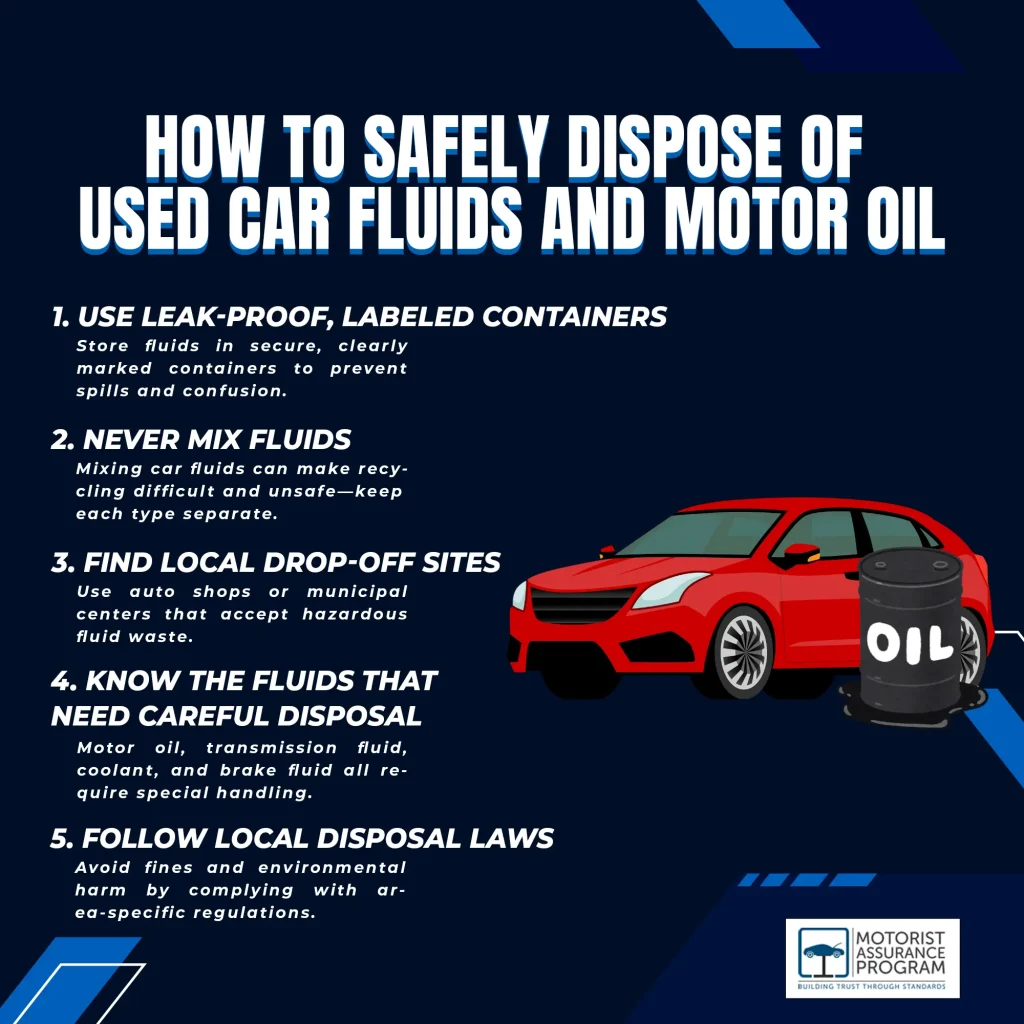

Keep used motor oil and transmission fluid in separate containers unless the facility receiving them explicitly says it accepts the mixture. Both can enter used-oil recycling streams, but that does not mean every drop-off program accepts them together. If you have already combined them, stop adding other liquids, identify the contents honestly, and ask the local waste program for an approved collection route before transporting or pouring anything into a shared tank.
This guide concerns fluids removed from vehicles for collection. It does not recommend mixing fluids inside an engine or transmission. It uses United States environmental agency and municipal guidance to show how acceptance decisions work; a reader elsewhere should contact the corresponding local waste authority. Collection rules, container limits, and household eligibility are location-specific, even when the materials have similar names.
Before your next fluid change, identify where each waste fluid will go. Ask the receiving site whether it accepts used engine oil, used transmission fluid, and a mixture of those two. Those are three separate questions. A list that includes both products establishes that the site handles both; it does not, by itself, establish permission to combine them in your garage.
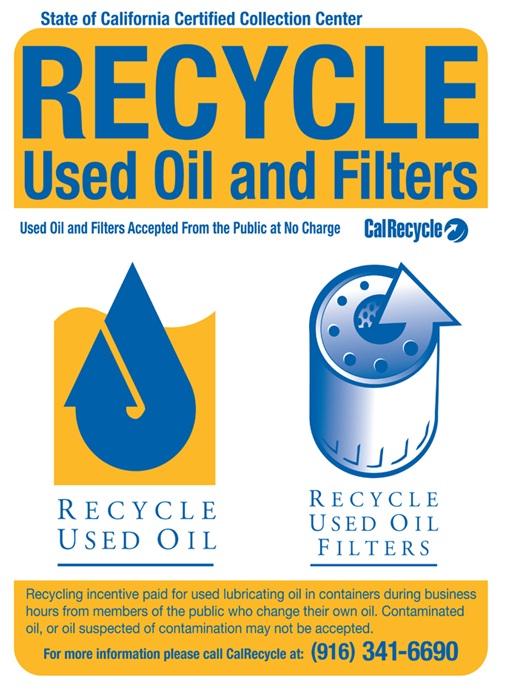
Credit: www.smchealth.org
Why the receiving facility's instructions matter
The EPA's used-oil reference table includes used engine oil and used transmission fluid. It also includes used synthetic oil. This helps explain why a processor may handle these materials within a broader used-oil system. The table describes a regulatory category, however, rather than the opening hours, equipment, contract, or acceptance conditions of your neighbourhood drop-off point.
A shared category is not a collection instruction
Washington's Shop Guide for Dangerous Waste Management discusses several used lubricants, including motor oil and transmission fluid, that can be combined without that act alone making the mixture dangerous waste under the guidance described there. Its context is workshop waste management. This is a useful example of why a blanket claim that these two fluids can never share a recycling stream is too broad.
Yet King County's household collection guidance, also in Washington, tells residents to keep transmission and other listed automotive fluids apart from used motor oil. Follow the instructions of the program you actually plan to use. A general classification and a household site's sorting instructions answer different questions; the first does not cancel the second.
Check the program, not a generic recycling claim
The City of Lakewood's guidance likewise directs residents to keep transmission fluid and other automotive chemicals in separate containers from motor oil. A motor-oil collection sign therefore should not be read as an invitation to bring every liquid from a vehicle. Use the program's named waste categories, and ask for clarification if transmission fluid is missing from the published list.
For example, imagine you have one jug of engine oil and a second jug of transmission fluid. A nearby site lists both as accepted. Keeping the jugs separate lets staff direct each to the appropriate collection point. Combining them first removes that option if the site requires separation. The small saving in storage space is usually less useful than preserving a straightforward way to hand over each identified material.
There is no useful universal household mixing ratio to calculate. A statement such as one quart of transmission fluid is acceptable in several gallons of motor oil cannot replace the receiving facility's policy. Describe what you have rather than trying to dilute a mixture until it seems mostly like the fluid named on a collection sign.

Credit: www.tractorsupply.com
What to do if the fluids are already mixed
An accidental mixture is a routing problem to disclose, not a reason to dump the contents or conceal them. Keep the container closed, keep other wastes separate, and make a short inventory of what entered it. Write down approximate amounts if you know them. If someone else used the drain pan or storage jug, include that uncertainty when asking the collection program for instructions.
When you know the mixture contains only two fluids
Use a precise description: used engine oil and used automatic transmission fluid from personal vehicle maintenance, with an approximate total volume. Say that they are already combined. Ask whether the facility accepts that specific mixture, whether it needs a different appointment or collection route, and how to label the container. If the answer is no, ask which local service can assess it. Do not pour it into a tank while waiting for permission.
When coolant, fuel, cleaners, or unknown liquids are involved
Treat a jug containing antifreeze, gasoline, degreaser, cleaning solvents, or unidentified liquid as a different enquiry from a known oil-and-transmission-fluid mixture. The EPA's household hazardous waste guidance advises against combining leftover products because some mixtures can react or lose recycling options. Tell the program every known ingredient. Do not identify an unknown liquid by tasting it, deliberately inhaling vapour, or guessing from colour.
Find a collection route before loading the car
Start with the website of your city, county, or local waste authority. Search its accepted-materials directory for used motor oil and transmission fluid separately. The EPA's consumer recycling guidance also points readers toward vehicle-maintenance facilities, waste collectors, and local waste officials. A convenient retail store can be worth asking, but confirm the individual location's current service rather than relying on a chain-wide assumption.
Ask a specific acceptance question
A useful enquiry covers the material, its source, its condition, and its amount: I have used engine oil and transmission fluid from my own car; they are separate, or already combined; there may or may not be other contaminants; the total is approximately this much. Then ask about container size, daily quantity limits, fees, proof of residency, and whether staff unload the containers. Record the location and instructions so you do not accidentally follow another site's rules.
Confirm eligibility as well as accepted materials
A program can list the right liquid and still be unsuitable for your visit. For example, Nashville's household collection page lists motor oil and transmission fluid, instructs visitors not to combine liquids, and excludes business-generated hazardous waste. Read the complete visit instructions rather than stopping at the accepted-items list. Check the current schedule, residency rules, and any appointment requirement immediately before setting out.
Collect and transport fluids without creating another mixture
Preparation starts before the drain plug is opened. Set aside suitable containers for the specific fluids you expect to remove, and keep the collection area clear of unrelated chemicals. If one drain pan is used for multiple jobs, do not leave the previous job's contents in it. An open pan used as a general catch-all makes it harder to describe the final waste accurately.
The EPA's consumer oil-recycling leaflet recommends a clean plastic container with a secure lid and warns against containers previously used for chemicals, food, or drinks. For used oil, choose an appropriate oil container or purpose-made collection container that is intact and closes properly. Do not reuse an antifreeze or cleaner bottle simply because it is empty; residual material and a misleading label create avoidable problems.
Label the contents and secure the load
Label each container with what it actually holds; include the mixture where applicable. The City of Elk Grove's transport guidance stresses sealed, non-leaking containers, upright loading, and bracing against movement. Follow your destination's packaging and vehicle-loading instructions, including its local limits. A container that fits a facility's size limit still needs a secure lid and support so it cannot tip when the vehicle brakes or turns.
Keep cleaners and other waste out of the oil stream
Do not spray parts cleaner into a pan holding used oil, or use a waste-oil jug to catch solvent from a cleaning job. Washington's workshop guide warns that contamination by certain solvents or aerosol products can change how the waste must be managed. Keep cleaning activities and fluid collection distinct. The concern is the added material, even when the amount seems small compared with the volume of oil.
Do not try to make an uncertain mixture acceptable by settling it, skimming a visible layer, filtering it through cloth, or topping it up with more oil. Those steps do not establish what dissolved chemicals remain or demonstrate that the receiving program accepts it. A clear description of the container's history gives the waste specialist more useful information than an attempt to make the liquid look cleaner.
If a container is leaking, damaged, or unstable, address that before transport. Ask the receiving program how it wants the container contained or overpacked. Elk Grove, for example, publishes separate packaging instructions for leaking containers; those directions are not a reason to carry an uncontrolled leak in your vehicle. Do not make additional transfers of an unidentified mixture simply to fit a convenient bottle.
A rejected load still needs an appropriate destination. Contact the local environmental or solid-waste service for the next route rather than leaving it beside a closed collection point. EPA household guidance identifies permanent collection sites, special collection days, and some participating businesses as possible options. It also warns against disposal into drains, onto the ground, or into storm sewers. Rejection by one site does not make any of those alternatives acceptable.
Plan for filters, containers, and workshop waste too
A fluid change can leave more than a jug of liquid: a used filter, an empty bottle, oily wipes, or absorbent from a spill may also need attention. Ask about each item individually. EPA's consumer guide recommends draining and recycling used oil filters, noting that collection centres often handle them alongside oil. Confirm your centre's preparation instructions before assuming that a filter can go into the same container or bin as the liquid.
Do not treat every oily item as the same material
A facility may accept a liquid but handle its container differently. Find out whether staff return your jug, keep it, or require you to empty it under their direction. Ask separately about filters and cleanup materials. Make a brief inventory before the visit so nothing is left without a plan. Avoid pouring liquid into absorbent merely to turn it into something that looks suitable for ordinary rubbish; ask the waste authority for that material's route.
Commercial waste needs a commercial answer
Oil generated by a repair business or fleet is not automatically eligible for a household collection service. The EPA's business guidance addresses storage, spills, and other management responsibilities, while noting that state rules can be stricter. It also explains that there is no general federal requirement for every oil retailer to accept used oil from others. New York's guidance illustrates state-specific collection obligations. Check the rules for your actual location and waste source.
Credit: www.alleganygov.org
Before you leave for the collection site
Check five things: the destination accepts your exact contents; household or business eligibility is satisfied; every container is correctly labelled and securely closed; the load meets that site's quantity and packaging limits; and you know how unloading works. Keep separate containers separate throughout the trip. On arrival, describe a mixed or uncertain load to staff before opening it or approaching a communal collection tank.
Recycling preserves useful material when it reaches a suitable process. EPA describes routes including re-refining oil into lubricant base material and processing it for other industrial uses. Those are managed processes, not instructions to reuse a garage mixture in a vehicle. Your practical contribution is to collect identifiable fluids, avoid adding contaminants, and deliver them to a program that has agreed to receive them.
If your real question concerns which fluid belongs in a vehicle, read whether motor oil and transmission fluid are the same. Recycling acceptance does not establish lubrication compatibility. The required vehicle specification and the collection facility's waste rules serve different purposes, and each needs its own answer. This guide draws on the linked public-agency guidance checked on 22 September 2026. The location examples explain why you should verify a destination's instructions; they are not a nationwide list of approved drop-off sites or a promise that a particular facility will accept your load.


Automotive reference information. Confirm specifications in the manual for your exact vehicle. Original replacement guides link to their research sources. About us