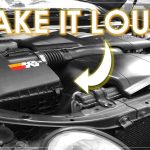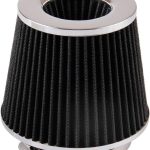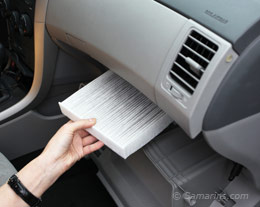

A car’s cabin air filter can capture some airborne smoke particles, depending on its design and the ventilation system. It cannot be assumed to remove every smoke pollutant or make hazardous air safe. The engine intake filter does a different job and does not clean the air passengers breathe. For wildfire smoke, reducing exposure and following local public-health or evacuation advice matter more than relying on a filter upgrade alone.
The word smoke combines several different concerns. You may mean fine particles from a wildfire, cigarette smoke produced inside the car, an outside exhaust plume or a smell left after an earlier exposure. These do not all respond to the same filter feature. Identify the source before deciding whether the next step is maintenance, a change in ventilation settings or investigation of a vehicle fault.
EPA describes wildfire smoke as a mixture of pollutants and highlights fine particles as a major health concern. Particle capture is therefore useful, but it is only one part of the problem. A product that reduces dust or pollen cannot automatically be credited with the same removal efficiency for smoke-sized particles, and a particle rating is not a gas-removal rating.
Start with the correct vehicle equipment and a documented replacement application. A premium label is not proof that a part fits, seals or works with the ventilation system. Our cabin-filter equipment guide explains how to establish what is installed. If the system cannot accept the proposed element, its advertised material or rating does not solve that mismatch.
This guide explains what filter claims can reasonably tell you and how to use that information during smoke exposure. It does not certify an individual car as a clean-air shelter or prescribe medical care. People with a personal smoke-response plan should follow it, and urgent symptoms or an immediate fire hazard take priority over researching replacement parts.
Match the pollutant to the claimed capability
MANN+HUMMEL distinguishes particle and combination cabin filters. A particle layer captures airborne material; a combination design adds media intended for certain gases and odors. That distinction matters when comparing products, but the presence of a dark carbon layer does not establish removal of every gas. Look for a clearly stated test and pollutant rather than interpreting “clean air” as an unlimited protection claim.
Also separate performance of the filter element from conditions in the occupied cabin. Air can enter through open doors or windows, and the ventilation setting changes the air path. Even an accurately stated laboratory rating does not prove the same percentage reduction for every passenger on every journey. Ask what the percentage actually measured before treating it as an exposure result.
The engine filter is upstream of the engine’s combustion process. Replacing it is not a remedy for passengers breathing smoke. Where a service receipt simply says air filter, verify which part was changed. If your concern is air from dashboard vents, ask about the cabin system specifically instead of purchasing an engine element with a familiar brand name.
| Concern | Relevant distinction | What not to assume |
|---|---|---|
| Airborne smoke particles | Particle filtration may reduce some of them | Every cabin element has the same efficiency |
| Smoke gases and odors | Specified sorbent media can target some compounds | Carbon captures every hazardous gas |
| Carbon monoxide | A separate serious gas-exposure hazard | A HEPA label establishes CO protection |
| Smoke produced in the cabin | The source is already inside the occupied space | Recirculation makes smoking safe |
| Residual smell | Odor and present particle concentration are different | A pleasant smell proves clean air |
What a HEPA or carbon label does not promise
EPA’s HEPA definition concerns a high-efficiency particle filter under a specified particle-size benchmark. It does not turn a vehicle into an airtight environment or establish gas removal. Our guide to HEPA claims in cars covers the terminology in more detail. Here, the practical issue is whether the exact automotive product has relevant evidence and fits the intended system.
For an advertised percentage, identify the particle size, test method and whether the result covers new filter media, a complete element or the installed vehicle. These are different test objects. If a seller provides only a large number without its conditions, request the missing information. Do not compare two percentages as though they measure the same thing merely because both appear on cabin-filter packaging.
EPA’s technical summary of residential air cleaners explains that carbon monoxide is not readily removed through the adsorption methods it discusses. That document is not an automotive product test, but it shows why a broad carbon-filtration claim should not be treated as CO protection. A cabin filter is not a remedy for a suspected exhaust leak into the passenger compartment.
CDC warns that carbon monoxide has no smell or color and that exhaust-system leaks can allow it to accumulate inside a vehicle. Therefore, the absence of a smoky smell is not proof of safety. If occupants feel ill and CO exposure is suspected, move to fresh air safely and seek urgent medical help; have the vehicle fault investigated rather than continuing to rely on a new filter.
Use recirculation as one exposure-reduction measure
EPA recommends the vehicle’s recirculation setting during high outdoor smoke levels, with a return to fresh air when conditions improve. Know how your own controls work before a trip, and follow the handbook if defogging or automatic climate operation changes the setting. The setting can reduce incoming outdoor smoke; it is not a promise that no outside air enters or that every pollutant already inside disappears.
The AirNow wildfire guide’s vehicle section cautions against treating a car as equivalent to a dedicated cleaner-air space. It also discusses cabin heat and carbon dioxide accumulation during prolonged closed-window recirculation. Use the car’s system as intended, remain alert to visibility and comfort, and reach a suitable cleaner destination rather than using indefinite recirculation as your entire smoke plan.
Keep the source of the smoke in mind. Recirculating cabin air does not move a cigarette outside the vehicle. CDC’s secondhand-smoke advice prioritizes keeping homes and cars smoke-free; air conditioning, ventilation or air-cleaning devices do not eliminate that exposure. A cabin filter replacement should never be offered as permission to smoke around other occupants.
Prepare the vehicle without making filtration promises
Before smoke season or a necessary journey, check that the specified cabin-filter service is up to date and that the system is assembled correctly. Use the vehicle instructions for access, element direction and refitting. A missing cover, damaged seal or incorrect element should be resolved. The maintenance goal is a functioning system, not a claim that a recent replacement now guarantees safe air.
When comparing an optional product, ask for application compatibility and evidence relevant to the pollutant of concern. EPA’s air-cleaner guidance separates particle and gas capabilities and does not endorse manufacturers’ health claims. Its home-product ratings should not be transplanted directly to a car. Likewise, an automotive seller’s unsupported promise that a filter prevents illness is stronger than a simple particle-capture claim and requires different evidence.
| Preparation | Useful check | Timing basis |
|---|---|---|
| Identify the cabin system | Correct part, instructions and any retrofit history | Before buying a replacement |
| Maintain the installed element | Service condition and manufacturer schedule | Vehicle and product guidance |
| Plan necessary travel | Current air quality, local alerts and destination | Before leaving and as conditions change |
- Plan the route and destination. Check official air-quality information and emergency alerts before departure. The EPA FAQ points US readers to AirNow’s Fire and Smoke Map; use the appropriate official service in other countries. Air quality and road/fire safety are different checks, so a favorable reading does not authorize entering a closed road or ignoring an evacuation instruction.
- Operate the climate system without sacrificing visibility or heat safety. Use the vehicle’s documented smoke/recirculation controls and keep the windows clear. Never leave children or pets unattended in a closed vehicle. AirNow’s vehicle guidance highlights rapid cabin heating; reducing smoke entry does not justify creating a separate heat hazard.
- Reassess at a safe stopping point. If outdoor conditions worsen, your destination becomes unavailable or an occupant becomes unwell, respond to the situation rather than assuming the filter will compensate. A passenger can review official updates while the driver concentrates on the road. Do not adjust unfamiliar equipment or study air-quality graphs while driving.
Credit: paulsautomotiverepair.com
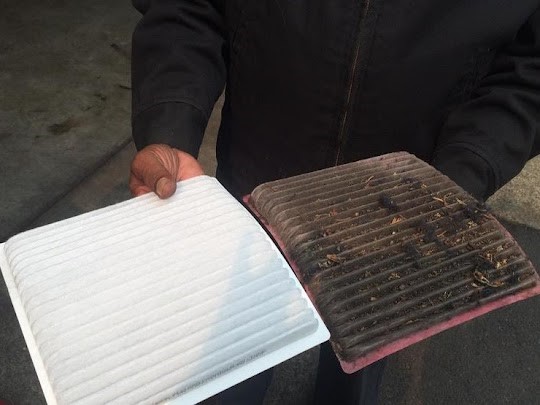
After exposure, inspect and service by the applicable instructions. Record the event and any persistent odor or airflow change. Ask the vehicle or filter manufacturer whether the exposure warrants earlier replacement. There is no single mileage figure or universal “one smoky drive” replacement rule established by this guide.
Do not attempt to restore a disposable cabin element by washing or spraying fragrance onto it. A smell-masking product does not measure pollutant removal, and an unsupported treatment may leave the filter unsuitable. If an odor remains after correct service, the ventilation system or contaminated interior may need further assessment. Use our filter-cleaning eligibility guide before assuming any element is washable.
A suitable cabin filter is one useful part of an exposure-reduction plan. Its limits remain important: particles differ from gases, laboratory efficiency differs from in-car exposure, and filtration does not replace source control or emergency advice. Maintain the right system, interpret claims narrowly, avoid smoke where practical and investigate vehicle-generated fumes. This article summarizes public-health and manufacturer information, without claiming to have tested the air in your car.


Automotive reference information. Confirm specifications in the manual for your exact vehicle. Original replacement guides link to their research sources. About us