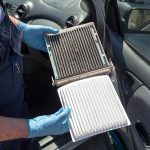

Car air filters are not automatically HEPA filters. An engine intake filter and a cabin ventilation filter have different jobs, and neither name establishes a HEPA rating. Some factory-installed cabin systems and some replacement cabin filters explicitly use HEPA filtration. To identify one, check the exact vehicle equipment or filter part number and the supporting test information. A claim about a filter’s particle capture is not a promise that every pollutant inside the passenger compartment will disappear.
Start by identifying which air filter you mean. An engine air filter serves a combustion engine’s intake; a cabin filter serves the passenger ventilation system. Replacing the engine filter does not upgrade cabin filtration. For the broader distinction, see what the different car air filters do. The question here is narrower: what evidence supports the HEPA label on the part you are considering?
A conventional cabin filter can capture useful amounts of particulate material without being described or tested as HEPA. Conversely, a premium price, dark-colored medium or pollen-filter label does not establish that it meets a particular HEPA classification. Treat the description as the beginning of the investigation, then look for the specific performance statement and the application list.
The practical answer therefore has two parts: establish the rating, then establish that the rated product is suitable for the vehicle. If either part is missing, ask the manufacturer for clarification. An impressive efficiency figure on an unrelated filter cannot fill the gap. The same applies to a feature shown in a newer vehicle brochure but absent from your car’s equipment.
What a HEPA claim actually establishes
HEPA stands for high efficiency particulate air. The US EPA’s explanation describes removal of at least 99.97% of particles at 0.3 micrometers under the stated HEPA definition. That is a particle-filtration reference, not a cabin cleanliness percentage. It does not mean that 99.97% of every chemical, odor or exposure encountered while driving is eliminated.
The 0.3-micrometer figure should not be read as a simple opening size below which everything passes through. EPA explains that HEPA filters can capture particles larger and smaller than the most penetrating size more efficiently. For a particular product, however, use its stated test method and conditions. Do not replace its measured specification with a homemade interpretation of pore size, thickness or the number of pleats.
| Filter use | Evidence to check | What it does not establish |
|---|---|---|
| Engine intake | Engine application and performance specification | A passenger-cabin HEPA rating |
| Cabin ventilation | Particle test, stated classification and vehicle fit | Removal of all cabin pollutants |
Different testing frameworks address different questions. ISO 29463-1:2024 concerns classification, performance, testing and marking of high-efficiency filters. A seller citing a standard should identify the relevant part, result and product. A familiar acronym without those details is insufficient evidence of a specific classification. Do not automatically treat every percentage, class designation and HEPA-related marketing phrase as interchangeable.
Engine, cabin and carbon filters are different categories
Engine filters are selected around the engine intake system’s requirements. The scope of ISO 5011:2025, for example, includes laboratory comparison of engine and compressor air cleaners for airflow restriction, dust collection and dust capacity. Those are meaningful engineering measures. They do not convert an engine filter into a passenger air purifier, even when its dust-removal performance is high.
Cabin-filter testing has its own methods. ISO/TS 11155-1:2001 addresses particulate filtration for vehicle passenger compartments, including pressure loss, fractional efficiency and particle-holding capability. Its public abstract also cautions that laboratory rankings may change in service. Seeing this standard on a cabin-filter document is not, by itself, evidence that the product has a HEPA classification.
Activated carbon adds a different function: treatment of certain gases and odors. It is not another name for HEPA particle filtration. MANN-FILTER’s cabin range distinguishes particle, activated-carbon and biofunctional products. This illustrates why “upgraded cabin filter” is too broad a description for comparing two purchases; the added feature may address a different pollutant or mechanism.
Gas-filtration evidence should be evaluated separately. ISO 11155-2:2009 concerns gas adsorption testing for passenger-compartment filters, rather than the particle test in Part 1. A charcoal layer does not justify a claim to remove every gas, and a HEPA particle rating does not substitute for gas-removal data. Ask which substances were tested and under what conditions.
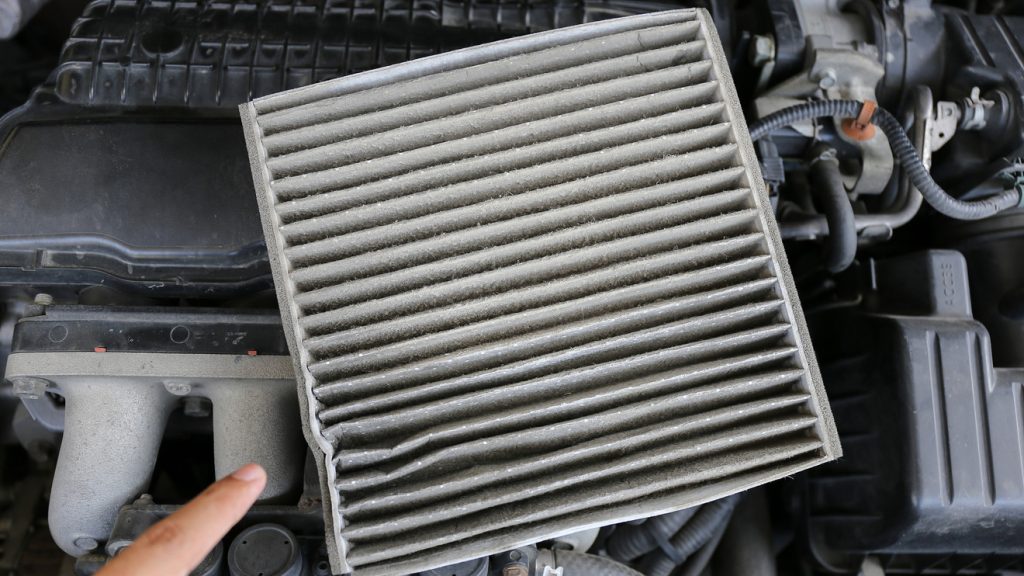
Avoid judging the category by appearance. Two pleated filters can look similar while using different materials and specifications; a dark layer does not prove either its carbon capacity or its particle efficiency. If you are unsure whether a cabin filter is fitted at all, start with the vehicle-specific checks in whether every car has a cabin air filter, then identify the installed part.
Read manufacturer claims at their actual scope
Bosch provides a useful example of why the footnote matters. Its HEPA Premium Cabin Air Filters brochure states 99.97% efficiency at 0.3 micrometers. The footnote identifies ISO 29463-3:2011, an air velocity of 5.33 centimeters per second, and part numbers 6003C, 6026C, 6029C, 6055C and 6056C. Keep those qualifications attached to the claim rather than extending it to every replacement part.
The distinction goes deeper than the number. ISO 29463-3:2011 specifies testing of flat-sheet filter media. A result for media under a defined test is not the same evidence as an assessment of an installed filter’s seal or a complete car cabin during a journey. This does not invalidate the media result; it identifies the question that the cited method answers.
Factory equipment also needs qualification. The current US Tesla Model Y climate-control manual describes a HEPA system conditionally, for vehicles equipped with it. It discusses outside-air operation, a secondary filtration system and activated carbon. That wording supports a real vehicle-system example, but it does not establish that every Tesla, every Model Y configuration or every replacement cabin filter includes the same equipment.
For a used vehicle, confirm the installed configuration as well as the original specification. Ask for the applicable owner’s manual, the equipment information associated with the vehicle and the replacement part numbers. A service invoice saying only “air filter” leaves the engine/cabin distinction unresolved. Likewise, a generic marketplace vehicle-match badge does not prove the seller’s filtration-performance statement.
| Evidence example | Qualification to retain |
|---|---|
| Bosch HEPA brochure | Specified media test, conditions and listed part numbers |
| Model Y climate manual | HEPA operation applies when that equipment is fitted |
| Activated-carbon description | Gas treatment is separate from particle classification |
How to evaluate a HEPA cabin-filter upgrade
Choose an upgrade for a defined purpose, such as improved documented fine-particle capture, instead of buying the strongest-sounding label. Confirm the manufacturer lists the exact vehicle application, including relevant year or equipment differences. If no supported product exists, do not cut household HEPA material to size, stack extra sheets into the housing or substitute an unrelated filter merely because it physically fits.
Fit, airflow and sealing belong in the comparison alongside efficiency. A rating applies to air passing through the tested medium; it cannot describe air bypassing a poorly seated filter. The cabin-filter particulate standard includes pressure loss because resistance is part of performance. Do not assume every HEPA upgrade necessarily ruins airflow, or that a high efficiency figure proves acceptable airflow in your application. Ask for application-specific support.
| Check | Evidence worth keeping |
|---|---|
| 1. Identify the vehicle | Exact model, year, equipment and cabin-filter location |
| 2. Identify the claim | Part number, particle efficiency, test method and conditions |
| 3. Confirm installation | Approved application, fitting instructions, intact seal and normal ventilation |
Maintain the specified filter and its installation
Use the replacement schedule for the vehicle and the fitted product, including any conditions that call for earlier attention. There is no single mileage interval that establishes when every cabin HEPA filter must be changed. Tesla’s maintenance guidance, for instance, lists cabin-filter and HEPA-filter service separately and qualifies the HEPA recommendation by equipment. That distinction matters when ordering or documenting service.
Reduced vent airflow, new noise or difficult demisting after a filter change should prompt an installation and system check. They do not prove that the media is “too effective,” nor do they automatically mean the filter caused the problem. Verify the correct part, orientation, housing closure and absence of displaced packaging or debris, using the vehicle’s fitting instructions. Have unresolved faults inspected.
Follow the filter manufacturer’s instructions about replacement or cleaning. Do not assume a disposable high-efficiency cabin element becomes reusable after vacuuming, washing or compressed-air cleaning. A surface that looks cleaner does not establish that its tested performance has been restored. Our article on cleaning and reusing car air filters explains why the exact filter type must come first.
Record the installed part number, service date and any unusual conditions when replacing it. That simple record is more useful at the next service than “premium filter fitted.” If a shop performs the work, ask it to distinguish the cabin element from any separate HEPA or carbon assembly, so a normal cabin-filter replacement is not mistaken for servicing the whole filtration system.

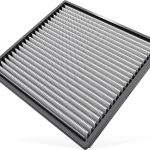
Credit: www.amazon.com
What HEPA filtration cannot promise inside a car
Filter performance and occupant exposure are different measurements. Windows and doors can admit unfiltered air, occupants can introduce particles, and only air reaching the filtration path is treated. A car is not converted into a controlled cleanroom by installing a highly efficient element. A useful purchasing comparison therefore keeps media test results separate from any claimed measurements of the complete vehicle interior.
Particle capture also does not establish that captured organisms are killed or that infection or allergy symptoms are prevented. Be cautious about a health claim based solely on the HEPA acronym. EPA’s air-cleaner guide explains the broader limits of filtration and the distinction between particles and gases. Its household equipment recommendations should not be treated as vehicle-fitment instructions.
Do not rely on HEPA or carbon filtration to make exhaust intrusion safe. Tesla’s Model Y manual specifically notes that activated carbon does not effectively remove some gases, including carbon monoxide. If exhaust is entering the cabin, stop using the vehicle and have the source investigated; replacing a filter is not a repair for an exhaust or sealing fault. An absence of odor is not evidence that hazardous gas is absent.
For everyday use, keep the ventilation system maintained and follow the owner’s manual for fresh-air, recirculation and demisting settings. Avoid smoking inside the vehicle or treating a purifier as permission to create pollution in the cabin. If windshield visibility is deteriorating, restore proper demisting rather than insisting on a particular air setting solely because it sounds better for filtration.
Verify the product, the test and the vehicle fit
The answer to “are car air filters HEPA?” is product-specific. Engine air filters serve a different system, ordinary cabin filters are not automatically HEPA, and genuine HEPA-labelled cabin products or factory systems require their own evidence. Keep the manufacturer’s part number, stated test conditions and equipment limitations together when comparing options. A clear, limited claim is more useful than an unqualified promise of pure air.
Before purchasing, be able to answer three questions: which filter is being replaced, what documentation supports its particle-filtration claim, and who confirms it is suitable for this vehicle? If those answers are available, you can make an informed comparison. If they are missing, request them rather than guessing from a brand name or a percentage on the front of a package.


Automotive reference information. Confirm specifications in the manual for your exact vehicle. Original replacement guides link to their research sources. About us