
Car air filters remove unwanted material from an air stream, but the engine filter and cabin filter serve different destinations. The engine-intake filter helps keep abrasive airborne particles out of a combustion engine. The cabin filter captures particles in air passing through the heating and ventilation system; some versions also reduce certain gases and odors. Replacing one does not replace the other. Before buying a part or approving a service, establish which filter the quotation names and which system has the problem.
The useful distinction is the route air takes. Intake air heads toward the engine’s combustion process; ventilation air heads toward the passenger compartment. MEYLE’s comparison of engine and cabin filters separates those two circuits. A dusty dashboard, a weak air vent and poor acceleration therefore do not all point to one universal air filter. Describe the observation first, then identify the relevant system. That prevents a correct replacement in one circuit from being mistaken for a repair to another.
Neither filter manufactures oxygen, cools air by itself or guarantees that every contaminant disappears. Its effect depends on the filter medium, the flow path, its condition and how well it fits. A package can describe the material’s capabilities, but it cannot compensate for a poorly seated element or establish that a particular vehicle needs replacement today. Ask for the applicable part number and the reason for service alongside any advertised benefit.
If you are deciding what to do now, find the engine-air-cleaner and cabin-filter entries in the owner manual or maintenance schedule. Check whether inspection or replacement is due, and note any dusty-operation instructions. If there is a new symptom, record when it occurs and whether it concerns engine operation or cabin airflow. A scheduled filter service and a fault investigation can both be worthwhile, but they answer different questions.
The engine filter protects the intake air path
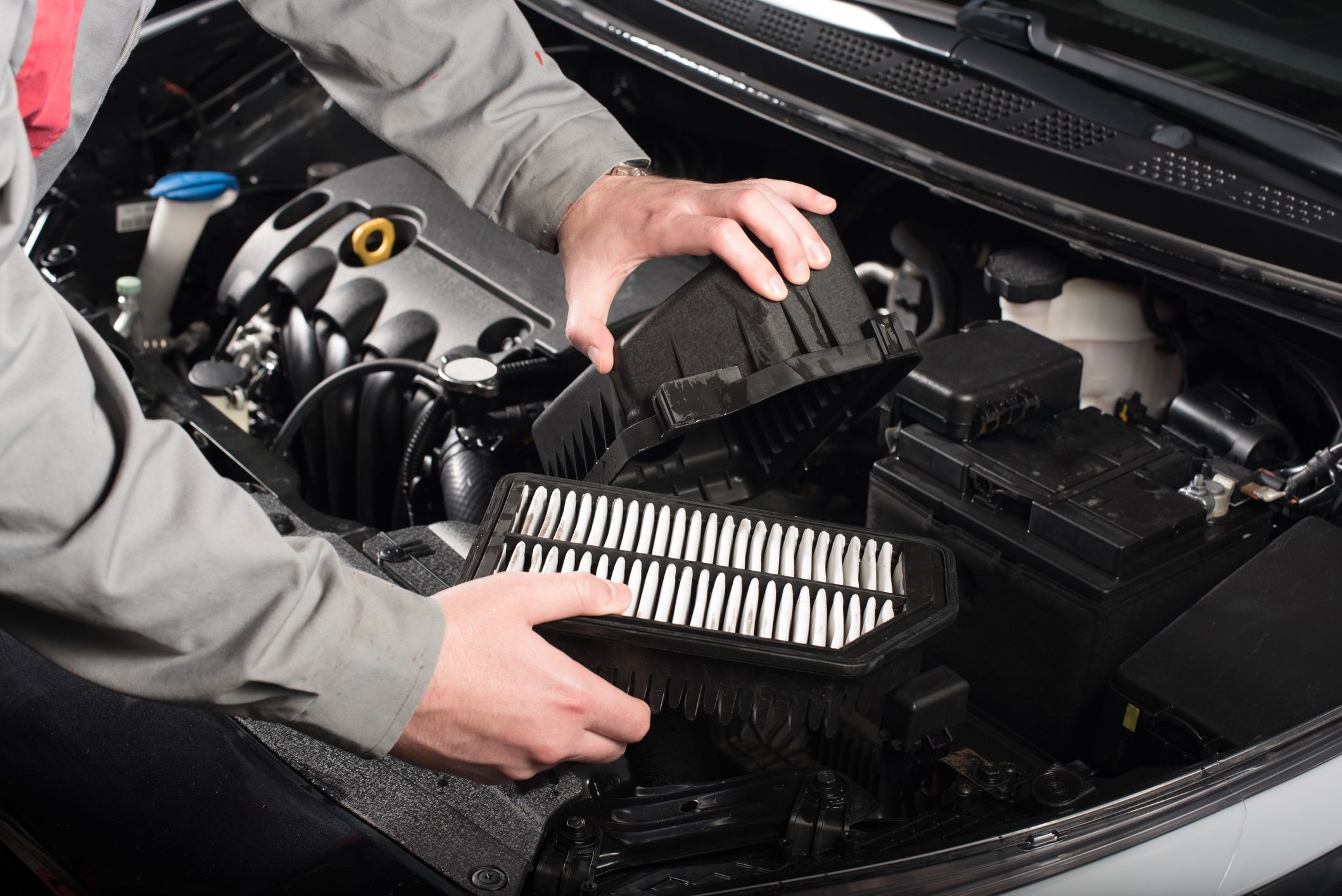
A combustion engine draws air through an intake system. The filtering element intercepts particles before that air reaches sensitive downstream components. MANN-FILTER’s engine-filter description explains the need to combine particle capture and dirt-holding capacity with limited flow resistance. Many elements use folded material to provide a substantial filtering surface in a compact housing. The folds also need support so the element retains its shape. An air filter is a controlled passage for air, not an airtight stopper.
The surrounding housing and seal are part of that protection. The intended air stream must travel through the filtering material rather than around a gap at its edge. A filter that looks close to the right size may still seat incorrectly. Check the catalog application, orientation and cover engagement instead of forcing an approximate fit into place. Replacing an element cannot by itself repair a broken latch, damaged housing or disconnected intake duct. Those findings need attention as part of the same inspection.
The engine-air filter also has a different job from the engine-oil filter. One works in incoming air; the other traps particles in the lubrication circuit. Our explanation of oil-filter operation covers that separate system. An oil change does not automatically mean the air filter was replaced, and a service invoice should identify each item. Similarly, an intake filter is not the exhaust system’s particulate filter: its location and the material it encounters are different.
Restriction and damage are different problems
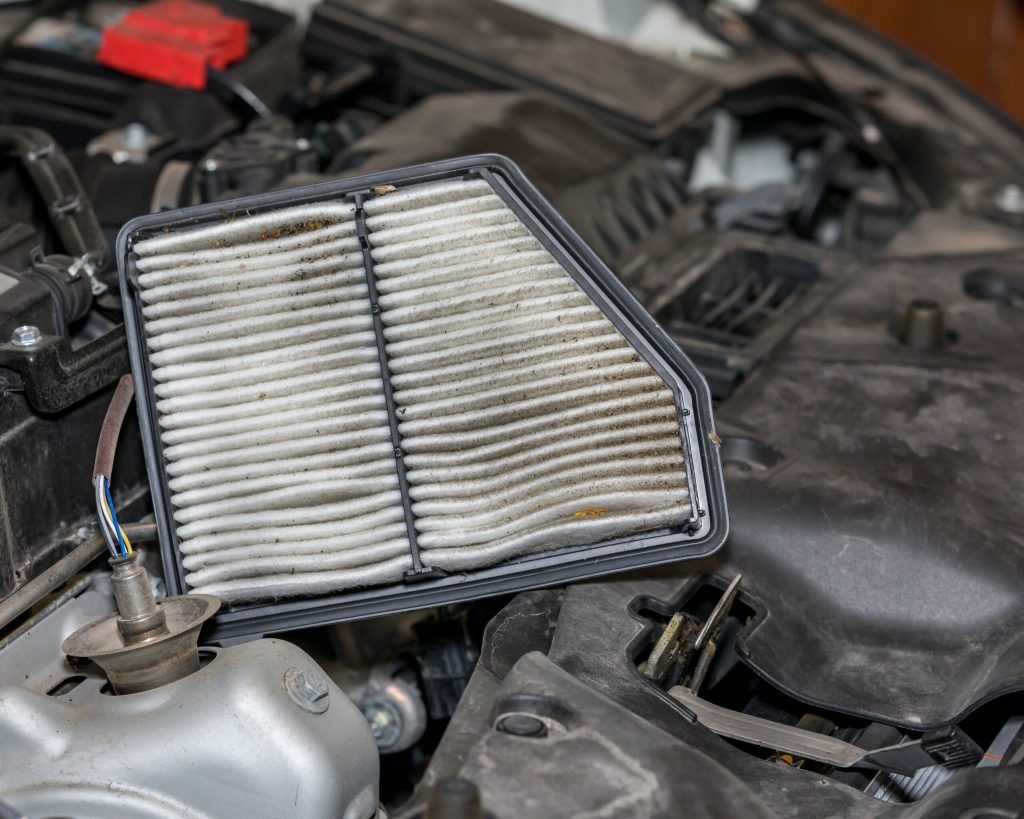
As captured material accumulates, it can make airflow through the element more difficult. Heavy restriction can limit how much air the engine receives when it demands high output. Damage creates another problem: a torn element or failed seal may allow dirty air to avoid the intended barrier. These are not opposite ends of a simple clean-to-dirty scale. A visibly cleaner filter with a tear can be unsuitable even though it offers little resistance to airflow.
Avoid treating every replacement as a fuel-saving upgrade. The U.S. DOE/EPA fuel-economy guidance distinguishes modern fuel-injected, computer-controlled gasoline vehicles and diesels from older carbureted vehicles. It says replacing a clogged filter can improve acceleration in modern vehicles without improving fuel economy, while older carbureted engines can respond differently. The reason to maintain the correct filter remains protection and proper airflow. A promise of a fixed percentage improvement in your next tank of fuel needs evidence specific to that claim.
The underlying research also has limits. A 2009 Oak Ridge National Laboratory study compared restricted and clean filters on three then-modern fuel-injected vehicles and an older carbureted car. It found no significant fuel-economy effect in the newer test vehicles, while acceleration improved with clean filters. That controlled result is useful evidence against a blanket mileage promise; it is not a test of every current engine or proof that every performance complaint is filter-related. We did not conduct those experiments.
An inspection provides clues, not a complete diagnosis
Follow the vehicle procedure before opening its air cleaner. Ford’s Ranger manual for vehicles built from 3 October 2022 warns against starting the engine with the air cleaner removed or removing it while the engine runs. It also requires the specified replacement element. Do not remove the filter and drive the car as a shortcut for testing power. Such a trial takes away the barrier you are trying to assess and is not an appropriate owner diagnostic method.
With inspection performed as permitted by the manual, useful observations include torn material, distorted edges, an element that does not seat, heavy debris, or a cover that will not secure correctly. Record what you actually see rather than assigning an exact remaining service life from color. Visible dust shows that the filter has collected material; it does not, by itself, measure restriction. If the vehicle uses a filter monitor or restriction indicator, follow its own interpretation and reset instructions instead of improvising a threshold.
A rough idle, warning light or sudden loss of power calls for diagnosis, even if a filter also looks due for service. Tell the workshop whether the symptom started immediately after work on the intake, after driving in unusually dusty conditions, or without any obvious event. If there is unexpected water, oil or physical damage in the assembly, identify its cause rather than merely installing another element. A new filter may be needed, but it does not establish why the previous one became contaminated or damaged.
Choose service from the manual and the actual filter type
Use the applicable vehicle schedule as the starting point. Do not apply an engine-filter interval to the cabin filter because both appear on one invoice. Driving conditions can matter as well as elapsed time and mileage, so check the schedule’s conditions and footnotes. Keep the last replacement date and mileage where they can be checked at the next service. When the history is unknown, state that uncertainty; a clean-looking housing is not a service record.
Replacement should restore the specified arrangement. Match the vehicle, engine and relevant production details in a reliable parts catalog, then compare the delivered part with its listing. A familiar brand name does not make all shapes or materials interchangeable. Ask whether the quote covers only the element or also a damaged cover, clips or housing. This makes it possible to compare like-for-like work and avoids approving an unspecified upgrade when the actual need is a correct, sealed fit.
Cleaning is appropriate only when the exact filter is designed for it and its instructions are available. Do not assume that a reusable product’s method also applies to a disposable element. Even reusable filters can require different treatments: K&N’s cabin-filter cleaning instructions specify its cabin Refresher kit and exclude its engine-filter Recharger kit. That is a product-specific distinction, not a recommendation to wash every cabin filter or add engine-filter oil. Identify the part before deciding what can safely be reused.
The cabin filter serves ventilation, heating and air conditioning
The cabin filter sits in the passenger ventilation air path, with its precise location depending on the vehicle. DENSO’s cabin-filtration information describes particle filters that capture material such as dust, pollen and soot, and carbon versions with an additional activated-charcoal layer. The filter’s job is separate from the blower that moves air and the heating or cooling components that change its temperature. It also helps keep particulate debris out of the HVAC system, rather than servicing the engine intake.
A carbon layer adds a different kind of treatment to particle collection: it can adsorb certain gas molecules and reduce some odors. It does not make the cabin airtight or establish protection against every gas. MANN+HUMMEL’s cabin-filter explanation distinguishes the replaceable element from the housing and wider filtration system, and notes that carbon capacity is finite. For a replacement, compare the correct fit and the manufacturer’s stated capability. Do not assume that a darker element is dirty; carbon-containing media can look different from a plain particle filter when new.
Electric cars still need appropriate cabin-air filtration because occupants use ventilation even without a combustion engine. Tesla’s maintenance guidance separately identifies cabin filters and HEPA/carbon equipment where fitted, with recommendations varying by model, model year and environment. It also identifies Cybertruck as lacking a standard cabin filter while listing a HEPA service requirement. This is why a fixed claim that every car has exactly two air filters is unreliable. Check the fitted system rather than inferring its parts from the vehicle’s fuel type.
For an electric vehicle, this air-filter service should not be confused with lubricant filtration elsewhere in the drivetrain. Our guide to Tesla oil filters explains that separate distinction. For any vehicle, use its actual equipment description when selecting a cabin replacement: particle, activated carbon and HEPA are not interchangeable labels. An unfamiliar filter name on an invoice is a reason to request the part number and location, not evidence that the job is unnecessary.
Credit: www.caranddriver.com
Turn cabin symptoms into specific service questions. Reduced airflow makes the filter worth checking, but it does not prove that the filter is the only fault. Describe which vents are affected, whether the blower responds to different settings and whether the problem concerns air volume or temperature. Those distinctions help the person inspecting the vehicle separate a possible restriction from other ventilation or cooling problems.
Replacing a blocked cabin filter can restore lost airflow through its path. It cannot replenish refrigerant or repair a compressor. Persistent odor or slow window clearing also needs broader assessment if filter service does not resolve it. Explain whether the symptom occurs with fresh air, recirculation, heating or cooling instead of requesting repeated filter replacements without a reason. Follow the vehicle’s defogging instructions, and do not continue driving with inadequate visibility while waiting for a filter change to help.
Finish service by confirming that the correct element is installed as directed and that its cover and any disturbed trim are secured. Record the part, date, mileage and reason for replacement, with any continuing symptom kept separate. This guide explains filter functions from manufacturer information and published research; it does not claim a test of a particular product or your car. The practical outcome is a clear answer about which air path is being protected, what evidence supports service and what still requires diagnosis.


Automotive reference information. Confirm specifications in the manual for your exact vehicle. Original replacement guides link to their research sources. About us