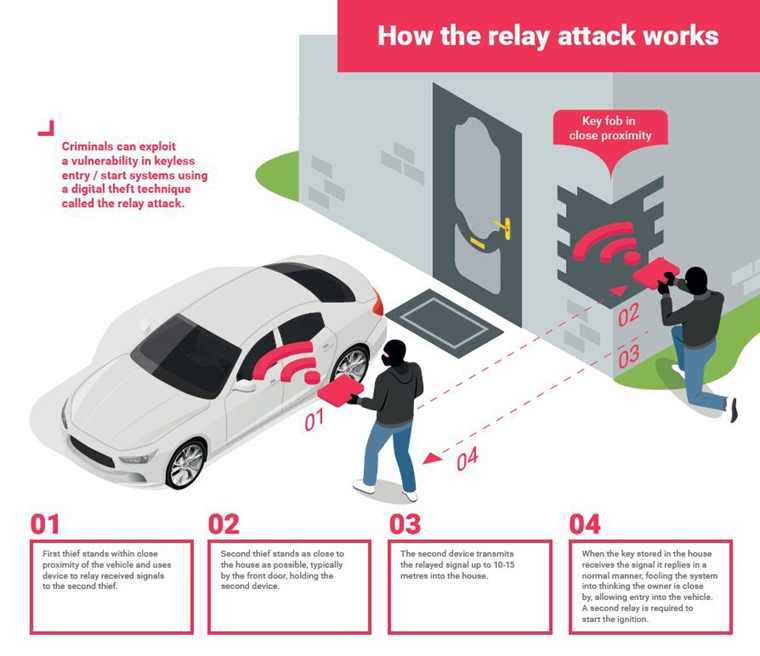

Protecting a keyless car works best as a set of checks: confirm it locks, store every authorized key securely, verify any signal-blocking storage and use suitable additional physical security. No single pouch, alarm or setting prevents every type of vehicle theft.
Identify which keyless functions your car has
Passive entry lets the vehicle respond to a nearby authorized key without pressing its remote button. Push-button starting and remote-button unlocking are related features but do not establish the same behavior. Read the vehicle's description of its actual equipment before changing settings.
Understand the risk without assuming one attack explains all theft
A relay attack can make a passive-entry vehicle treat a distant key as nearby. That is one risk, not the only way a car can be stolen. Key theft and other methods remain relevant even when passive entry is disabled or the key is screened.

Credit: www.amazon.com
Credit: www.locksmiths.co.uk
Make the protection verifiable
Police.uk: preventing vehicle theft recommends secure key storage, screened pouches and additional physical measures. The checklist below turns those categories into practical questions you can revisit, rather than treating a purchase as permanent proof of protection.
Check a signal-blocking pouch with every key
Close the pouch as its manufacturer instructs and verify that the stored key does not enable the normal passive-entry function. Keep another means of access available and do not lock yourself out during testing. Repeat after wear or damage; a key placed in an unscreened outer pocket may not be protected.
Review where the vehicle and keys are kept
Keep keys out of sight and away from easy reach through doors or windows. Include the spare in the plan. For parking, consider visibility, lighting and available physical barriers, while recognizing that a well-lit location is not a guarantee against theft.
Use supported passive-entry settings
If the manufacturer provides a way to disable passive entry or a key's wireless function, follow that exact procedure. Confirm what is disabled and how normal access works afterward. Do not assume a motion-sleep feature or an unfamiliar button sequence applies to every fob.
Add a suitable visible physical measure
A properly fitted steering lock or another approved device adds a different obstacle from key screening. Check compatibility and the product's instructions. Store it securely when driving so it cannot interfere with controls or become a loose object in the cabin.
Understand what an alarm or tracker contributes
An alarm may alert people; a tracker may support recovery. Neither should be described as proof that the car cannot be taken. Check activation, subscription requirements where relevant and the response procedure before relying on the device.
Review authorized keys after a change of ownership
Ask an authorized service provider how to verify and manage keys registered to the vehicle. Keep the record with the purchase documents. Having two physical keys in your possession does not by itself explain whether other credentials remain authorized.
Make storage a household habit
Choose a consistent secure place for all regularly used keys and the spare. Tell other authorized users how the pouch or storage system works. A protection plan is less useful if a spare remains near the door or someone routinely leaves the pouch open.
Confirm locking without defeating your own check
Use the vehicle's documented locking indication and an appropriate check. A passive-entry handle may unlock again when an authorized key is nearby, so interpret the result correctly. Do not assume mirror movement alone proves every opening is secure on every model.
Questions worth resolving for your vehicle
Does disabling passive entry eliminate theft risk?
No. It addresses a particular feature or exposure. Keep physical security, secure keys and the vehicle's other protections in the plan rather than treating one setting as complete protection.
How can I tell whether my pouch is still useful?
Test the intended passive function with the key fully enclosed according to the product instructions. Inspect closure and material condition and repeat periodically. A label on the pouch is not a substitute for checking its behavior with your keys.
Can I compare vulnerability from a model name alone?
Equipment, model year, software and key design can differ. Ask the manufacturer or an authorized provider about the exact vehicle and any applicable updates. Avoid relying on an unsupported ranking of brands.
What if the key battery fails while I use these precautions?
Security storage does not replace an access plan. Our dead-key-fob guide explains how to find the approved mechanical-entry and backup-start instructions for the vehicle.
A repeatable security review
Review the arrangement after replacing a key, buying a used car, changing a device or noticing pouch damage. Keep the process simple enough that every authorized driver can follow it consistently.
What each measure needs you to verify
| Measure | Useful check | Limit |
|---|---|---|
| Screened key storage | Key is enclosed and passive access is blocked in the intended test | Does not address every theft method |
| Passive-entry setting | Correct function is disabled using the vehicle instructions | Other access and theft risks remain |
| Physical security | Device fits and is used correctly each time | No device is an absolute guarantee |
| Alarm or tracker | Activation and response arrangements are understood | Alerting or recovery is different from preventing entry |


Automotive reference information. Confirm specifications in the manual for your exact vehicle. Original replacement guides link to their research sources. About us