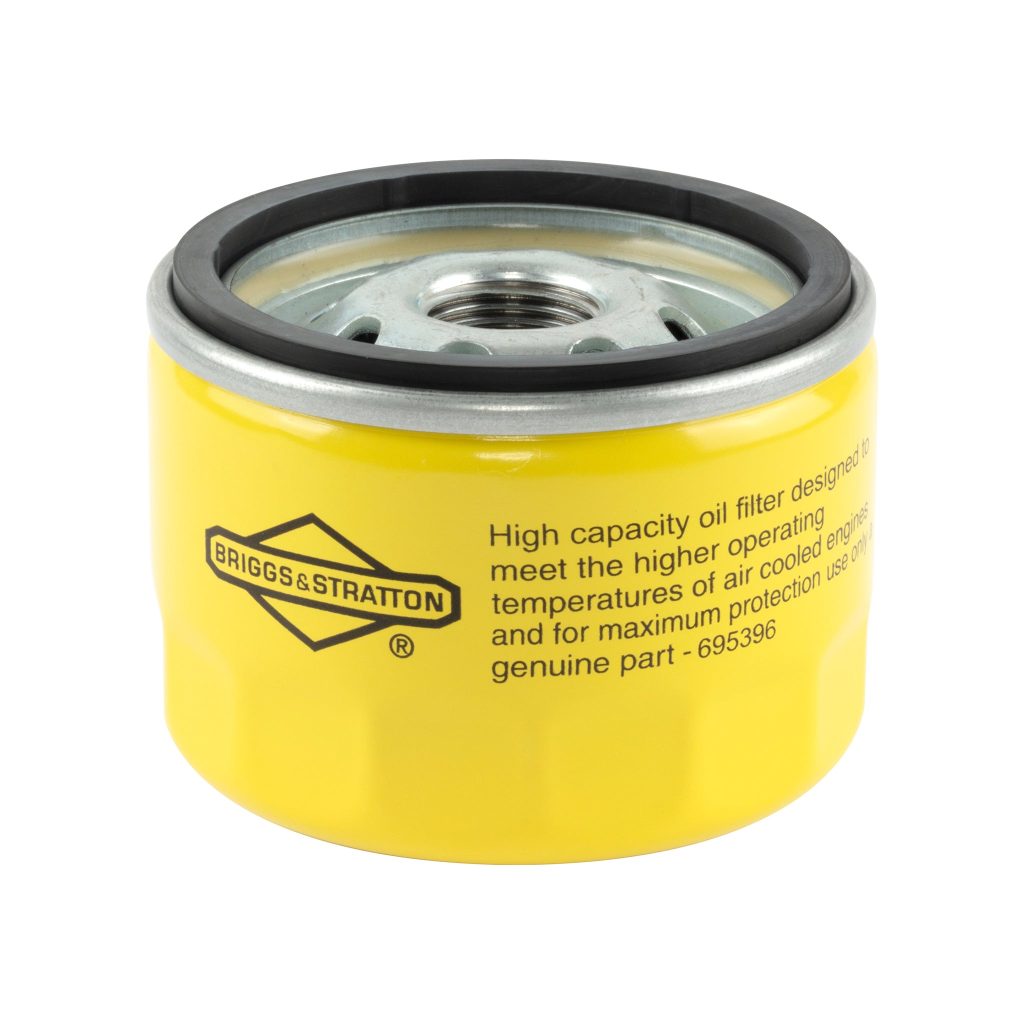

Briggs & Stratton oil filters are not all the same. A widely used filter is still limited to its listed applications, and a Vanguard engine can require a different product from another engine carrying the same corporate brand. However, two different numbers do not always mean two incompatible filters: the manufacturer also uses service and DIY identifiers. The reliable purchase starts with the installed engine’s identification and its parts information, then checks the delivered product against that requirement.
Start with the engine, not the mower’s sales name
A riding mower’s badge identifies the equipment, while its engine carries the information needed for engine parts. Photograph both if necessary, but keep their roles separate. A previous engine replacement is particularly important: ordering by the mower’s original configuration could send you back to an engine that is no longer installed. Horsepower, deck width and a familiar hood decal are useful context for a dealer, not a complete oil-filter specification.
Record Model, Type and Code before searching
Briggs & Stratton’s engine-identification guide explains where to find its Model, Type and Code markings. Their location varies with engine design; a decorative cover may obscure the actual marking. The guide specifically distinguishes these identifiers from emissions-label numbers, which cannot identify the engine for this purpose. Copy the complete marking, retain any letters and leading zeros, and include a clear photograph so a hard-to-read character does not silently become a different application.
A parts diagram’s callout is not the ordering number
The manufacturer’s explanation of illustrated parts lists distinguishes a diagram reference number from the service part number used for ordering. Follow the illustration’s callout into its corresponding parts table rather than entering that short reference into a shopping search. The same reference can have entries governed by Type or Code information. If a note applies to your engine, it belongs in the selection decision; do not discard it because another line is easier to find in stock.
Define what you mean by the same filter
A comparison becomes clearer when it separates the physical item, its catalog identity and the engine application. These can overlap without being identical. Two packages may identify one service product, while two similar-looking cans may serve different engines. Treat each question as something to establish from documentation, not as an assumption carried over from the previous filter purchase.
- Same product: look for an explicit manufacturer connection between the numbers. A similar label, shared logo or nearby shelf position does not document that relationship.
- Same approved application: confirm that the replacement is listed for your complete engine identification. An established alternative needs application support even when its external appearance differs.
- Same maintenance package: inspect the entire kit. A correct oil filter does not establish that the included air filter, spark plugs or other service parts fit your engine.
Read broad product descriptions carefully
The official 492932S listing describes a 2¼-inch-high filter used on most pressure-lubricated Briggs & Stratton engines. “Most” leaves exceptions; it does not authorize installation on every engine from the company. The store also directs buyers to verify the engine application. That wording is a useful starting point for recognizing the product, but a seller shortening it to “fits Briggs” has removed a significant qualification.
Build a short, traceable lookup record
Before buying, create a note that joins the engine identity to the proposed filter. The aim is to preserve the reason for the purchase, not merely the number of whatever happened to be installed last time. This makes a later packaging change, catalog update or supplier question much easier to resolve.
Use the official Briggs & Stratton parts lookup to investigate the identified engine. A practical record has three parts:
- Engine evidence: save the identification photograph and the exact characters entered into the lookup. Keep the equipment model separately if it helps establish access or installation context.
- Catalog evidence: record the relevant diagram, service part number and any applicable Type or Code note. A screenshot should retain enough surrounding information to show which engine was selected.
- Purchase evidence: compare the proposed seller’s complete part number with that result. If the listing claims a replacement number, obtain the documented connection before accepting the substitution.
If the lookup produces several possible entries, uncertainty has not disappeared just because each result says oil filter. Return to the engine identification and application notes. When the necessary marking is unreadable or the assembly has been modified, give a dealer the photographs and the unresolved question instead of choosing the first plausible result.
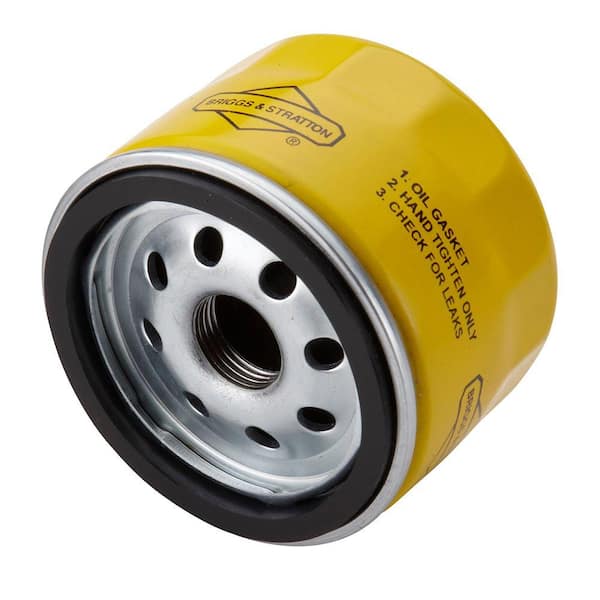
Credit: www.homedepot.com
Three documented examples show why numbers need context
These examples describe manufacturer publications checked for this guide. They are not a complete fitment chart. Use them to understand the distinction between a broad application description, a narrower engine family and linked sales identifiers; then complete the lookup for your own engine.
| Manufacturer identifier | What the cited information establishes |
|---|---|
| 492932S | The official listing describes a 2¼-inch-high filter for most pressure-lubricated Briggs & Stratton engines; it is not universal. |
| 842921 | The official store identifies select Vanguard V-Twin Big Block applications. The exact engine still needs verification. |
| 696854 / 5076 | The manufacturer’s Extended Life instructions identify 696854 as the service number and 5076 as the DIY number. |
The 842921 product page expressly limits its description to select Vanguard V-Twin Big Block engines. Separately, the Extended Life installation sheet, updated in January 2026, connects service part 696854 with DIY part 5076. This is a documented numbering relationship, not permission to treat every Vanguard filter as interchangeable. Nor does it establish that either number replaces 842921. Each conclusion needs its own supporting application information.
A maintenance kit is a separate application decision
For a concrete example, the 84002442 maintenance-kit listing includes oil filter 492932S together with air-cleaner components, a fuel filter, spark plugs and oil. It also warns that maintenance kits are engine-model-specific. Finding the correct oil-filter number among those contents therefore establishes only one part of the kit comparison. It does not make the remaining contents correct for every engine that uses that filter.
Check the kit as a collection of service items. If one component is unsuitable, buying the required items separately may be clearer than assuming the whole package must fit. Likewise, bottle sizes in a kit are not a refill instruction: use the installed engine’s specified oil and level-check procedure. A convenient bundle should simplify the service, not replace the information that determines what the engine needs.
Oil Guard is a lubrication system, not just a filter label
Vanguard’s Oil Guard description identifies an external reservoir with an accessible replaceable filter cartridge. The 2026 Oil Guard brochure describes a dry-sump arrangement and advertises a 500-hour oil-change interval for that system. This is a substantially different context from assuming that any branded spin-on can is the same service item. Confirm whether the engine actually has that system before using its parts or maintenance information.
- Identify the configuration: use the equipment and engine documentation to establish whether Oil Guard is installed. Do not infer the system from the Vanguard name alone.
- Keep the interval attached to its system: the brochure’s service interval does not convert an ordinary engine to the same schedule when a different filter is fitted.
- Obtain the applicable procedure: follow the reservoir, filter and oil instructions for the installed arrangement. Do not adapt a generic spin-on replacement sequence to a cartridge by improvisation.
For a conventional arrangement, the applicable operating manual remains the place to check oil and filter maintenance. The Extended Life installation sheet itself sends the reader there. Avoid making a universal rule from an online product page’s interval, a neighbor’s mower or the color of drained oil. A product’s name is not enough to set the engine’s service schedule.

Credit: shop.briggsandstratton.com
Confirm the service plan before opening the oil system
Selection and installation are connected, but they answer different questions. Even the correctly identified filter needs the correct procedure. Prepare the job while the engine is still assembled so an unexpected part difference can be resolved without leaving the equipment drained and unusable.
- Locate the relevant instructions: have the engine and equipment safety steps available, including how to prevent unintended starting during service and how to manage hot components.
- Compare the delivered item: read the actual filter and packaging, inspect for damage, and account for any seals or supplied instructions. A familiar box does not excuse a mismatched part inside.
- Use the specified oil and quantity procedure: obtain the required grade and refill guidance for this engine. Do not calculate the fill from an unfamiliar filter’s outside dimensions.
- Resolve physical differences: if the approved replacement looks different, confirm the documented revision or application before fitting it. Our guide to oil-filter dimensions explains the distinction between the body and its sealing features.
- Plan the final checks: follow the applicable instructions for level and leak inspection. If an active leak or abnormal oil-pressure indication appears, stop safely and investigate instead of repeatedly tightening a questionable installation.
Do not assume that every filter uses the same tightening method or access tool. Use the instructions attached to the specified product and engine. A component that will not seat as described needs inspection; extra force cannot establish whether the selected filter, its seal or the mounting arrangement is correct.
Questions owners ask when a filter number changes
Does different packaging prove the part was superseded?
No. Packaging can change without a new service application, and an unfamiliar number may identify a different sales format. The documented 696854/5076 relationship is an example of why that distinction matters. Ask for a manufacturer listing or confirmed parts history connecting the old and proposed numbers. Do not create a replacement chain by joining unrelated seller cross-reference lists.
Is the old installed filter enough to order another?
It is useful evidence, especially when its number is readable, but it does not prove the previous selection was right. Compare it with the engine-based lookup. If they disagree, save both references and resolve the discrepancy. Repeating a past purchase is convenient only after the original choice has been established as appropriate.
Can an aftermarket filter be a suitable alternative?
Assess a proposed alternative through the filter maker’s application information for the exact engine and required service part. Avoid claims that an outside brand must be inferior or that matching threads guarantees equivalence. Our oil-filter interchangeability guide explains that broader question. This article’s manufacturer examples do not certify any unlisted aftermarket substitution.
What if an older engine is missing from an online menu?
Preserve the markings and seek the appropriate historical parts information through manufacturer support or a knowledgeable dealer. An absent search result is not evidence that a newer filter fits. Distinguish an obsolete number, an incomplete lookup and an unsupported modification before deciding what replacement is appropriate.
Keep a verified reference for the next service
Once the part is confirmed, save the engine identification, filter reference and the source used to verify it. Add any legitimate replacement-number documentation rather than overwriting the earlier record. That history helps explain why a future filter may carry a different label without forcing the next owner to reconstruct the decision from memory.
For several machines, label each spare against its engine record. Two boxes on one shelf can look convincing beside the wrong mower, and one commonly shared filter does not establish that every consumable is shared. Recheck the record after an engine replacement or an oil-system modification.
The useful answer is application-specific: Briggs & Stratton offers multiple filter arrangements, while some identifiers describe linked versions of one product. This guide interprets manufacturer documentation; it does not report a bench test or a trial installation. Let the complete engine identity and documented parts relationship determine the purchase.


Automotive reference information. Confirm specifications in the manual for your exact vehicle. Original replacement guides link to their research sources. About us