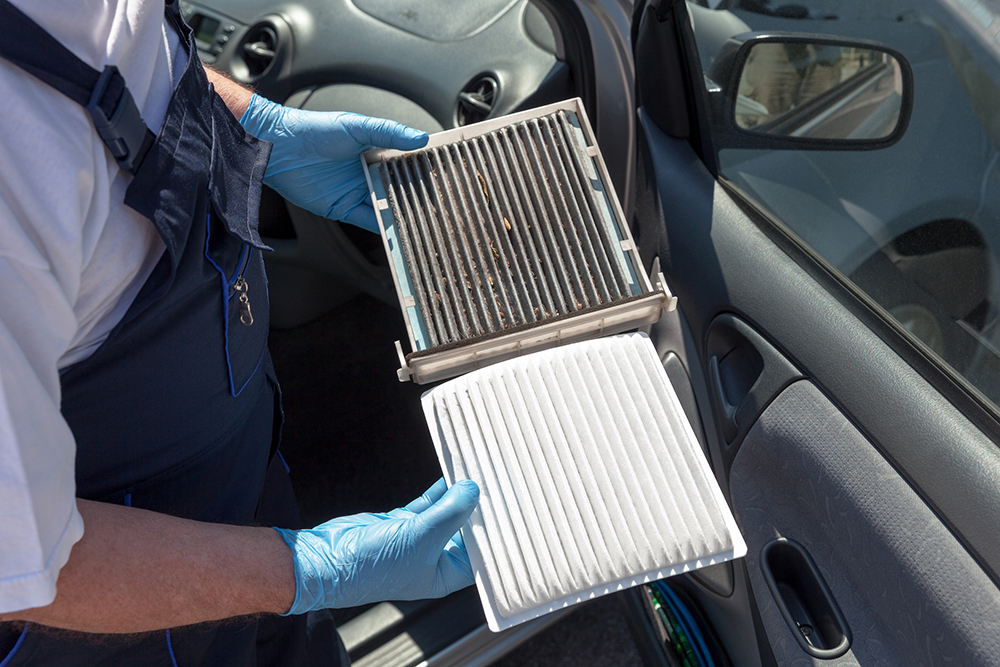

Car air filters differ in their job, housing fit, seal, filtering material and service method. Two products with similar pleats are not necessarily substitutes, and two approved alternatives for one position need not use identical materials. Start by identifying the system and exact application, then compare the features that matter for that use.
An engine filter and a cabin filter address different air paths. One belongs to the engine intake; the other serves passenger ventilation. They can both appear under an online store’s air-filter category, which makes the category name insufficient for ordering. The full product description and vehicle listing should establish which position is being supplied.
The comparison also changes depending on your question. “Will this fit?” concerns compatibility. “How well does it filter?” concerns performance under stated conditions. “Can I wash it?” concerns the approved service procedure. An answer to one does not settle the others. Keeping these questions separate makes a specification sheet more useful than a broad premium or performance label.
A useful purchase note identifies the system, vehicle details, required part reference and any equipment qualification before mentioning brand or price. It should also identify whether you are buying a replacement element for an existing housing or a kit that changes the intake. These are different products with different installation implications, even when the same seller lists both.
Compare the job before comparing the material
Bosch’s filtration overview separates engine filtration from standard and activated-carbon cabin products. Particle-filtering material and media intended to address certain gases are different capabilities. A cabin product’s odor-related claim is not an engine-protection specification, and an engine product’s airflow advertisement does not describe passenger exposure.
Shape is another incomplete shortcut. Panel, cylindrical and conical elements describe broad geometries, not universal vehicle applications. A cone shape does not establish a power increase, and a flat panel does not establish that the element is disposable. Treat shape as one identifying feature while checking the product’s actual function, mounting arrangement and instructions.
Several alternatives can legitimately appear for the same cabin-filter position. For example, one may use particle media alone while another adds activated carbon. That choice concerns the listed product’s capability, provided both are approved for the application. It does not justify substituting a differently sized insert or assuming every dark-colored element has the same construction.
For engine filters, replacement-style elements and complete intake assemblies need separate comparisons. An element designed for the original airbox retains that housing; an intake kit may change ducts, mounting or other components. Do not use a test of a complete kit as evidence that a standalone element will deliver an identical result in an otherwise standard car.
The seal and supports are part of the filter
The MANN-FILTER construction guide identifies application-specific media, sealing contours and element stabilization as relevant features. Its comparisons are manufacturer material, not an independent ranking of every competing product. The useful lesson is that the pleated center is only one component: the surrounding gasket and supports also need to suit the housing and operating conditions.
Overall length and width cannot describe every sealing detail. Edge profiles, corners, locating tabs and the contact surface may differ. A part that lies inside the airbox can still fail to sit correctly when the cover closes. Obtain the specified application rather than trimming an oversized element, adding improvised padding or relying on cover pressure to reshape it.
Ford’s 2024 Bronco Sport replacement instructions specifically warn against pinching the element’s edges between its housing and cover, because a damaged or poorly seated element can admit unfiltered air. That is an installation issue as well as a product-selection issue. Buying the right reference does not remove the need to seat it according to the vehicle procedure.
Read performance claims as measured quantities
Filtration efficiency, airflow restriction and capacity describe different aspects of performance. A percentage without its test conditions is incomplete, as is a flow figure without the conditions under which it was measured. Ask which part was tested, what the test measured and whether the comparison used equivalent conditions before treating two marketing numbers as directly comparable.
Do not assume a replacement will repay its price through better fuel economy. DOE and EPA maintenance guidance distinguishes computer-controlled, fuel-injected engines from older carbureted engines: replacing a clogged filter can help acceleration on modern vehicles without the fuel-economy improvement commonly promised in advertisements. That guidance is not a claim that every filter material performs identically.
The state of the old part also affects the meaning of a comparison. Replacing a blocked, torn or incorrectly installed element and then observing an improvement does not isolate the new brand as the cause. A claim about one material outperforming another needs a controlled comparison, not merely an account of a vehicle improving after overdue service.
Likewise, more intake sound is an observation about sound. It cannot by itself establish filtration efficiency, engine durability or a measured power gain. Our guide to air filters and intake noise explains why the filter and surrounding intake should be considered separately when interpreting a change heard from the driver’s seat.
Use the application listing to decide compatibility
The MANN-FILTER catalog offers several search routes, including vehicle and product lookup. Use the vehicle information to establish application, then use product details to resolve differences between candidates. A dimension search can help describe an unidentified part, but an approximate dimensional result is not the same as an explicit listing for the installed engine or ventilation system.
Read qualifications such as engine option, build date and market before assuming that a shared model name means a shared filter. If a previous owner changed the airbox or intake, the original vehicle lookup may no longer describe the fitted assembly. Provide the assembly’s identity to the manufacturer or supplier instead of concealing the modification behind a standard vehicle selection.
K&N’s 19569C radial-seal instructions explicitly treat cross-references as dimensional comparisons requiring application and sealing verification. The same sheet identifies that particular medium as Dryflow and says it does not need oil. This is a documented example of why neither a cross-reference nor a brand name supplies every fact needed for fitting and servicing a filter.
The correct cleaning method depends on the actual medium
K&N’s cleaning selector separates oiled cotton, Dryflow, industrial, heavy-duty and cabin products. The procedures are not interchangeable. A washable element may require a particular cleaner and drying process, while an oiled cotton product has an additional treatment stage. “Reusable” therefore describes a maintenance commitment, not permission to apply one household cleaning recipe to every filter.
Read the product instructions before deciding that a dusty element can be washed. Appearance does not identify all coatings, adhesives or service restrictions. Equally, do not add oil because another filter from the same manufacturer uses it. If the product cannot be identified, resolve its reference or replace it with a documented suitable part rather than experimenting on unknown media.
For a reusable choice, consider whether you can complete the required service before needing the car again. The required process may involve cleaning, drying, inspection and a media-specific treatment. A disposable choice has a different maintenance pattern. Compare those obligations as well as purchase price; neither arrangement is automatically the best fit for every owner.
Keep the instructions with the part record so a later service does not mistake a reusable element for an ordinary disposable one, or oil a product designed to remain unoiled. If a workshop will maintain the vehicle, tell it which product is installed. Our air-filter reuse guide covers the identification step before any cleaning decision.

Credit: www.firestonecompleteautocare.com
Choose between suitable products using useful evidence
Once compatibility is established, compare the information each supplier actually provides: the part reference, media description, installation requirements, service instructions and relevant performance evidence. Where a claim lacks a stated test or only describes a product family, mark that limit in your comparison. An unknown measurement should not be converted into a guessed score or a confident ranking.
The price comparison should include what the box contains. One listing may supply a single insert, another a matched set, and another a kit with a cleaner or housing component. Compare the quantity needed for a complete service rather than only the displayed price. Our filter-count guide explains why a function, an assembly and a retail package can represent different quantities.
Higher price alone cannot prove better fit, longer life or stronger filtration. Conversely, an inexpensive product is not disproved by its price alone. Prefer traceable application information and specific supporting documentation over assumptions drawn from packaging. If a proposed replacement differs visibly from the established reference, have the supplier explain the difference before installation.
A reusable filter’s savings depend on purchase cost, service supplies, the number of eligible services and how long you keep the car. Those inputs are personal, not universal. Do not add an assumed fuel saving or count an advertised maximum service period as guaranteed use in your conditions. Evaluate the actual maintenance plan and product instructions.
After installation, retain the invoice and exact reference. Record the service performed, including cleaning or treatment where applicable, so the next decision starts with reliable history. A new warning, poorly closing housing or abnormal running condition calls for inspection of the work and vehicle; it should not be dismissed as a normal adjustment period for a supposedly superior filter.
A suitable filter is defined by more than its appearance
The most useful comparison starts with function and application, then examines sealing, construction, evidence and maintenance. Similar-looking filters may differ substantially, while distinct materials may both be legitimate options for a specified position. Choose from documented suitable products and follow their instructions. That approach answers the practical question without pretending that every car air filter is the same or that one label proves universal superiority.


Automotive reference information. Confirm specifications in the manual for your exact vehicle. Original replacement guides link to their research sources. About us