
Yes, a faulty brake caliper can contribute to vibration, particularly when abnormal movement or release affects pad contact, wear or temperature. But vibration alone does not identify a bad caliper. Disc condition, hub mounting, wheel and tyre problems, suspension faults and other brake-system issues can overlap in the way they feel to the driver.
The correct next step is a structured inspection with measurements, not replacing the caliper because the steering wheel shakes. Start by describing when the vibration happens and whether braking changes it.
A vibration present while cruising calls for a broader investigation than one that appears only with brake application, although neither pattern proves a single cause. If there is severe shaking, a loose or damaged wheel assembly, reduced braking, smoke, a fluid leak or a strong pull, stop using the vehicle and arrange safe assessment.
Do not perform repeated high-speed stops to collect more evidence. This guide explains what existing observations and workshop checks can establish without offering a road-test recipe for a potentially unsafe car.
Record the pattern before assigning a part
Tell the repairer whether the symptom is felt mainly through the pedal, steering wheel, seat or whole vehicle. Explain whether it occurs during braking, while coasting or under acceleration, and whether it began suddenly or developed gradually. Note any recent tyre, wheel, hub, suspension or brake work. Include whether the symptom changes after the vehicle warms up, but do not deliberately overheat the brakes to reproduce it. Information already observed during normal use is enough to begin the investigation. The repairer can decide which controlled tests are appropriate after an initial safety inspection.
Avoid using a sensation as a location guarantee. Steering-wheel movement may guide attention toward the front of the vehicle, but it does not identify which component is faulty. Pedal pulsation is also a description rather than proof of a seized piston or a warped disc. Anti-lock operation can produce pedal feedback under relevant conditions, while an unexpected repeated sensation during ordinary braking needs its own diagnosis. Record warning lights and the conditions in which they appeared. A scan can contribute information when the vehicle system calls for it, but a clean fault-code list does not clear every mechanical brake problem.
Ask whether the reported condition has actually been reproduced and documented before approving parts. A technician may find a brake defect that needs repair even if it is not the sole cause of the vibration. Keeping those findings separate avoids promising that one component will cure every sensation. For example, a damaged boot may deserve attention, while a measured disc or hub issue may explain the pulsation. The estimate should identify both the confirmed faults and any question that remains unresolved.
| Recent service history deserves attention without becoming an automatic accusation. A symptom that begins after disc replacement may warrant checking the installed parts, hub contact surfaces, assembly and wheel fastening. A symptom that returns after a short improvement may indicate that only an effect was corrected while another cause remained. Provide dates and approximate mileage between the repair and recurrence. That timeline is more useful than saying that new parts cannot be involved. |
How a caliper can contribute—and what else can mimic it
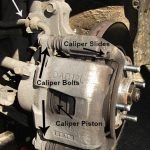
A floating caliper must move as intended within its guide arrangement, and its pads must operate correctly in their supports. A fault in that movement can affect how the friction surfaces work together. Ferodo’s brake-noise guidance identifies poor caliper sliding as a possible contributor to uneven or tapered pad wear and judder. This is a plausible causal route, not proof that every uneven pad or vibration comes from a guide pin.
The inspection must consider pad fit, guide condition, piston behaviour and the complete assembly rather than selecting one part from a symptom chart. A brake that remains applied can also develop abnormal heat and associated friction-surface problems. Establish whether the cause is mechanical or hydraulic before condemning the caliper. Wagner’s brake-system inspection checklist includes hose condition and restriction checks, illustrating why the supply and return path belongs in the investigation.
A caliper that appears to drag may be responding to a problem elsewhere. Opening hydraulic connections or manipulating a bleeder to explore that possibility should be left to the applicable controlled diagnostic procedure. It is not a safe roadside trick for making the wheel turn and continuing the trip. Disc and hub measurements are important because a vibration felt during braking may originate in the rotating assembly or its installation.
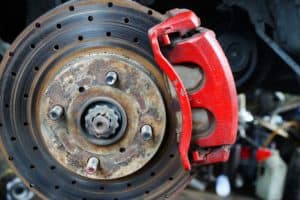
Ferodo’s brake-judder guidance discusses disc or hub run-out and contamination at the mounting interface. Brembo’s noise-and-vibration guidance similarly recommends looking beyond replacement pads and discs to the surrounding system. Use the limits and measurement procedure for the actual vehicle and component. A generic number from another application is not an acceptance standard for your car.
Run-out and thickness variation are different measurements. Run-out concerns the sideways movement of the installed rotating surface relative to the measuring setup; thickness variation concerns differences in disc thickness around the specified measurement locations. They should not be combined into the vague statement that the rotor is warped. Ask which condition was measured, how the assembly was prepared and what specification was used.
A visible surface mark alone does not provide either measurement. Likewise, a disc that looks clean can still require proper dimensional checks. Wheel, tyre and chassis conditions can also produce or influence vibration. A symptom present without brake application makes those areas particularly relevant, but brake application can change vehicle loads and how an existing problem is felt.
The workshop should check the vehicle as a system and address unsafe looseness or damage before further testing. Do not dismiss those possibilities just because a caliper is old. Nor should a wheel balance be sold as a guaranteed cure for every brake-only pulsation without evidence. A loose caliper attachment is a different concern from ordinary judder and calls for immediate correction of the mounting fault and any damage.
If recent work or a clunk raises that possibility, the vehicle should be inspected before further use. Tightening a visible fastener without identifying it and checking the joint is not adequate verification. The exact hardware, thread condition, installation and specified tightening procedure matter. The repair must restore a sound assembly, not simply quiet a noise for a short drive.
What the inspection and repair should demonstrate
A useful workshop report ties observations to findings. It should describe the vibration pattern, note any immediate safety issue and identify the inspections or measurements that support the proposed work. For the caliper, that may include movement, guide and boot condition, pad wear, mounting integrity and hydraulic checks appropriate to the symptom. For the disc and hub, request the relevant measured values and their application-specific limits. If the shop cannot reproduce the complaint, ask what evidence was found and what diagnostic step remains rather than accepting a confident single-part diagnosis without support. Repair the confirmed cause and assess any resulting damage.
If a binding assembly has affected pads or discs, replacing the caliper alone may not restore satisfactory operation. If a hub interface or installed run-out problem is present, fitting another disc without correcting the underlying condition may leave the complaint unresolved. On the other hand, a caliper that passes the appropriate checks should not be replaced merely to complete a list of possible causes. Explain the difference between a demonstrated defect and a preventative recommendation on the estimate. Do not use grease, a penetrating spray or aggressive bedding stops as a general vibration cure. Lubricants have specified locations and material-compatibility requirements, and must not contaminate friction surfaces.
Bedding instructions apply to suitable correctly installed components after the system is confirmed serviceable. They are not a way to fix loose hardware, hydraulic leakage or an undiagnosed hot wheel. If a shop recommends a bedding procedure, ask which product instruction applies and what checks established that the assembly is safe for it. After the repair, verification should revisit the original complaint under appropriate controlled conditions once static safety checks pass. Record whether the same symptom has disappeared and whether the pedal, brake release and other relevant functions are normal. A brief change in feel without checking the original conditions is weaker evidence than a documented comparison.

Credit: m.youtube.com
If vibration remains, reassess the outstanding possibilities instead of automatically replacing the same part again. Multiple faults can coexist, and a correctly repaired brake defect may not have been the only source of the sensation. For an owner comparing estimates, ask three practical questions. What evidence identifies the caliper rather than another component? What damage or associated condition must also be addressed? How will the completed repair be checked against the original vibration?
These questions encourage a diagnosis that can be explained and verified. They also help distinguish a quote for investigation from a quote that assumes a cause before inspection. Our guide to sticking-caliper checks addresses brake release symptoms in more detail, while caliper lifespan and inspection explains why age alone is not a replacement trigger. For vibration, keep the focus on the relationship between symptom, measurement and fault. A bad caliper can be part of that relationship, but the driver's sensation does not name the defective part on its own.


Automotive reference information. Confirm specifications in the manual for your exact vehicle. Original replacement guides link to their research sources. About us