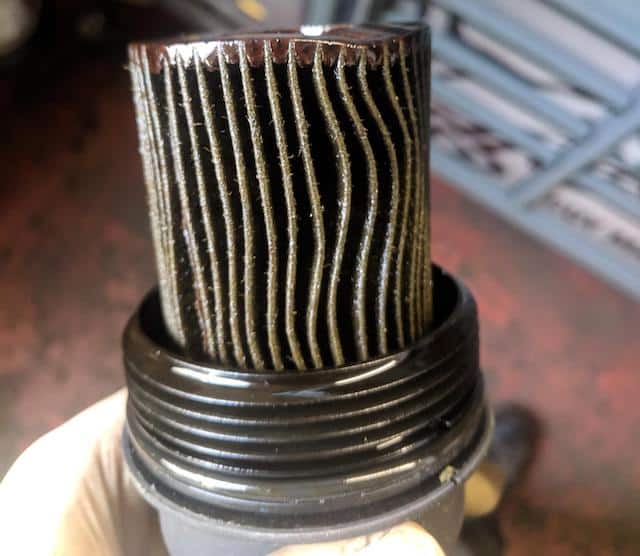

An installed oil filter should be replaced at the interval specified for the vehicle and service conditions, using a filter suitable for that interval. There is no single mileage at which every filter expires. The applicable trigger may involve distance, calendar time, a maintenance reminder or operating hours. A long-distance claim on a filter package does not automatically extend the vehicle’s schedule. Start with the exact owner’s manual and maintenance record; then check that the replacement product supports the intended use. That gives a defensible due date rather than a generic 3,000-, 5,000- or 10,000-mile guess.
This guide concerns a filter already installed and in service. An unused filter sitting in its packaging presents a different question about storage, age and condition; our oil-filter expiry guide addresses that decision. For an installed filter, count from the actual replacement, not the day you bought the spare or last added oil. A top-up does not replace the filter or establish a new service baseline. If your records say only “oil service,” confirm what work was completed before assuming the filter was renewed.
Separate three limits: the vehicle’s maintenance requirement, the filter product’s supported service conditions and the engine’s actual condition. They need to make sense together. A filter chosen for a shorter intended interval should not be stretched to a longer vehicle interval without manufacturer support. Conversely, a filter marketed for longer service does not erase a shorter vehicle requirement. An abnormal leak or oil-pressure warning also demands attention even when the planned replacement is months away. Scheduled life is a maintenance target under the stated conditions, not a guarantee against every possible installation error or fault.
Credit: www.fram.com
Read the application schedule before choosing a mileage
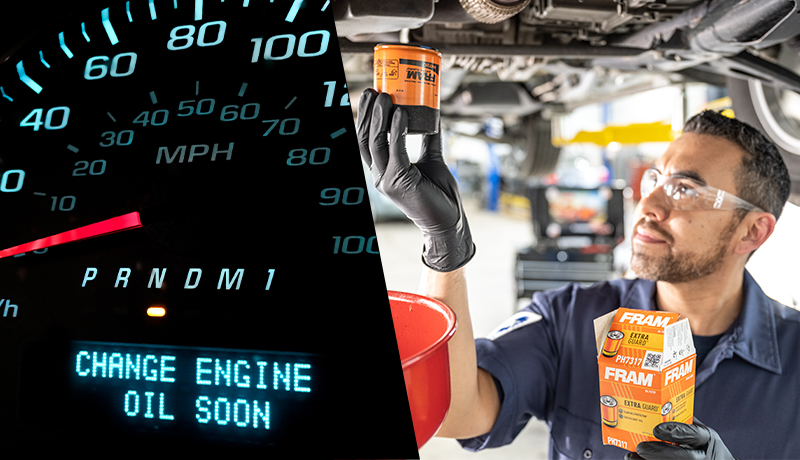
Oil and filter requirements can be stated together. Chevrolet’s engine-oil support guidance says its engine oil and filter should be changed at least annually, even if the oil-life system does not call for service earlier under favourable conditions. It also directs owners to their specific manual. That is an example of a calendar limit that matters to a low-mileage driver; it is not a universal rule for every brand or engine. Read the whole instruction, including the response required when a maintenance message appears. Do not keep driving toward a box’s advertised mileage after the vehicle has already called for service.
Some maintenance systems distinguish oil from oil-and-filter work. In the 2025 Honda Civic Hatchback Hybrid manual, the U.S. main code A calls for engine oil, while code B includes oil and filter plus inspections. The Canadian section uses its own code arrangement. This example is why an article should not claim that every manufacturer describes every service identically. Use the exact year, model and market’s items and footnotes. If a shop recommends changing the filter at an additional oil service, discuss that separately from the manufacturer’s required tasks. Preserve the record of when the filter was actually changed so the next due service is not inferred from an unrelated reset.
Driving conditions can change the applicable schedule. The FRAM maintenance FAQ directs owners to their manuals and identifies conditions such as short trips, towing, dust, stop-and-go use and excessive idling as reasons to consider the relevant severe-maintenance instructions. That does not mean every vehicle uses an identical definition or interval. Read the conditions associated with the oil and filter row in your own schedule. A work vehicle that spends hours idling can accumulate substantial engine operation without adding much odometer distance. A low-mileage car used repeatedly for short journeys likewise should not be treated as equivalent to one covering the same distance in steady long trips.
A maintenance monitor estimates a service need; it is not a filter inspection. Ford Australia explains that its Intelligent Oil Life Monitor analyzes vehicle data and provides an estimated remaining oil-life percentage on supported vehicles. Do not reinterpret that percentage as the amount of empty space left inside the filter. Maintain the history required for the system to be useful: reset only after the appropriate work, and use the vehicle’s instructions if a reset was accidental or the history is uncertain. A display showing a high percentage after a used-car purchase is not a receipt. Ask for the dated oil-and-filter record or arrange a suitable baseline service when that history cannot be established.
Read extended-life claims with their qualifications. FRAM’s discussion of filters and synthetic oil explicitly tells owners to prioritize the vehicle maker’s interval and filter requirements regardless of the maximum mileage on the package. Meanwhile, the Mobil Canada Extended Performance filter warranty attaches conditions to its service coverage, including distinctions involving product suffixes and the oil used for extended intervals. A warranty page is not a blank authorization for every engine, driving pattern or filter version. Confirm the current terms for your purchased product and region. An advertised maximum should remain a qualified product claim, not become a new maintenance instruction pasted over the owner’s manual.
Do not wait for a symptom to decide routine replacement. Donaldson explains that full-flow filtration balances efficiency, contaminant capacity and restriction, and that a bypass valve can maintain oil flow when conditions such as heavy loading or cold oil cause restriction. The continued ability of an engine to run does not demonstrate that a filter has unlimited useful life. A bypass valve is not a maintenance extension feature. Oil colour, engine sound and a casual look at the outside of the canister cannot quantify remaining holding capacity. Use the scheduled replacement decision, and treat unusual symptoms as a separate diagnostic problem rather than a convenient countdown to the next filter change.
Calendar and hour limits also matter outside road cars. The John Deere 325/335/345 service-interval page combines annual requirements with hour-based tasks and distinguishes models within its schedule. That illustrates why a lawn tractor, generator or other stationary engine should not inherit an automotive mileage recommendation. Read the table headings and the initial-service requirements for the exact machine. A first oil-and-filter service after break-in may be different from recurring maintenance. If the machine lacks a reliable hour history, use documented records and the manufacturer’s guidance to establish a baseline. Do not convert an hour interval into road miles using an arbitrary average speed.
Changing only one service item does not reset everything else. If a repair requires replacing the filter between scheduled oil services, document that replacement and the reason. Follow the repair instructions for oil handling, refilling and any additional service. Do not assume the older oil has become new because it now passes through a fresh filter. The reverse is also true: replacing oil does not remove material already retained by a filter that remains installed. Whether the filter must be replaced at that particular service comes from the applicable maintenance or repair procedure. Keep separate dates when tasks were completed separately instead of making the next technician reconstruct the history.
Credit: blog.amsoil.com
Set a clear next service point and keep the evidence
To calculate the next due point, record the completed service date and odometer or hour reading, then identify the appropriate recurring schedule and its time limit. For an illustrative schedule that specifies distance or time, calculate both and act at the earlier trigger; the example does not supply a new interval for your car. If the vehicle uses a maintenance monitor, follow that system together with its manual’s maximum time and any exceptional-use instructions. A change in use, such as starting regular towing or delivery work, is a reason to revisit which schedule applies. Keep the filter number and oil specification with the record so the interval is supported by the actual products installed. When transferring the record between an app, a windscreen sticker and a paper invoice, preserve the units. A kilometre figure copied into a miles field creates a different due distance. Also distinguish “next service at” from “distance since service”: the first is an odometer target and the second is an elapsed amount. Correct a clerical discrepancy using the completed-work record instead of simply choosing whichever reminder is later.
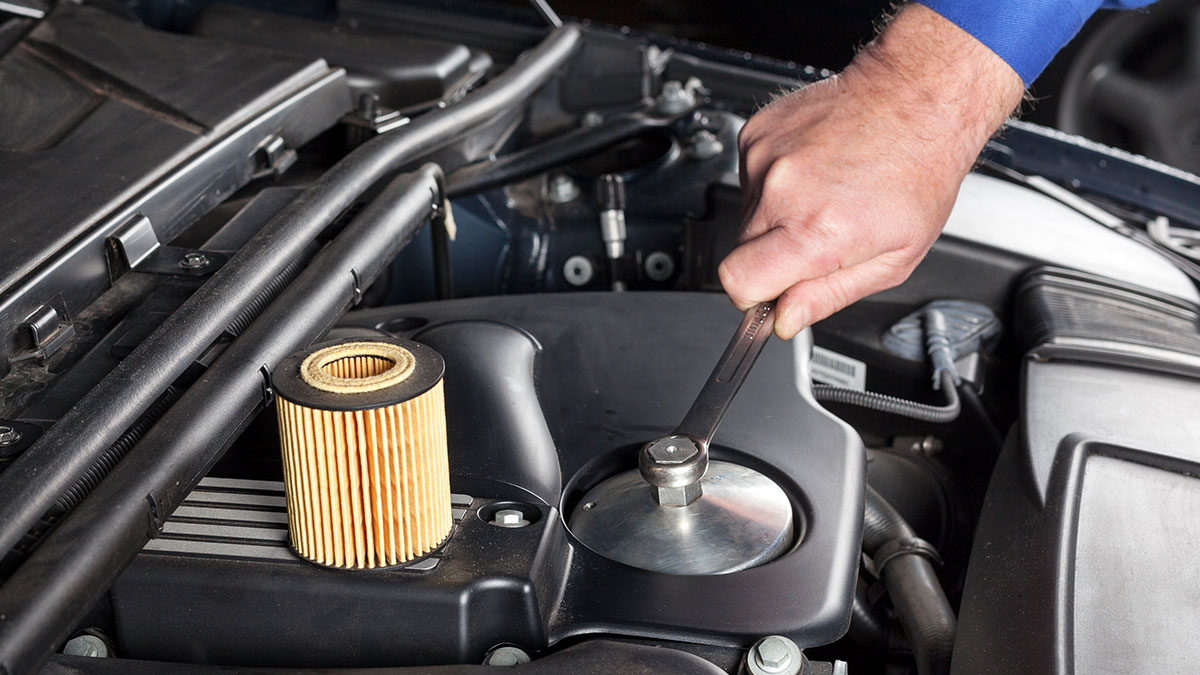
Before service, verify the replacement application and required seals. Follow the prescribed installation and tightening instructions, then complete the level and leak checks. A correctly selected filter can still leak if assembled incorrectly. If an oil-pressure warning or significant leakage appears, follow the manual’s immediate action rather than continuing to test an assumed remaining mileage allowance. Retain receipts and note who performed the work. Our used oil-filter recycling guide covers collection after removal, which is a separate task from determining whether the installed filter is due. A tidy service record is more useful than remembering that the last filter was an expensive brand.
The practical answer is the next required service point for your application, not the longest interval someone reports online. Use the vehicle or engine schedule, relevant driving conditions, actual installation history and the filter’s documented limits together. Where records or product claims conflict, obtain clarification before extending service. This approach does not predict the exact moment an individual filter would fail; it gives you a repeatable maintenance decision while the filter is still expected to be doing its job.


Automotive reference information. Confirm specifications in the manual for your exact vehicle. Original replacement guides link to their research sources. About us