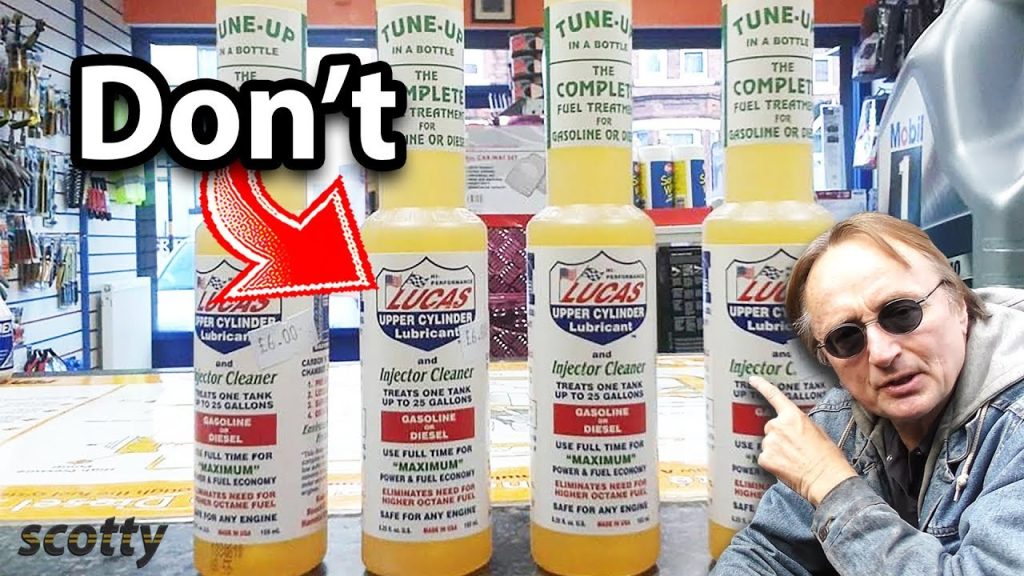

Use Lucas Fuel Treatment only after checking the exact product label and your vehicle’s fuel requirements. Lucas sells different treatments, so “Lucas injector cleaner” is not a sufficiently precise product identification. A dose for Fuel Treatment must not be copied automatically to Deep Clean, an oil additive or another formulation.
For the Fuel Treatment product reviewed here, Lucas’s current directions specify 2–3 US fluid ounces per 10 US gallons of gasoline or diesel, added to the fuel tank. Confirm the directions on your actual container, particularly if its packaging differs. The following guidance explains how to apply a verified label without turning a treatment into a substitute for diagnosis.
Check the bottle and vehicle before adding anything
Read the full product name on the front and the instructions on the back. Confirm that you have a fuel-tank product.
- Do not rely on bottle color alone. Check the stated fuel compatibility.
Check the quantity of fuel the container is intended to treat. Read any restrictions printed beside the directions.
- Next, check the vehicle’s fuel and additive guidance. A product maker’s broad compatibility statement does not replace a vehicle-specific restriction.
- If the two instructions appear inconsistent, obtain clarification before using the product. Keep the bottle available when contacting either manufacturer.
- A photograph of both labels can help avoid confusion over similarly named products.
- Identify why you are considering it.
- Preventive use on an otherwise normally running vehicle is different from trying to cure a severe misfire.
- A visible leak or strong fuel smell needs assessment first.
- Do not add cleaner and continue driving to see whether an unsafe condition disappears.
Our rough-idle guide explains the limits of using a treatment for an unidentified fault.
Credit: www.reddit.com
Choose a treatment occasion for a defined reason
The bottle instructions determine the intended application frequency. Do not build a new maintenance schedule from another owner’s anecdote.
Also check whether the manufacturer of your vehicle recommends, permits or restricts supplementary treatments. An optional purchase should not be described as mandatory scheduled maintenance without that support.
If a workshop recommends Lucas, ask which exact product and for what finding. Request the proposed dose and the amount of fuel it is meant to treat.
Ask whether the service is simply adding the product or includes separate diagnostic work. Keep those charges distinguishable on the invoice.
- Avoid stacking products because several labels promise cleaning.
- A cleaner, stabilizer and cold-weather treatment can have different purposes.
Combining them changes the mixture beyond the directions for a single product.
- Obtain compatibility guidance rather than assuming that individually suitable products must be suitable together.
Do not expect an additive to repair wiring, a damaged injector or a mechanical engine fault.
- Improvement after refueling does not identify which change caused it.
- Record the original symptom before use if an appropriate treatment has been recommended.
Stop the experiment if the vehicle develops an unsafe symptom.
Does the whole bottle match your fuel quantity?
The answer depends on the container and its stated treatment quantity. A small single-use bottle and a large bulk container are not interchangeable units.
“One bottle” means little without the product size. Read the amount on the actual label before opening it.
Lucas lists a 5.25-ounce Fuel Treatment bottle for up to 25 gallons on its product page. That packaging instruction does not mean every Lucas bottle belongs in every tank.
Large containers are intended to supply multiple doses. Do not empty a quart container because a video used a small bottle.
- The page also presents bulk-package treatment claims alongside a dosage range.
- Do not silently reconcile differing label or website wording with your own stronger mixture.
- If the packaging you have gives different directions, contact Lucas with the product number.
Follow clarified instructions for that formulation.
- Fuel quantity and nominal tank capacity can differ.
- A partially filled tank does not contain its full advertised capacity.
- Use a reasonable, documented fuel quantity consistent with the treatment instructions.
Avoid pretending a dashboard gauge gives an exact volume.
If uncertainty changes the dose materially, resolve it before adding the product.
Calculate from the stated units
Keep US gallons and US fluid ounces together when using the cited ratio. They are units of volume, not a direction to weigh the liquid. Do not substitute Imperial gallons without conversion. When the bottle supplies metric directions, using those directly avoids an unnecessary conversion and rounding step. As an arithmetic example, 15 US gallons at a stated rate of 2–3 US fluid ounces per 10 gallons corresponds to 3–4.5 fluid ounces. This illustrates the ratio only. It does not override a different container instruction or authorize use in a vehicle whose guidance prohibits the treatment. Check both before measuring.
Measure a known dose without contamination
Use the product’s dosing arrangement or a suitable, clearly identified measuring container. Do not use a drinking cup or food container. Keep the equipment clean and reserved for the task. Dirt introduced during measuring defeats the purpose of careful fuel-system maintenance. Close the bulk container after dispensing.
Keep the original label with any remaining product. Do not store the liquid in an unmarked bottle. Record the opening date if you plan to keep it. If the container is damaged or its contents cannot be identified, do not use it merely to avoid waste.
Avoid improvising a stronger mixture
Use the verified instructions rather than doubling a dose to speed up cleaning. A larger quantity does not establish a better repair result. It also makes it harder to interpret a later symptom.
- More product is not evidence of more appropriate treatment. Do not combine the cleaner with transmission fluid, rubbing alcohol or another household solvent. Those mixtures are outside the directions being discussed.
- Do not pour it directly into a disconnected injector or pressurized rail. This guide concerns the identified tank treatment, not a workshop cleaning machine. If too much was added, retain the product details and estimate the amounts honestly.
Contact the manufacturer or a qualified repairer for advice specific to the mixture and vehicle. Do not invent a universal correction by adding another chemical. If fuel was put in the wrong vehicle filler, avoid starting the engine and seek assistance.
What correct dosing can and cannot establish
A correctly measured dose establishes that you followed the chosen ratio. It does not prove that deposits were present.
It does not establish that an injector has returned to specification. Those are different questions requiring different evidence.
- Manufacturer performance claims describe the product’s claimed benefits. They are not a measured forecast for your car.
- Do not budget on a guaranteed mileage improvement or assume a particular number of miles will cure a complaint. Fuel consumption changes with operating conditions and measurement method.
- If you track an outcome, record fuel purchases and comparable driving conditions.
- Note any other maintenance performed during the same period.
A smoother idle after several simultaneous changes cannot be attributed confidently to one bottle.
Treat the observation as context for diagnosis, not proof that other tests are unnecessary.
Use the correct filler and ordinary fueling precautions
The cited Fuel Treatment directions specify the fuel tank.
Identify the correct fuel filler before opening anything.
- Do not add it to engine oil, coolant, brake fluid or the diesel exhaust-fluid tank.
- Similar-looking caps are not interchangeable entry points.
- Shut the engine off and follow the fueling rules at the location.
- Keep ignition sources away.
- Handle the container so liquid does not spill on the vehicle or ground.
- Follow the label’s handling and first-aid instructions if a spill or exposure occurs.
- Do not leave the open container where children can reach it.
- Capless fuel systems may require the vehicle’s specified funnel for adding from a container.
- Consult the owner’s manual.
- Do not force a bottle neck or an improvised tool through a filler mechanism.
- A damaged filler can create a new problem unrelated to injector deposits.
- Close the filler and container correctly afterward.
- Return any vehicle-specific funnel to its designated storage position.
- Keep the receipt or a photograph of the product if you are evaluating a workshop recommendation.
- Record when and how much was added.
That history is useful if the engine later needs diagnosis, without assuming the additive caused or cured the condition.
When should a result be expected?
There is no universal completion time that proves an injector has been cleaned.
The product moves through the fuel system as the vehicle uses fuel, but elapsed time alone does not measure deposit removal.
Do not keep driving a badly running vehicle to reach an arbitrary mileage target.
If a workshop recommended treatment for a documented complaint, agree on the follow-up before beginning.
- Ask what improvement is expected and what will happen if it does not occur.
- Repeatedly adding bottles without reassessment can delay finding an electrical, mechanical or fuel-supply fault.
- Tank treatments also follow the fuel’s route.
Bosch describes direct injection into the combustion chamber.
- Do not assume that a tank additive necessarily washes every intake surface that another engine design exposes to fuel.
- An intake-valve cleaning claim needs an appropriate procedure and evidence for that application.
- If the original symptom persists, return with the product and treatment record.
Describe when the fault happens rather than only saying the cleaner “did not work.” This helps the next diagnostic step address the actual complaint.
A short record makes future decisions easier
Keep four details: exact product, quantity added, estimated fuel quantity and date. Add the vehicle’s mileage if useful.
Keep the label instructions available until any question is resolved. That record is more informative than remembering that “some injector cleaner” was used.
For a normally running vehicle, continue the manufacturer’s scheduled maintenance. Do not use an additive to postpone required filter service or another specified operation.
For a vehicle with symptoms, distinguish safe optional treatment from a needed diagnosis. A bottle is not a general permission to continue driving with warning signs.
If you remain unsure about dose, identify the container before buying more. If you remain unsure about a fault, obtain diagnostic evidence before buying replacement parts.
Those are separate uncertainties.
Resolving the right one first is the practical way to avoid unnecessary treatment and unnecessary injector replacement.


Automotive reference information. Confirm specifications in the manual for your exact vehicle. Original replacement guides link to their research sources. About us