
If a suspension ball joint breaks or separates, the wheel assembly can lose a connection that controls its position. The wheel may tilt or move out of its intended alignment, steering can become ineffective and nearby components can be damaged. The exact result depends on the suspension layout and the way the connection failed. It is not safe to assume the car can still be driven because the tire remains attached to the hub.
MOOG’s safety guidance warns that severe joint wear can allow the stud to separate from its housing and lead to loss of vehicle control. A failure may instead involve a damaged stud, mounting or related attachment, so the visible result does not establish the initiating cause. Treat an apparent separation as a recovery and repair situation, not a roadside opportunity to push the wheel back and continue. This article addresses what happens during and after a failure.
If the joint is only suspected of wear, our symptom guide explains diagnostic confirmation. There is no universal distance you can safely drive with a confirmed unsafe joint. Do not attempt to create or reproduce a failure to determine how serious it is.
A lost connection changes how the wheel is controlled
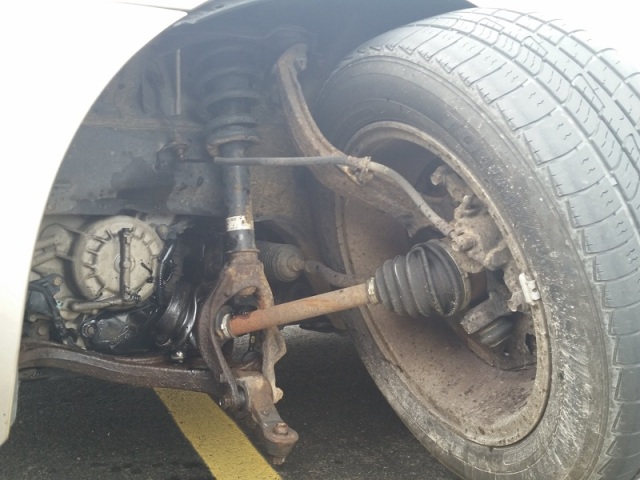
The suspension normally locates the wheel through a defined set of links and joints. When one critical connection separates, the remaining parts are not automatically capable of keeping the wheel in its intended position. The result can include a sudden change in wheel angle, contact between tire and bodywork or inability to steer normally. A low-speed event can still immobilize the vehicle or cause damage.
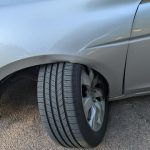
A higher-speed event can create a serious loss-of-control risk. Do not picture every failure as the wheel completely falling off the car. The hub and tire may remain attached while the suspension geometry collapses or the wheel moves into an abnormal position. That is still a major failure.
- Conversely, the appearance of an angled wheel can result from more than one type of damage. A professional inspection must identify which connection failed and what else was affected. If an event occurs while moving, concentrate on controlling the vehicle and reaching a safe stop as circumstances permit. Avoid deliberately accelerating, swerving or making another test run.
- Once stopped, do not assume that a return to a seemingly normal position means the connection has restored itself. Keep the vehicle out of use and contact appropriate assistance. If there is an immediate danger, collision or injury, use local emergency assistance. A parked vehicle with a visibly displaced wheel should remain parked.
-
Do not try to steer the wheel straight while someone pushes or rocks the body. Do not crawl underneath to lever a joint back into place. The vehicle may not be supported as expected, and movement can create further damage or injury.
- A lifting jack alone does not make investigation beneath a damaged suspension safe. Inform the recovery operator that a suspension joint may have separated and describe the wheel position. Explain whether the car can roll, whether any fluid is visible and whether a wheel appears trapped against the body.
- Do not guess that it can be driven onto a carrier. The operator needs the actual condition and the vehicle’s recovery requirements to select a suitable loading method. The immediate goal is safe recovery, not preserving an ordinary towing routine.
-
Different drivetrains and damaged wheel positions require different handling. Leave decisions about dollies, lifting and loading to the equipped professional. Do not attach a rope to a suspension part or ask another vehicle to drag the car free.
A compromised connection should not be used as a convenient pulling point. Take photographs only from a safe position. Record the location, visible damage and circumstances if that can be done without exposure to traffic or unstable components.
A picture can help the workshop prepare, but it does not replace recovery assessment. Do not place yourself under the car to document a detail. Personal safety takes priority over gathering evidence.

Credit: community.cartalk.com
Warning signs and failure evidence are different things
A prior clunk may be relevant history. A change in steering may be relevant too.
Uneven tire wear can justify inspection. None of those observations identifies the exact failed interface on its own.
Tell the workshop when each symptom began. Mention any recent impact.
- Provide records of recent suspension work. State whether a professional had already reported a defect.
-
Keep the description factual rather than assigning blame at the roadside. An intact-looking nut does not rule out internal separation.
- A damaged boot does not prove that contamination caused this particular event. A missing fastener is important evidence but still requires assessment of the connection and surrounding damage.
- A photograph after failure may show consequences as well as causes. The investigator should distinguish those categories.
- Avoid changing the assembly unnecessarily before it is inspected. Do not discard loose hardware or failed parts if they can be retained safely through the recovery and repair process.
-
Delphi’s service information treats the ball joint as safety-critical and emphasizes checking its condition with the method appropriate to the suspension. That guidance supports acting on a confirmed defect before failure.
- It does not mean every failure must have produced a warning the driver could recognize. Do not assume that a lack of noise proves the event was impossible or that the owner necessarily ignored it.
- If there was a recent repair, provide the invoice, part number, installation date and any follow-up instructions. The workshop may need to assess application, retention, mating surfaces and related components.
- An early failure can have several possible explanations, and a brand name alone does not identify which one applies. Let the findings establish the cause rather than turning an unfortunate timing into a certain accusation.
-
If there was a previous advisory, retain its exact wording. An observation of boot damage, a measurement of excessive play and a warning that a mounting connection was unsafe are different records.
- The current failure investigation should consider them accurately. Do not paraphrase all three as the shop said it would last another year unless that is what was actually documented.
For an unfailing but suspect component, the next action is a proper inspection, not waiting for a dramatic symptom. For a component that has already separated, routine symptom checks are no longer the priority.
Recovery, damage assessment and a complete repair come first. Keeping those stages distinct helps avoid dangerous advice intended for a healthy vehicle being applied to a damaged one.
Inspect the consequences before deciding the repair scope
Replacing the broken joint may be only part of the repair. The workshop should inspect the receiving component, mounting area and any parts affected by abnormal wheel movement. Depending on what happened, that can include the control arm, knuckle, steering connection, tire, wheel, brake hose, wiring or drive-shaft components. These are assessment areas, not a claim that every item must always be replaced. The findings should determine the scope.
A stretched hose or damaged wire should not be dismissed because the main failure is a suspension part. A tire that contacted bodywork also needs appropriate assessment. Conversely, a large estimate should explain what damage requires each item rather than treating proximity as proof. Ask the repairer to separate failed parts, consequential damage, required installation hardware and optional recommendations. The receiving bore or taper deserves attention when the failed connection involved that interface.
A new joint cannot compensate for an unacceptable mounting surface. The supported repair might require a larger assembly depending on the design and damage. Do not approve welding, staking, oversized substitutions or other modifications solely because they seem cheaper; any repair method needs to be supported for the actual component and condition. Request a clear record of the failure mechanism where it can be established. Was the stud separated from its socket, fractured, loose in its attachment or involved in another damaged connection?
What evidence supports that conclusion? If the cause remains uncertain, the report should say so. A repair can restore the vehicle without proving every detail of the initiating event, and that uncertainty should not be disguised. Before return to use, the complete affected system needs the applicable installation, fastening and functional checks. Alignment assessment may be required, but an alignment reading cannot clear a damaged or unsecured component.
Braking and steering functions affected by the event must also be verified. A wheel standing upright again is not an adequate completion criterion. Keep the final report, photographs and replaced-part information, especially if a warranty or insurance assessment is involved. Ask the relevant organization how it wants evidence handled rather than allowing important parts to be discarded automatically. Do not request an unsupported conclusion simply to fit a claim.
Accurate records serve both repair quality and later review. Can the car be moved a few feet after separation? The safe method depends on its condition and should be directed by the recovery professional. Can the joint be pushed back temporarily?
That does not restore the original retention or establish safe operation. Can a new joint alone complete the repair? Only if the full inspection and supported procedure show that no further work is required. The practical answer is to treat a broken ball joint as a loss of a safety-critical connection, recover the vehicle appropriately and verify the entire affected assembly before driving again.


Automotive reference information. Confirm specifications in the manual for your exact vehicle. Original replacement guides link to their research sources. About us