
Silicone wiper blades can be a worthwhile choice when a compatible product offers the durability or water-beading behavior you want. They are not automatically quieter, better fitting or more economical than every other rubber blade. Silicone is itself a type of rubber; the useful comparison is between particular formulations and complete blade designs. Choose by vehicle application, dependable clearing, documented features and total replacement cost. A material label cannot compensate for a wrong adapter, poor glass contact or a damaged wiping edge.
What manufacturers mean by a silicone blade
The silicone description usually concerns the flexible wiping element, not every component of the assembly. The frame, beam, connector and spoiler still affect how that element works against the windshield. PIAA’s silicone range, for example, includes conventional, hybrid and frameless designs and describes a water-beading effect from its silicone rubber. That shows why material and construction should be separate entries on your comparison list. It does not establish that every product sold as silicone uses the same compound, coating or frame, or has the same instructions for preparing the glass.
The other side of the comparison is not one basic rubber
Ordinary “rubber wiper” is a broad shopping description. It can conceal different compounds, edge treatments and structural designs. Bosch describes the ClearMax 365 material in its Envision range as a dual synthetic-rubber blend with a polymer edge; its Aerotwin information identifies a dual-rubber compound with a graphite coating. These are examples of engineered alternatives, not evidence that one brand wins this comparison. Avoid comparing a premium silicone assembly with an unspecified old or damaged natural-rubber blade and treating the difference as a universal material result.
Durability claims need their test conditions
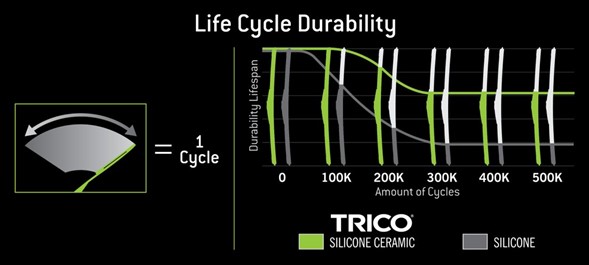
Rain-X markets its Silicone AdvantEdge squeegee as lasting twice as long as traditional rubber squeegees and identifies ASTM D1149, Method A, Procedure A1 in its testing explanation. The claim belongs to that product and stated comparison. ASTM D1149 concerns cracking under controlled ozone exposure; its public scope cautions that accelerated results may not correlate with outdoor service. Read such a result as evidence about a tested degradation mechanism, not a promise of twice the calendar life on your windshield. Dirt, ice, installation and use still differ between vehicles.

Credit: www.tricoproducts.com
Wiping quality depends on contact and construction
The best material cannot clear an area it does not contact correctly. DENSO’s development description evaluates geometry, pressure distribution, attachment and operating behavior as well as durability. These are useful comparison criteria regardless of compound. Confirm that the product is listed for your car and the relevant side before comparing marketing features. Judge an installed blade by consistent clearing and absence of missed bands during appropriate operation. “Works in all weather” is not a guarantee against a frozen blade or a windshield covered in contamination.
Silicone does not guarantee silence
Noise is a result to investigate, not a reliable way to identify the rubber chemistry. Contaminated glass, an incorrect connection or an ineffective blade can cause poor wiping in either category. DENSO’s troubleshooting advice separates cleaning, replacement and possible arm issues. If your current set has begun jumping, use the wiper-chatter diagnostic guide before assuming a material change will cure it. A premium replacement should not be expected to repair an existing arm or fitment fault, and repeated arm bending is not an appropriate comparison test.
Credit: www.youtube.com
Compare purchase cost with useful service life
Check current prices for the exact compatible parts, including both front blades if that is what you need. If the silicone option costs more, its financial advantage depends on how much longer it actually clears effectively, not just the claim printed on its packaging. A simple comparison is total replacement cost divided by months of acceptable service. Include fitting charges and approved refill costs where relevant. You will not know the service-life value with certainty before using the product, so treat the calculation as a decision aid rather than a forecast. A higher purchase price alone does not prove higher lifetime cost or better value.
Refills can reduce discarded assemblies, with limits
Some products allow the wiping insert to be replaced while retaining a serviceable frame. PIAA’s silicone refill information specifies compatible blade families and dimensions; refill availability is not a feature of every silicone assembly. Check the exact refill and the condition of the frame before choosing that route. Fewer discarded complete assemblies can be useful, but it does not establish that one material has a lower overall environmental impact. That broader claim would require evidence about manufacture, actual service life and disposal, not merely a durability slogan.
Weather resistance is product-specific evidence
Manufacturers may describe resistance to heat, sunlight or ozone, but those are different exposures and tests. Rain-X’s Silicone Supreme page describes its own environmental-performance claims. Such information is relevant when that exact product fits the car; it should not be generalized into “silicone never deteriorates” or “all other rubber is unprotected.” Nor does a stated temperature test supply a guaranteed replacement interval. Consider your actual failure history: a blade torn by ice needs better ice management, while repeated deterioration during outdoor storage raises different questions about the product and environment.
Installation depends on the connector and preparation
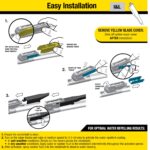
Both categories can be straightforward to fit when the application and adapter are correct, but neither is universally interchangeable. Follow the specific fixing instructions, keep control of the spring-loaded arm and confirm the connection is secure. Some silicone products require a preparation or activation sequence. The PIAA Super Silicone instructions include a supplied preparation pad and a defined conditioning step. Those directions are for that product, not a general permission to run any blade dry. Check compatibility with the vehicle and any existing glass treatment before applying a new preparation product.
Availability starts with your exact vehicle
A brand may offer a silicone range without offering the right version for every arm, length or vehicle configuration. Use its application lookup and verify the part numbers, rather than adapting a close match. The same rule applies to a conventional or synthetic-rubber alternative. Our explanation of wiper-blade fitment differences covers this separate issue. Check local replacement and refill availability as well: a theoretically economical refillable product is less convenient if the correct insert is difficult to obtain when the blade becomes unsafe.
Compare the complete products side by side
| Question | Silicone product | Other rubber product |
|---|---|---|
| Durability | Check the named product and test conditions | Check its compound, coating and test evidence |
| Wiping quality | Needs correct fit and glass contact | Needs correct fit and glass contact |
| Noise | Not guaranteed silent | Not inherently noisy |
| Cost | Compare actual installed cost and service life | Use the same cost and service-life basis |
| Refill option | Available only on specified designs | Check the specific blade’s service options |
| Weather resistance | Verify the relevant exposure claims | Do not assume the compound is untreated |
| Installation | Match connector and preparation instructions | Match connector and fitting instructions |
| Availability | Confirm exact vehicle and local supply | Confirm exact vehicle and local supply |
When paying for silicone can make sense
A silicone option is worth considering when the exact fit is supported, its documented features address your priorities, and the additional cost, if any, is acceptable. For example, you may specifically want the water-beading behavior described for a particular blade system, or value an approved refill option. Confirm those features individually. Do not assume a silicone label includes water-repellent preparation, a refillable frame, a long warranty and superior cold-weather clearing as one inseparable package.
A well-specified alternative can remain the sensible choice when it already gives satisfactory clearing, is easy to obtain and matches your maintenance budget. Replacing it solely because it is labelled rubber may solve no existing problem. If you are dissatisfied, identify the issue first: short service life, missed areas, chatter, attachment trouble or a coating interaction. That description makes it easier to choose a meaningful improvement rather than simply a more expensive material category.
Read warranty terms separately from durability advertising. Check the country of sale, covered components, proof-of-purchase requirements and treatment of normal wear. A marketing statement about longevity is not the same thing as a commitment to replace every worn wiping insert. Retain the fitting instructions and receipt, and document an unexpected defect with the wipers stopped. Avoid interpreting one anecdotal success or failure as proof that all blades using the same material behave identically.
Keep the same care and replacement standard
Whichever product you choose, begin with clean compatible glass, verify correct installation and inspect the blades during routine vehicle care. The guide to making wiper blades last longer focuses on reducing preventable damage without promising a fixed lifespan. Clear frost before operation and address visible splits, loose attachments or ineffective wiping promptly. A material advertised as durable still needs replacement when it cannot do the job. Do not continue driving in weather that requires effective wipers while trying to extract more value from a failing set.
Silicone is an option with useful product-specific benefits, not an automatic winner over every natural or synthetic-rubber formulation. Compare supported fitment, clearing performance, the precise durability evidence, preparation requirements and ownership cost. This article reviews manufacturer descriptions and testing scopes; it does not report a firsthand head-to-head trial. The right choice is the compatible complete blade that meets your needs while maintaining a clear view, with claims kept within the limits of their evidence.


Automotive reference information. Confirm specifications in the manual for your exact vehicle. Original replacement guides link to their research sources. About us