
Yes. A restricted brake hose can interfere with fluid return and leave a brake applied after the pedal is released. That can resemble a sticking caliper. The important distinction is retained hydraulic pressure versus a piston, guide or pad that is mechanically binding.
Heat, drag and uneven wear cannot make that distinction on their own. If the wheel is smoking, braking has deteriorated or the vehicle pulls strongly, stop safely and arrange recovery. Do not continue driving to warm the brake for a test.
This article explains the diagnostic reasoning behind a hose assessment. It does not give a driveway procedure for opening the hydraulic circuit or releasing a hot brake.
For the broader symptom picture, see sticking-caliper symptoms and checks. Here the question is narrower: what evidence would justify replacing a hose rather than assuming the caliper has failed?
Keep the sequence of events: which corner drags, whether the complaint follows pedal use, and whether it began after a repair. A newly installed component does not eliminate installation or circuit problems from consideration.
How a restriction can imitate a caliper problem
Wagner: brake-system inspection checklist describes restricted flow through a brake hose and the use of controlled hydraulic checks. The outside of a hose does not reveal every internal restriction. Conversely, an old-looking hose is not proof that it is responsible for the present drag.
Pressure that remains versus parts that bind
When pressure remains at a caliper, the brake may stay applied even though the pedal has been released. The technician must locate the reason pressure is not returning normally. A restriction elsewhere in the circuit can complicate the picture.
Mechanical binding is a different path: pad supports, sliding hardware, piston condition or parking-brake equipment may prevent normal release. A thorough inspection accounts for both paths rather than treating a hose and caliper as interchangeable guesses.
What symptoms do and do not establish
One hot wheel identifies where friction may be occurring. It does not prove that a flexible hose has collapsed. A temperature difference also needs the context of recent braking and measurement location; touching the wheel is not an appropriate diagnostic method.
Tell the workshop whether the problem affects one wheel or several and whether the pedal feels different. Those details help define the investigation, but the diagnosis still requires examination of the vehicle.
Why a pressure-release result needs context
If a controlled release of pressure frees the brake, that supports investigating the hydraulic path. It does not, by itself, locate the restriction in the flexible hose. The test has to be interpreted alongside pressure behavior and inspection of the remaining circuit.
Look for a written finding rather than “the wheel freed, so the hose is bad.” The technician should explain how the hose was isolated from other possible sources of retained pressure and whether mechanical resistance was also present.
Hydraulic testing requires suitable equipment and the applicable service information. Opening a bleeder can introduce follow-up bleeding and verification requirements. Never loosen fittings on a hot assembly or clamp a hose with improvised tools to perform this comparison.
A brake that does not free during one test also needs careful interpretation. Several faults can coexist. The repair decision should reflect the complete findings, not a single binary check.
What should follow a confirmed hose fault?
The replacement must match the application and be routed without twisting, rubbing or tension through the required steering and suspension movement. The circuit then needs the specified bleeding, leak checks and brake-operation verification.
Ask whether heat-damaged pads or discs require attention and whether related hoses were inspected. Additional replacement should be explained by condition or manufacturer requirements, rather than an unsupported universal rule.
After repair, the original complaint should be reassessed under controlled conditions. Replacing a hose is not the end of diagnosis if the brake still drags or the pedal does not feel correct.
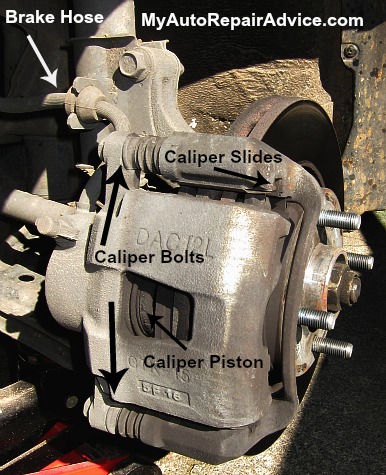
Credit: www.myautorepairadvice.com
Questions to take to the workshop
Ask: Was the brake mechanically bound, hydraulically held, or both? What localized the fault to this hose? Were routing and adjacent parts checked? What confirms that the brake now applies and releases normally?
Keep the answers with the repair invoice. They make a recurring problem easier to investigate and reduce the chance of repeating a replacement that did not address the original cause.
A hose can cause the symptom, but the symptom is not a hose diagnosis. Identifying the pressure path is what turns a plausible explanation into a supported repair.


Automotive reference information. Confirm specifications in the manual for your exact vehicle. Original replacement guides link to their research sources. About us