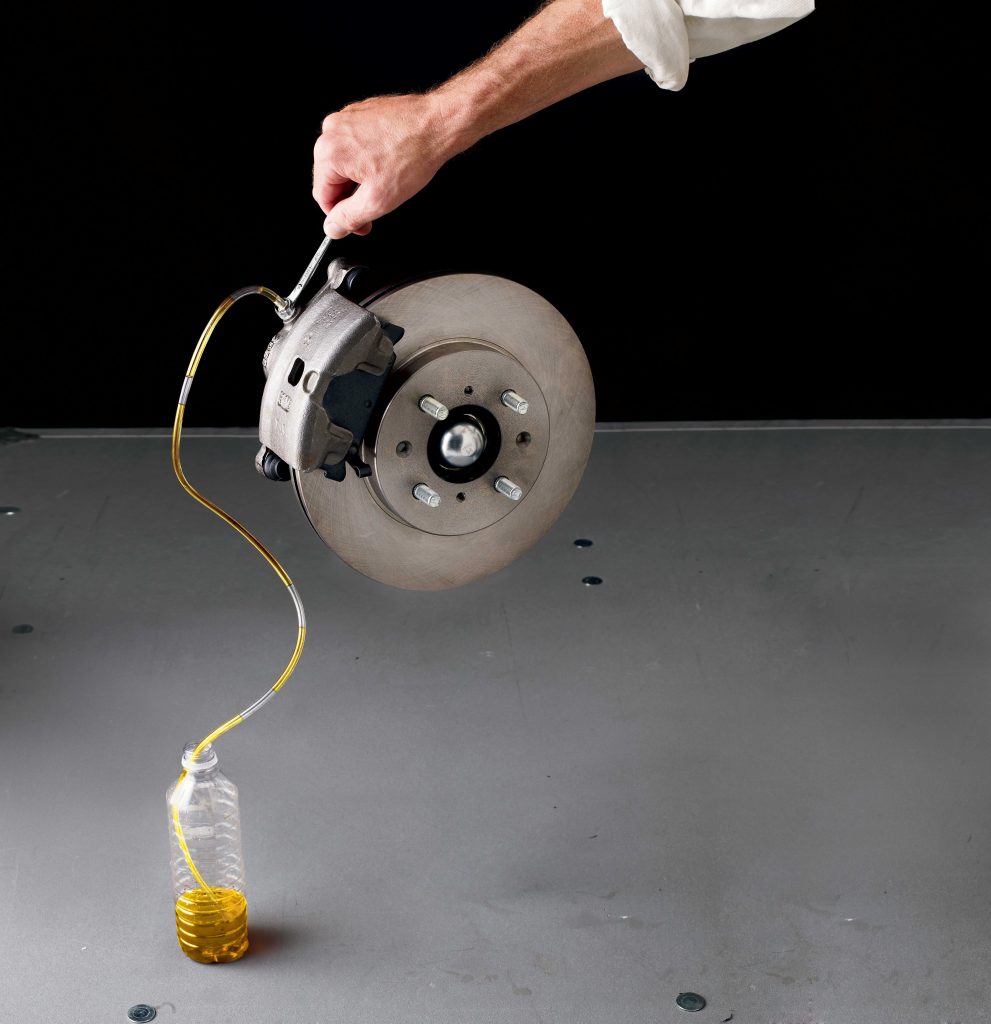

Yes. Replacing a hydraulic brake caliper involves opening the brake-fluid circuit, so the appropriate bleeding procedure is part of completing the job. Do not skip it because the hose was disconnected briefly, little fluid escaped or the replacement caliper was filled beforehand. Those observations do not establish that the assembled circuit contains no air.
The exact bleeding scope and method must come from the vehicle and brake-system instructions. There is an important distinction between changing the hydraulic caliper and temporarily moving an intact caliper aside during pad or disc work. If the hydraulic circuit remains closed, that is a different service situation.
Likewise, replacing a separate parking-brake actuator is not automatically the same as opening a hydraulic caliper. Identify what was actually disturbed before deciding which procedure applies. This page answers why bleeding is needed and what determines its scope; it does not prescribe one wheel order or one technique for every vehicle.
Why opening the circuit changes the job
The service brake transmits force through its hydraulic fluid. Air introduced during disconnection or assembly can compress, so part of the pedal movement may be spent compressing trapped air rather than producing the intended response at the brakes. Wilwood’s bleeding explanation describes the need to remove air after a hydraulic system is opened. Its illustrated procedure has a defined application scope; the underlying reason for bleeding does not make every detailed step universal.
Use the actual vehicle instructions for how the air must be removed. A replacement caliper introduces internal spaces that need to be correctly filled and purged through the approved process. Capping a hose can help control loss and contamination during the work, but it is not proof that air was excluded from the new assembly. Working quickly does not change that requirement.
Nor does keeping the reservoir apparently full guarantee that no air entered at the disconnected wheel end. These precautions can reduce complications without eliminating the finishing procedure. Prefilling a caliper, where permitted, also does not certify the completed system. Air can remain in the component or enter during connection, and the actual installation still needs its required checks.
A replacement labelled ready to fit generally concerns the supplied component; do not interpret that phrase as a statement that the vehicle needs no bleeding. Read the installation instructions rather than inferring a hydraulic procedure from packaging language. Opening a bleed screw during another service operation can also introduce fluid-handling obligations. The appropriate response depends on the work performed and the vehicle procedure, not just the name used on the invoice.
If you are unsure whether the circuit was opened, ask the person who performed the work to identify the disturbed connections. Do not decide solely from whether fluid is visible on the floor. A tidy job may still have opened the circuit, while spilled fluid can occur without the particular repair you assumed.
Credit: www.reddit.com
What determines how much bleeding is required
The repair history determines the starting point. Replacing one caliper while controlling fluid loss is different from allowing the reservoir to run dry or replacing major upstream hydraulic components. Air may have reached different parts of the system in those situations. Tell the repairer exactly what happened during the work.
Concealing that a reservoir emptied makes it harder to select the correct recovery procedure. The goal is to establish the actual condition, not preserve the appearance that a routine job went smoothly. Vehicle architecture also matters.
Brake circuits, ABS hydraulic units and electronically controlled systems can have particular service requirements. Some procedures call for diagnostic equipment or a defined operating sequence. An ordinary bleed at a wheel may not satisfy every case, while the mere presence of ABS does not justify inventing an identical scan-tool routine for all cars.
- Consult the exact application information and determine what the performed repair requires. A tool must support that function on the vehicle, not simply read engine fault codes. Do all four wheels need bleeding after one caliper?
- The applicable procedure determines the required scope. Do not assume that one replaced corner always means one bleeder only, and do not assume that every vehicle always uses the same four-wheel sequence. The layout, amount of air entry and manufacturer instructions govern that decision.
- Ask the workshop which procedure it is following and why. A clear answer identifies the repair condition and application rather than repeating a universal farthest-wheel rule. Caliper identification and installation orientation are also relevant.
- The correct side and intended bleed points must be established so that the procedure can work as designed. A component that bolts into place is not necessarily correctly located. If air cannot be cleared as expected, check the installed part and its orientation rather than continuing indefinitely with more fluid.
- Some assemblies have multiple bleed points with their own instructions. Do not assume that any accessible screw serves the same purpose. Bleeding is related to, but not identical with, replacing all old fluid as a maintenance service.
- A caliper change creates an immediate need to complete the hydraulic repair even if the scheduled fluid service is not due. Conversely, removing air from the area disturbed by a repair does not automatically demonstrate that all maintenance fluid requirements have been completed. Ask for those scopes to be described separately.
- The fluid used must meet the vehicle specification, and used or contaminated fluid should not be returned to the system. Other commissioning tasks remain separate too. A rear-caliper replacement can require parking-brake adjustment or an electronic completion routine.
Bleeding the hydraulic circuit does not perform those tasks. Fitting pads may require restoring their prescribed working position before the vehicle moves, which also does not substitute for bleeding an opened circuit. Treat each step as part of the same completed repair rather than assuming one successful action proves that all systems are ready.
Why shortcuts and pedal impressions are insufficient
A pedal that improves after repeated pumping does not prove that the repair is complete. An abnormal pedal can have several causes, including air, leakage and other hydraulic or mechanical conditions. Wagner’s soft-pedal guidance describes multiple possibilities, which is why repeated bleeding without diagnosing a persistent problem can miss the cause. Do not drive to see whether the pedal settles or use the parking brake as a substitute for incomplete service braking. Keep a vehicle with unresolved brake behaviour out of normal use.
A firm-feeling pedal is useful information within the prescribed checks, but it is not a complete acceptance test by itself. The assembly may still have a leak, incorrect routing, an unresolved warning or a parking-brake problem. A lack of bubbles visible during one observation likewise does not establish every part of the system's condition. The procedure defines how completion is assessed. Do not replace that assessment with a fixed number of pumps, a guessed quantity of fluid or a claim that gravity will eventually remove all air.
Avoid opening additional fittings as an experiment when the result is uncertain. Do not loosen lines to prove that fluid reaches the caliper and then assume the system is ready because fluid appeared. Any such diagnostic step belongs to a controlled service procedure with proper restoration afterward. If the available equipment or information is insufficient, a qualified workshop is the next step. The vehicle should be transported appropriately if its brakes are not ready for use.
What a completed repair should demonstrate
The caliper must be correctly identified, installed and secured with its specified connections and hardware. The required bleeding procedure must be completed without leaving an unresolved air-entry or leakage problem. Fluid level and specification must be correct, and the pedal must meet the applicable operating checks.
- Any electronic or parking-brake procedures must also be completed. Brembo’s caliper fitting guidance includes checks for leakage and abnormal hydraulic pressure loss within its installation process.
- These are examples of why a caliper change is more than fastening a replacement casting to the vehicle. Ask the repairer to record which component was replaced, whether the reservoir ran low, what bleeding procedure was used and whether any additional hydraulic fault was found.
- If the first attempt did not produce the expected result, the explanation should say what was corrected before the vehicle was released. That record helps if a later complaint requires investigation.
- It is more informative than an invoice that lists only fluid added. For someone comparing quotations, ensure that the price for a caliper replacement includes the necessary hydraulic finishing work.
A quote excluding bleeding is not a complete like-for-like comparison with one that includes commissioning and checks. Required fluid, sealing components and any diagnostic functions may affect the total.
Ask what is included before the car is dismantled. Do not treat omission of a necessary step as a saving.
The narrow exception in the original question is a job described loosely as changing the caliper when the hydraulic unit was never disconnected or opened. Moving an intact unit aside is not the same operation.
Clarify that distinction rather than using it as a reason to skip bleeding after a genuine replacement. For the practical service-planning steps, see bleeding after caliper replacement.
If leakage remains the concern, see identifying a caliper-area leak. A replaced hydraulic caliper needs the correct bleeding procedure and full verification before the vehicle returns to service.


Automotive reference information. Confirm specifications in the manual for your exact vehicle. Original replacement guides link to their research sources. About us