
A bad fuel pump can create hesitation or loss of engine power that feels like a transmission problem, but that does not mean the pump has mechanically damaged the transmission. The engine and transmission work together to accelerate the vehicle. If engine torque becomes uneven, the driver may feel a stumble during a shift or an unexpected change in acceleration. The useful question is which system failed to do its job at that moment, not which component name best matches the sensation. A transmission that slips, a misfiring engine and insufficient fuel delivery can all be described as jerking.
That word alone cannot distinguish them. Note what the engine speed does, whether road speed follows it, when the event occurs and whether warning lights appear. Avoid intentionally reproducing a severe loss of power on a busy road. If the car stalls, loses drive or cannot accelerate safely, stop using it and arrange professional diagnosis.
This distinction can prevent two expensive mistakes: replacing a transmission for an engine-running fault, or replacing a fuel pump when the transmission really is slipping. It also prevents a third mistake, assuming every shifting complaint is caused by a computer reacting to engine trouble. Sometimes two faults coexist. The investigation should preserve that possibility until measurements narrow the explanation.
Credit: www.miramartransmission.com
Separate engine hesitation from loss of transmission drive
Start with a precise description of the event. A drop or irregularity in engine speed with rough running may point toward an engine contribution. Engine speed rising without the expected increase in road speed can suggest a drive-transmission problem, although normal downshifts and torque-converter behavior must be considered. Neither observation is a diagnosis by itself. It is a way to ask a more useful question than whether the car feels sluggish. Record the operating condition without using a phone while driving.
Useful details include cold or fully warm operation, light acceleration or heavy demand, a particular gear, a hill and the approximate fuel level. Ask a passenger to make notes where safe, or write the details after stopping. The aim is to give the technician a repeatable description, not to collect dramatic videos while controlling an unreliable vehicle. If the engine hesitates before a shift, fuel delivery is one possible branch among ignition, air measurement and mechanical causes. If the problem happens only when a particular gear engages, transmission-specific checks may take priority. A fuel pump does not know which gear has worn clutches.
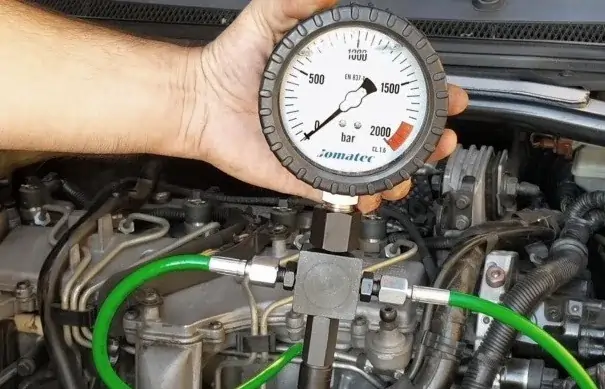
However, increased engine demand around a shift can expose a marginal supply problem. The relationship in time must therefore be tested rather than assumed to establish causation. Fuel-system testing should match the complaint. A normal idle reading does not settle a problem that appears only under load. Conversely, a low reading from an inappropriate gauge setup can create a false fuel diagnosis.
The service information should identify the correct test point, conditions and limits. A workshop can compare fuel data and engine behavior during an approved test without running exposed fuel lines into the passenger compartment. Delphi: performing a fuel-pump voltage-drop test explains why inadequate electrical supply can reduce fuel-pump performance. This matters here because correcting a connector or ground problem may restore engine torque without replacing either the pump or the transmission. Ask whether voltage was assessed while the circuit was loaded.
An unplugged connector showing nominal system voltage cannot by itself prove that the circuit will carry the pump's operating load. If the symptom is intermittent, the absence of a fault during a short visit should be recorded honestly. Delphi: fuel pump current waveform testing describes current-waveform analysis as one way of investigating intermittent pump-motor behavior. The correct diagnostic strategy depends on the vehicle and symptom. A pump that passes one brief test is not automatically proven healthy under every condition, but an intermittent complaint also does not justify replacing it without additional evidence.
Use engine and transmission evidence together
Scan all relevant modules with equipment that supports the vehicle, and save results before clearing them. A basic emissions reader may not expose the transmission information needed for this comparison. A code description can direct the test, but it does not prove that the part mentioned in the description has failed. For example, a pressure-related engine code and a gear-ratio transmission code raise different questions. They should not be combined into a single guessed explanation. Ford: diesel and gasoline OBD operation summaries illustrates how manufacturer documentation distinguishes monitored systems and operating conditions.
The lesson is to use the documentation for the actual vehicle, not to apply Ford diagnostic thresholds to a different manufacturer. Engine torque reporting, shift control and diagnostic coverage differ between vehicles. A generic article cannot supply the correct data-parameter list or pass/fail number for every powertrain combination. A technician may need to compare commanded and actual gear, input and output speed, engine speed and fuel-system measurements. These readings are useful only when interpreted in context. A normal commanded downshift can raise engine speed; a sensor reporting incorrectly can create misleading data.
The purpose of collecting several related values is to test whether the engine, transmission and sensors tell a consistent story during the event. Avoid assuming that transmission fluid service will solve an engine-running problem. Fluid condition and level require the transmission-specific procedure, and they deserve attention when the evidence points there. Adding fluid because the vehicle hesitates can cause a new problem if the level was already correct. Similarly, adding fuel-system cleaner is not a diagnostic test for either a weak pump or worn transmission components. It changes the conditions without necessarily identifying the cause.
Fuel smell introduces a separate safety issue. A smell around the vehicle can come from a leak or another fuel-system fault, and it is not proof of an underperforming pump. Do not continue road testing a vehicle with suspected escaped fuel to see whether its shifts improve. Stop, avoid ignition sources and arrange an inspection. A leaking system and a shifting complaint may be related, unrelated or part of a recent repair problem; safety takes priority over reproducing the symptom. After recent work, document exactly what changed.
A disconnected connector, damaged harness, incorrect part or disturbed hose may affect the engine. Transmission work may involve components shared with other systems or require its own documented adaptation process. Do not reset modules indiscriminately. Clearing learned data before recording the complaint can make comparison harder and should not be offered as a universal cure. Consider a simple hypothetical comparison. In one vehicle, engine speed falters and fuel delivery drops below the specified requirement during demand while transmission ratios remain appropriate.
That evidence supports investigating fuel supply. In another, fuel delivery and engine operation remain normal while the measured speed relationship fails the transmission's specified check. That evidence points in a different direction. These examples show the logic of separation; they are not substitutes for a manufacturer's diagnostic procedure. A third outcome is inconclusive testing.
Perhaps the fault cannot be reproduced, or only a generic scan was performed. The next step may be a longer monitored test, better equipment or a specialist assessment. It should not be a confident claim that the fuel pump caused transmission damage. Ask the workshop to distinguish what was observed, what was ruled out and what remains an informed possibility. That distinction makes an estimate much easier to evaluate.

Credit: in.pinterest.com
Authorize the repair that the evidence supports
A repair estimate should also separate diagnostic labor from the proposed parts work. Ask what additional evidence would change the recommendation before authorizing a major replacement. This keeps an unresolved engine-versus-transmission question from becoming an open-ended sequence of purchases. A useful repair explanation identifies the complaint, the measurement that failed and why the recommended part addresses that failure. If the shop recommends a pump, ask how supply voltage, control and restrictions were considered. If it recommends transmission work, ask what demonstrated a transmission fault rather than an engine stumble. You do not need to know every parameter yourself; you need a clear chain between the symptom and the proposed repair. Verification should recreate the relevant condition safely after the repair. A smooth idle is not enough if the original complaint was a surge during highway acceleration. A single smooth shift is not enough if the issue occurred only after the vehicle became hot.
The technician should decide the appropriate post-repair checks and record the outcome. Retain those records if the same sensation returns later. Do not combine unrelated replacements merely to cover every possibility unless the uncertainty and costs have been explained. Replacing several parts at once can restore operation without showing which one was responsible. Sometimes additional work is justified by visible damage or a documented service requirement, but that reason should appear on the estimate. The owner should be able to tell a confirmed defect from preventive work or an unproven recommendation. A fuel-delivery problem can therefore imitate a shifting complaint by changing engine performance. It is not a blanket explanation for slipping, harsh engagement or every transmission warning. Describe the event carefully, preserve diagnostic information and require tests that compare both systems. The resulting repair may be much smaller than a transmission replacement, but the correct conclusion comes from evidence rather than from the reassuring possibility that the pump is cheaper.


Automotive reference information. Confirm specifications in the manual for your exact vehicle. Original replacement guides link to their research sources. About us


