
The short answer depends on the exact product
- Do not spray WD-40 Multi-Use Product over an assembled brake caliper as a general cleaning, lubricating or noise-removal treatment. Keep it away from the pads, rotor braking faces and other friction surfaces. WD-40 is also a brand used on different specialist products, including a dedicated brake cleaner in some markets. The brand name alone therefore cannot answer whether the can in your hand is suitable. Identify the full product name, intended application and current label before using anything near the brakes.
- The distinction is practical, not merely wording. A maintenance product intended to lubricate or protect a surface performs a different job from a cleaner intended to remove oily contamination. Substituting one for the other can create the problem you were trying to prevent. This guide separates those uses, explains what to do after accidental overspray and identifies when a mechanical fault needs service rather than a spray. It does not authorize a product for every vehicle simply because another product shares its logo.
A caliper contains surfaces with different jobs
| The outside housing, guide components, piston protection, hydraulic connections and nearby friction material do not share one maintenance requirement. Some specified sliding contacts may require an approved lubricant, while braking surfaces depend on friction and must remain uncontaminated. Rubber boots and bushings add material-compatibility requirements. An exposed metal casting may tolerate a product that should not reach the seal or pad beside it. Spraying broadly ignores those boundaries and makes the amount reaching each surface difficult to control. Before considering a chemical, identify the problem and the exact location. Cleaning road dirt from a permitted exterior surface is different from freeing a corroded bolt, servicing a guide or diagnosing a piston that fails to release. Each task has its own instructions and acceptance checks. If the concern is reduced braking, overheating, a strong pull or fluid leakage, stop using the vehicle and arrange assessment. A can of spray does not provide a safe first diagnostic test for those symptoms. |
What WD-40 says about Multi-Use Product
In its caliper-specific FAQ, WD-40 warns against applying Multi-Use Product to surfaces that require braking friction. The company describes limited maintenance or storage situations while requiring avoidance of friction materials and cleaning before return to service. That qualified statement is not permission to coat the brake assembly on the vehicle. The exact task still needs to be compatible with the component instructions, and uncontrolled overspray remains a concern.
- For an owner asking whether to spray it through the wheel to cure a squeak or release a dragging brake, the answer is no. The fault has not been identified, the application cannot be controlled adequately, and a temporary change in sound would not verify brake performance. Read any manufacturer allowance in its complete context rather than extracting the words seized components as a universal repair method. If a fastener needs a specified penetrating treatment during professional maintenance, that is a separate controlled operation with protection, cleanup and inspection requirements.
Dedicated brake cleaner is a different formulation
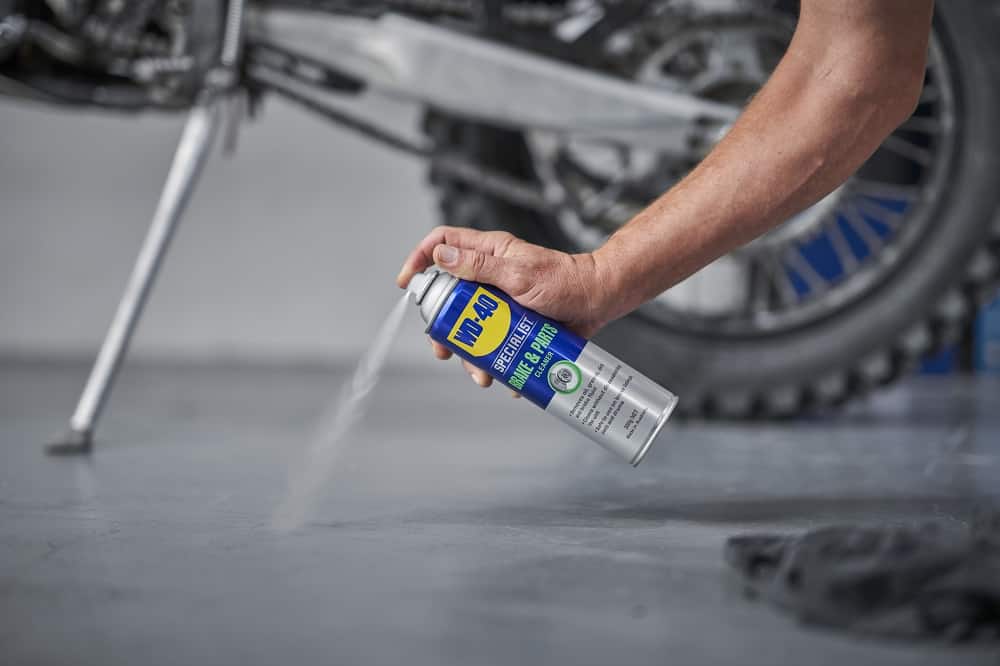
The WD-40 UK Specialist Motorbike range includes a product expressly named Motorbike Brake Cleaner, described for removing contaminants from brake and clutch components. It is a different product from Multi-Use Product and from the same brand’s chain lubricants, silicone products or general degreasers. Its existence explains why advice using only the phrase WD-40 can be misleading. Check the actual can instead of relying on color, a familiar straw or a brief online comment. A motorbike product listing is not, by itself, blanket approval for every car caliper and every associated material. Use the current label and the brake or vehicle maker’s cleaning instructions for the component being serviced. Availability and formulations can differ by market. Do not assume a cleaner sold under a similar name elsewhere has identical limitations. Where compatibility is unclear, obtain a suitable specification before applying it. A purpose-made cleaner still requires careful use; it does not automatically restore contaminated friction material or repair damaged seals.
If Multi-Use Product reached the pads or rotor
Do not drive to burn off oily residue or see whether braking improves after several stops. Keep the vehicle out of use until the affected surfaces and components have been assessed. Identify the exact product, where it was sprayed and whether the vehicle has moved since application.
Keep the container or a clear photograph of its label for the technician. This information is more useful than saying only that some cleaner was used. Follow the brake-component manufacturer’s procedure for contamination.
Do not assume a visible wipe proves a pad is restored, or that a generic solvent can reverse every exposure. The appropriate response may include replacing affected friction components and cleaning permitted surfaces using a specified method.
The extent of work follows the actual exposure and service guidance, not a universal number of spray passes. If braking became poor after application, arrange recovery rather than driving to the repairer.
Do not use sandpaper, a flame, an oven or repeated hard braking as an improvised decontamination process. These actions can add damage while leaving uncertainty about performance.
Avoid escalating from one unidentified chemical to another. A qualified inspection should establish which parts remain serviceable and how the final brake operation will be verified.
Record what happened honestly; concealing the product used makes diagnosis harder. If overspray appears limited to an outer surface, still check whether it could have reached nearby pads, the disc or protective materials.
The position of the nozzle is not proof of the final destination. Fluid can spread beyond the visible wet patch during handling.
Do not rely on smell disappearing as evidence that all functional surfaces are clean. The return-to-service decision concerns braking condition, not whether the assembly looks dry from outside.

Credit: m.youtube.com
Squeaks and sticking need a diagnosis before a product
- Brake noise can have several causes, and spraying lubricant until it goes quiet does not establish which one was present. Changes in pad fit, hardware, wear or other conditions may need inspection. Likewise, a brake that remains applied may be mechanically binding or held by hydraulic pressure. Neither problem is safely diagnosed by coating the housing. A quieter wheel can still have an unresolved defect, and a freed part can still be damaged.
- Describe the symptom to the repairer: when it occurs, which wheel seems involved, whether recent service preceded it and whether braking changed. Do not create another road test if the vehicle is already unsafe. Our caliper-release guide explains why temporary movement is not a completed repair. For noise without a confirmed cause, request an inspection of the actual assembly rather than a promise that one spray fixes every squeal.
Guide lubrication is not general spray maintenance
| Where a floating-caliper guide requires lubrication, use the specified product in the specified location. HELLA’s guide-pin guidance discusses how incompatible material can affect rubber components and why guides and protection need inspection. A general water-displacing spray is not automatically a substitute for the required guide lubricant. Neither is every product labeled silicone, ceramic or high temperature suitable for every caliper design. Do not lift a boot and spray underneath it to treat a sticking piston or pin without an approved procedure. That can introduce an unsuitable material and obscure the condition that needs repair. Our lubrication-location guide explains the difference between moving contacts and surfaces that must stay dry. Product selection comes after identifying the mechanism and materials, not before. |
Use cleaning products only within their instructions
A cleaning plan should identify the permitted surfaces, the required ventilation and protection, and the handling restrictions on the actual label. Do not spray onto dangerously hot parts or near an ignition source. Keep airborne brake dust controlled rather than blasting it into the work area. Use the vehicle’s safe support procedure if access requires removing a wheel. These precautions remain relevant even when the product is specifically sold as brake cleaner.
- Avoid treating a safety data sheet as a complete vehicle-service approval. It explains hazards and handling, while the product directions and component instructions establish the intended application. If one source permits general metal cleaning but the caliper maker restricts the proposed use, resolve that conflict before applying the chemical. A convenient aerosol cannot replace inspection, correct assembly or a hydraulic-service procedure.
Keep chemical treatment away from repair substitutions
No spray repairs a cracked housing, damaged mounting thread, leaking seal or worn guide. Do not apply it to a fluid connection in an attempt to stop leakage. Do not loosen hydraulic fittings as part of a cleaning experiment. If the circuit is opened during a proper repair, the specified sealing, bleeding and verification steps apply. Brembo’s fitting guidance emphasizes keeping lubricants off braking surfaces and using a competent installation process. Those requirements continue to matter when cosmetic cleaning is the original reason for working near the assembly. Ask the workshop to separate cleaning from mechanical repair on the invoice. The record should say what was found, what product was used where permitted and what parts were renewed. This makes later servicing more informative than a vague note saying brakes sprayed. It also helps establish whether the original complaint was actually resolved.
A useful check before picking up the can
Read the full product name. Identify the exact surface.
Find the vehicle or brake maker’s instruction for the task. Confirm that the label supports that use and that nearby materials can be protected.
If any answer is missing, stop before spraying. This short check is more reliable than deciding that all WD-40 products are either suitable or unsuitable for all brake work.
For Multi-Use Product, keep the practical restriction clear: it is not a blanket brake-cleaning or brake-lubrication treatment, and it must not contaminate friction surfaces. For a separately branded brake cleaner, follow the actual formulation’s instructions and the component requirements.
Neither product category proves that a dragging, leaking or noisy brake needs only a chemical treatment. Proper diagnosis determines whether cleaning has any role in the repair.
If you already applied an unknown product, preserve its label and explain the exposure before the vehicle returns to use. If you have not applied anything, identify the problem first and avoid creating contamination that complicates it.
A well-maintained caliper is one whose parts remain correctly fitted, protected and functional. Its condition cannot be judged by how recently it was sprayed.


Automotive reference information. Confirm specifications in the manual for your exact vehicle. Original replacement guides link to their research sources. About us