
Spark plugs can be unfit for use after a period of storage, but “the car sat for months” does not establish that the plugs failed. The important distinction is between unused parts in a box and plugs already installed in an engine. Look at prior service, contamination, exposure and handling rather than treating elapsed time as a diagnosis. There is no universal storage deadline in the manufacturer guidance reviewed here that makes every spark plug expire after the same number of months.
For a parked car, the plugs retain whatever wear or deposits they had when the engine stopped. For an unused spare, the questions are its identity, condition and storage history. Those situations call for different decisions. Neither is equivalent to a battery losing charge, and fitting new plugs is not a substitute for checking why a stored vehicle will not start.
Begin by recording which situation you have: a sealed spare, a loose unused part, a previously used plug kept for later, or a car returning to service. That classification prevents advice meant for a complete vehicle from being applied to a small boxed component, and keeps a parts-storage question separate from an engine diagnosis.
What was happening before the car was parked?
An engine may already have been starting poorly, using oil or running unevenly before storage. If that history is forgotten, the first unsuccessful start can make the parking period look like the cause. Review previous service records and the reason the vehicle was taken off the road before deciding that inactivity damaged its plugs. NGK lists repeated short trips among conditions associated with carbon fouling.
The interval without driving is only one part of the timeline. Ask whether the engine was healthy beforehand, whether it was started occasionally, and whether any covers or ignition components were removed during other work. Those details help distinguish a pre-existing condition from exposure or handling during storage.Existing wear does not disappear during storage
Electrode erosion is associated with operation, not a need to keep the plug continually active. Deposits from previous running can remain on an installed plug. If it was already worn or fouled when parked, the next start may reveal that condition without showing that storage created it. Check the service history before attributing the entire problem to inactivity.Exposure is a condition question, not a calendar rule
Wet packaging, a flooded engine or water found near an ignition connection are different exposures. Do not assume that parking outdoors automatically lets water reach the firing end of every installed plug. Where there is evidence of water entry, the engine and affected systems need assessment; replacing the plugs alone is not a complete response.
Credit: www.thompsonsales.com
Separate boxed spares from parts left in service
A never-used plug has not accumulated combustion deposits through running. A removed used plug may already have deposits, electrode wear or an uncertain service history. Label them separately. A clean-looking box containing a used part should not be mistaken for new stock merely because the exterior packaging is intact.
The storage date is useful context, but also record whether the package got wet, was crushed, lost its label or was moved loose among tools. These are actionable facts to give a supplier. “Old” by itself does not describe the type or extent of a possible problem. DENSO discusses the effects of infrequent, short journeys; that is an operating pattern, not proof that an unused boxed plug expires.
Inspect moisture exposure without assuming every stain is rust
NGK describes corrosion-resistant plating on its spark-plug threads. That protection is not a guarantee for every storage environment. If a loose or water-exposed part shows corrosion, damaged threads or contamination, ask the maker or supplier to assess suitability instead of scrubbing it until it appears new. A coating description is not a published unlimited shelf-life warranty.
Handling history matters as much as the shelf
DENSO’s precautions warn that dropping a plug can damage it internally or alter its gap. A part can therefore have a concern even when its age is short and its box is dry. Conversely, ordinary calendar age does not prove that its ceramic has cracked. Set aside a dropped or crushed item and disclose the incident when seeking replacement advice.
For installed plugs, investigate the surrounding system
If moisture or oil is found around a plug well or ignition connection, establish how it arrived and which components are affected. A spark plug, boot and coil are separate parts. Replacing one does not repair a leak into the well or prove the other components are sound. Avoid describing every external moisture problem as corrosion inside the combustion chamber.
Appearance can narrow the question
NGK’s condition guide treats electrode erosion and deposits as different observations with different possible causes. Photograph relevant findings before cleaning or discarding anything. Keep track of cylinder location when a workshop removes the plugs; an isolated condition and a similar pattern across the set can lead to different follow-up questions.
A starting problem still needs a starting-system diagnosis
Mazda’s no-start guide covers battery, starter, fuel and ignition concerns. Describe whether the engine does not turn, turns slowly, turns normally without starting, or starts and runs unevenly. These are more useful descriptions than “the plugs went bad.” Do not keep cranking repeatedly while swapping parts without a plan.

Credit: www.reddit.com
Protect spare parts and preserve their identity
Keep unused replacements in their labeled protective packaging, separated from used components and heavy tools. This is a practical way to limit knocks, dirt and ordering mistakes, not a manufacturer-certified storage-life extension. Follow any storage instructions actually supplied with the product, especially if a distributor has specified additional conditions.
A spare-parts routine should preserve traceability and prevent avoidable physical damage. It should not introduce a new cleaning or lubrication treatment simply because the part has been stored. Keep the item identifiable until the day it is selected for an actual application.Use packaging to protect, not to hide uncertainty
Choose a clean, dry storage location where packaging will not be soaked or crushed. Keep the full label and any fitting instructions with each part. Do not put a damp component into a container and assume sealing it has removed the moisture. If the package has deteriorated, document the condition and seek product-specific advice before installation.Do not run the engine solely to exercise its plugs
There is no reason to rotate loose plugs or start a parked engine just to give the plugs activity. Short starts are not equivalent to a proper storage program. Follow the vehicle maker’s procedure for preserving the whole car, including its ventilation and safety requirements, rather than inventing a plug-exercise schedule.What inspection and testing can establish
There is no single household test that certifies every stored spark plug for service. Identity, visible condition, correct application and permitted handling all matter. If the part’s history is unknown, tell the technician that rather than treating one electrical reading as proof that everything inside the component is intact. Niterra’s ignition-testing work uses controlled pressure conditions, illustrating why a spark observed outside the engine is not a complete service simulation.
A resistance reading is only one kind of evidence
A meter result must be interpreted against the specification and test method for the exact design. Do not assign every plug the same acceptable resistance. Continuity or a plausible resistance reading does not certify the ceramic, sealing, electrode condition or ability to work reliably in the engine. Avoid improvised live high-voltage checks around the vehicle.Let the actual concern determine the assessment
If the engine fails to start after storage, preserve fault information and describe the cranking behavior before removing parts. If a technician inspects plugs, retain their locations and observations. Do not sand electrodes, wire-brush fine tips or change a gap merely to make a test result look better. A damaged part and an underlying engine fault require their own resolutions.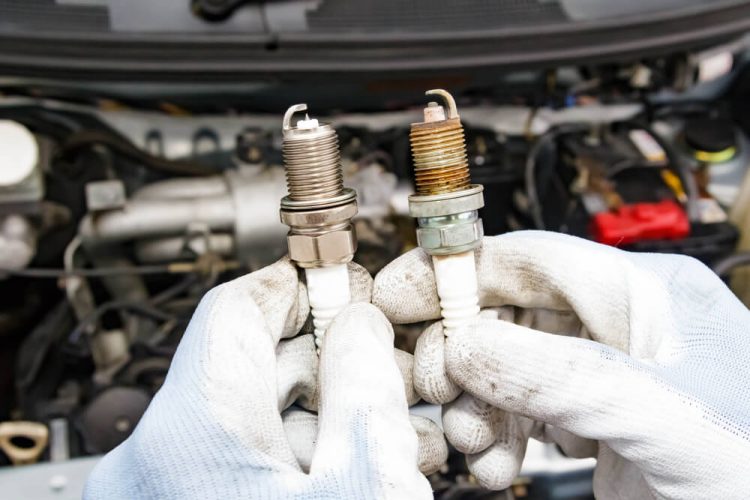
Credit: www.freeway.com
Choose replacement for a reason you can explain
Replacement may be appropriate because the part is damaged, the application is wrong, the installed set is due for service, or inspection identifies a defect. Those are stronger reasons than an invented expiry date. The aim is reliable operation after storage, not proving that every old part can be saved or that every old part must be discarded.
If you have a receipt and an uncertain spare, contact the supplier with photographs, the full reference and the known storage events. Ask whether the manufacturer has guidance for that product and condition. Do not treat a general internet answer as an extension of a warranty or an authorization to use a visibly compromised component.
Prior mileage and deposits still count
Parking a vehicle does not reset its maintenance history. A set near its specified replacement point before storage remains near that point afterward. Record the last installation mileage and the distance subsequently traveled; where history is incomplete, say that explicitly instead of assigning the plugs a new service life from the restart date.
Deposits also need context. A replacement may restore ignition while the process that contaminated the old plug remains. If the same cylinder repeatedly fouls, the next step is diagnosis of the cause rather than assuming every replacement suffered a storage defect. Our guide to spark-plug symptoms separates these observations from a confirmed diagnosis.
Avoid cleaning away all evidence simply because the car has been parked. A technician may want to distinguish fuel wetting, oily deposits, normal wear and mechanical damage. An aggressively polished surface can lose that information while leaving the underlying fault unresolved.
Use the actual maintenance schedule
DENSO’s replacement FAQ points to the vehicle manufacturer’s interval. Check the schedule for the particular engine, including any applicable time or severe-use requirement. A mileage-only assumption may miss a time-based instruction; equally, an arbitrary yearly plug change is not a substitute for reading the specified schedule.
If the car was stored because it already had a fault, resolve that fault before using a maintenance replacement as the return-to-road plan. Plug service is one item within recommissioning. The vehicle may also need attention to its battery, fuel system, fluids, tires and brakes under its own storage instructions.
A brief successful start does not complete that assessment. Watch for warnings or abnormal operation without revving the engine to “burn off” an unknown problem. If it runs severely unevenly, smells strongly of fuel or shows an urgent warning, stop safely and obtain the appropriate help.
Keep the return-to-service record short and specific: storage dates, known exposure, pre-storage symptoms, work performed, parts fitted and unresolved concerns. That information is more valuable to the next technician than the broad label “bad from sitting,” which mixes several different possibilities.
Time in storage is context, not the verdict
Assess an unused spark plug by its verified application, condition, packaging history and manufacturer guidance. Assess installed plugs as part of the vehicle’s service and fault history. Neither a long stay on the shelf nor a low odometer reading is enough to certify a component or condemn it.
The sensible outcome may be to use an appropriate undamaged spare, obtain supplier clarification, perform scheduled replacement or diagnose the parked car’s starting problem. Choose among those actions using evidence about the actual item and engine, rather than a universal storage lifespan.
Retain the part numbers and storage notes with the repair record.


Automotive reference information. Confirm specifications in the manual for your exact vehicle. Original replacement guides link to their research sources. About us