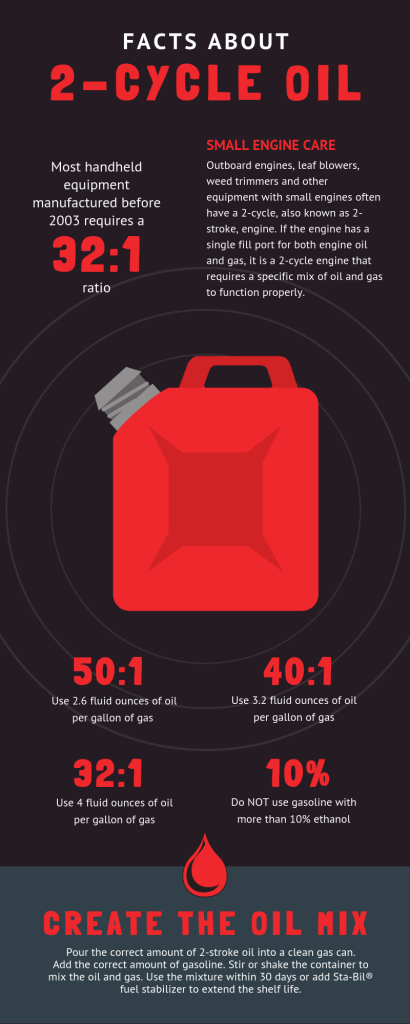

Do not substitute ordinary four-stroke car motor oil for the two-stroke oil required in a fuel mixture. Use the exact lubricant type and fuel-to-oil ratio specified for your machine. Two-stroke oil is also an engine lubricant, so the words motor oil can be ambiguous: verify whether the bottle is the required two-stroke product rather than relying on the general name.
There are two separate checks. First, does the oil meet the engine’s requirement? Second, is the specified quantity mixed with the correct quantity of fuel? Accurate arithmetic cannot make the wrong formulation appropriate. Likewise, a suitable oil does not correct a guessed ratio or an unknown amount of gasoline.
This guide explains selection and measurement without prescribing one fuel recipe for every chainsaw, trimmer, motorcycle, or outboard. It includes worked calculations for ratios a manual might specify. The calculations are examples, not permission to use those ratios in an unidentified engine.
Identify the lubrication system before mixing
Start with the machine’s model, engine identification, serial range where relevant, and operator manual. Determine whether the instructions call for premixed fuel, a separate oil-injection reservoir, or a separate four-stroke oil sump. Do not infer the system from engine size, smoke, or what a previous owner remembers.
Premix and oil injection are different tasks
For a premix system, the specified lubricant is deliberately combined with fuel before filling. An oil-injection system meters oil through its own arrangement. Do not add an improvised premix to an injection-equipped engine merely because both are called two-stroke; follow the instructions for that system and operating condition.
The NMMA’s two-stroke marine-oil explanation describes lubricant passing through the engine and being consumed, contrasting it with recirculating sump oil. This helps explain why a conventional four-stroke crankcase-oil label does not establish suitability for the fuel-lubricated application.
The equipment name does not identify every requirement
A chainsaw and an outboard can both use two-stroke lubrication while requiring different oil performance. Even machines used for similar jobs can have different instructions. Read the exact manual before deciding that one container of mixed fuel can supply everything in the shed.
Also avoid the reverse shortcut that every four-stroke machine must take straight gasoline with a separate oil fill. STIHL’s 4-MIX design is a documented four-stroke system using a fuel mixture. It is a specific reason to identify the actual design rather than creating a universal rule from the cycle name.
If the machine has changed hands or been modified, confirm the installed engine and any changes to its lubrication system. A missing oil tank, disconnected line, or conflicting label is not a reason to invent a ratio. Seek qualified guidance before operating it.

Credit: www.quicksilver-products.com
Choose the oil before calculating the amount
Read the product’s intended application, performance claims, and any restrictions. Look for the required two-stroke specification and whether the product supports the specified premix or injection use. A familiar brand can sell several unrelated oils, so compare the full product name rather than just the logo.
Why automotive crankcase oil is the wrong shortcut
Husqvarna’s mixing guidance expressly rejects four-stroke motor-vehicle oil for the covered two-stroke products and calls for oil intended for their air-cooled application. This is a direct manufacturer restriction, not a claim that any household lubricant will work if enough is added.
Synthetic is not the required application
A synthetic automotive oil remains an automotive product unless its actual documentation establishes the required use. A synthetic two-stroke product still needs to match the equipment requirement. Choose on the application and specification first; do not use the formulation category to skip those checks.
Separate marine and other two-stroke requirements
NMMA distinguishes TC-W3 two-stroke marine oils from FC-W and FC-W(CAT) four-stroke marine oils. Those are different certification families. A marine logo or outboard illustration does not identify the correct lubricant without the exact family and engine requirement.
The useful distinction is the service the oil is formulated and specified to perform. Do not decide that two products are interchangeable because both pour easily, both are petroleum-based, or both are sold beside engine parts. None of those observations demonstrates the performance required by the machine.A shared word does not establish a shared specification
A product described as outboard oil may be intended for a particular marine application. A product described as chainsaw oil may instead lubricate the external bar and chain. Read the full application statement. Similar packaging and oil color are not reliable ways to distinguish fuel-mix lubricant from a different maintenance product.Check the whole product identity
A multi-application product needs explicit supporting claims for your application. Do not assume that an oil carrying a marine requirement also meets an air-cooled-tool requirement, or vice versa. If the documentation is unclear, ask the equipment maker and lubricant supplier about the exact product before mixing it.
Credit: canberradiamondblade.com.au
If the wrong oil was already mixed
Do not pour the batch into the machine or add more gasoline in an attempt to turn an unsuitable formulation into a suitable one. Close and identify the approved fuel container, retain the oil bottle, and arrange advice or disposal appropriate to the actual mixture. Keep it separate from clean fuel.
If the engine has not been started
Record whether the mixture is only in the container or has entered the tank. Tell the service provider the product, estimated amounts, engine model, and whether any starting attempt occurred. Do not start the machine to use up the bad batch. Ask for the model-specific procedure before opening fuel-system components.
If it has already operated
Stop using the machine safely and report the approximate running time, symptoms, and mixture details. A brief successful run does not prove compatibility, and a symptom does not identify damage by itself. Do not invent a safe running period or assume that topping up with the correct oil will undo the problem.
What correct oil and measurement help you control
A documented oil choice and measured mixture remove two avoidable uncertainties from operation. They do not guarantee that an engine is healthy or repair a clogged filter, fuel-system fault, or mechanical problem. If a machine runs poorly with the correct fresh mixture, investigate the actual fault rather than repeatedly changing ratios.
Write the oil product, ratio, mixing date, and intended machine on a durable label. Include the measured batch size if useful. This is particularly helpful when several people use the same equipment and an unmarked container might otherwise be mistaken for straight gasoline or a mixture intended for another machine.Keep a record of the batch
Keep a simple batch note when troubleshooting a recurring problem. Record what was measured rather than reconstructing it from memory later. That makes it possible to distinguish an uncertain fuel batch from a problem that also occurs with a correctly prepared, documented mixture.Do not use smoke as a measuring instrument
Exhaust appearance cannot measure the oil ratio accurately. Smoke, smell, or the engine starting successfully does not replace known quantities and the proper product. Do not keep adding oil until the exhaust looks different or dilute the mixture until it appears cleaner.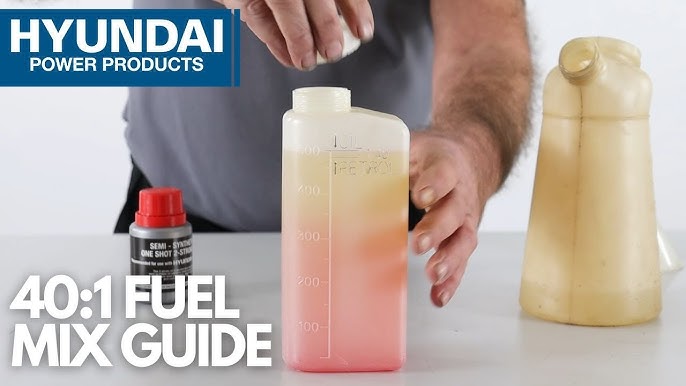
Credit: www.youtube.com
Read the ratio from the exact instructions
STIHL’s published guide explains mixing for its gasoline equipment and refers owners to the product manual. Its familiar 50:1 example is not a universal recommendation for other manufacturers, older machines, modified engines, or unrelated injection systems. Resolve the requirement before doing arithmetic.
Record fuel quality and oil requirements together
If the instructions state an exception for running-in, a particular oil, or another condition, preserve that context. Do not transfer the exception to ordinary service or another engine. When old and new instructions conflict, obtain clarification using the exact model and the passages that differ.Use the instructions for the actual operating condition
Use a manageable batch size that fits your actual work and the applicable storage instructions. Factory-premixed fuel and a home-mixed batch may have different storage guidance. Check the actual product rather than assigning every mixture one universal shelf life. Labeling also helps prevent old and new batches from becoming an unidentified combination.Calculate the oil quantity with consistent units
For a fuel-to-oil ratio of R:1, divide the measured fuel volume by R to obtain the oil volume, using the same unit for both. The calculation starts with the fuel quantity, not the final combined mixture. Convert units before dividing and write down the result before opening either container.
Use a measuring container with markings suitable for the quantity involved. A kitchen spoon, an unmarked cap, or a guess from the level in a large bottle can introduce substantial uncertainty into a small batch. Keep equipment used for fuel and oil separate from food preparation.Worked metric examples, conditional on the manual
For a documented 50:1 requirement, 1,000 mL of gasoline requires 20 mL of oil; 5,000 mL requires 100 mL. At a documented 40:1 requirement, the same 1,000 mL of gasoline requires 25 mL. These are arithmetic examples only. They do not select the correct ratio for your engine or override its instructions.Avoid rounding a whole batch by eye
Do not mix US-gallon and imperial-gallon markings or confuse fluid ounces with ounces by weight. If the fuel amount is uncertain, the calculated oil amount is uncertain too. Do not use a dosing bottle labeled for one batch volume with another volume without recalculating from the actual instructions. Keep an unknown mixture out of the machine while resolving it.Finish with an identifiable, appropriate batch
Confirm the machine, approved oil, required ratio, measured fuel, measured oil, and container label before filling. Follow the manufacturer’s mixing and fueling sequence, including its cooling and safe-handling instructions. A ready-mixed product can simplify measuring when its specification and ratio fit the machine; it is not a universal replacement for checking compatibility.
For ordinary sump lubrication, use the separate guides to car oil in a four-stroke mower or motorcycle oil compatibility. Keeping those tasks separate prevents an appropriate product for one engine system from becoming an unsupported fuel additive in another.


Automotive reference information. Confirm specifications in the manual for your exact vehicle. Original replacement guides link to their research sources. About us