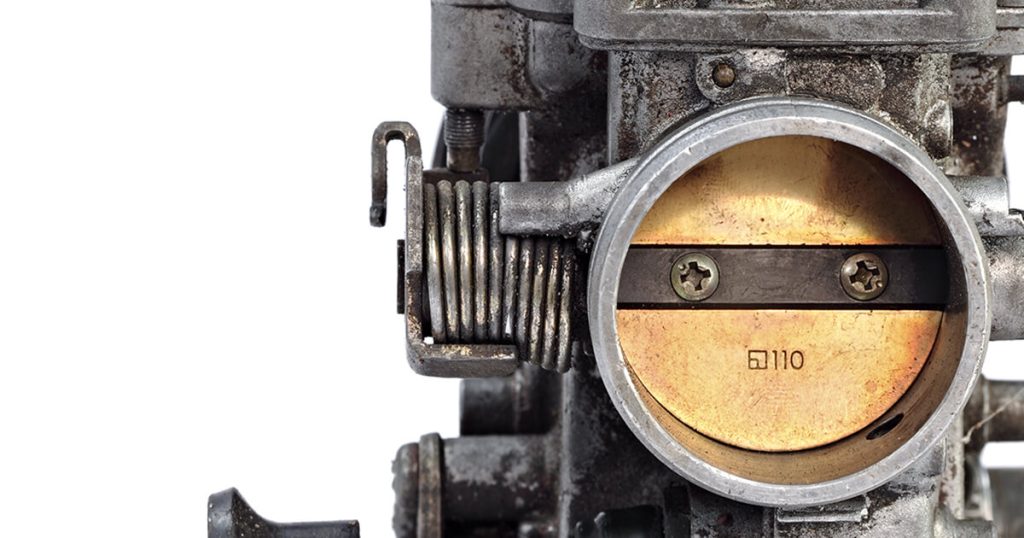

Usually, an in-tank fuel injector cleaner does not clean the throttle body on a modern port-injected or direct-injected gasoline engine. The reason is location.
Treated fuel travels through the fuel system, while the throttle body normally carries intake air. A cleaner cannot be assumed to remove deposits from a surface the treated fuel does not wash.
Older throttle-body injection systems are an important exception to this layout, but that does not make every tank additive a suitable throttle-cleaning product. Identify the engine before deciding what a bottle can reach.
If the car has a rough idle, do not assume that either the injectors or throttle body are dirty. Diagnose the symptom before purchasing several cleaning services.
Two components with different jobs
The injector meters fuel. The throttle body regulates airflow on the gasoline engines discussed here. Both influence combustion, so faults in either area can produce overlapping driving complaints.
That overlap does not mean the parts share the same fluid path. It also does not establish that the same chemical treatment will solve both problems.
Where an in-tank cleaner travels
An additive poured into the fuel tank mixes with fuel.
The mixture follows the vehicle’s fuel-delivery route.
That route includes the components between the tank and the injectors.
- The exact arrangement differs by engine.
- A product label may describe fuel-system deposit control.
- It does not automatically include the entire air-intake system.
- Read the named applications rather than relying on a broad phrase such as engine cleaner.
- A treatment’s ability to reach a component is the first question; compatibility and actual deposit removal are separate questions.
Where the throttle body sits
On a typical modern gasoline intake, air enters through the filter and ducting before reaching the throttle.
Fuel is introduced elsewhere downstream or inside the cylinder.
The throttle plate and bore therefore do not receive a continuous wash of gasoline from the tank.
- Oil mist and other intake-system contamination can nevertheless reach that area.
- Visible residue is a reason to assess condition, not proof that it causes a particular symptom.
- A small mark and a deposit that interferes with airflow are not equivalent findings.
- Electronic throttle assemblies also contain mechanisms that should not be forced.
- Do not move the plate by hand unless the vehicle procedure permits it.
Do not flood electrical sections with solvent.
The relevant service information determines whether cleaning is appropriate and how access should be obtained.
Can tank treatment reach the throttle plate?
Trace the fuel path on the actual engine. If injection occurs after the throttle, adding detergent to the fuel does not provide a normal cleaning stream across the upstream plate. This is a layout-based limitation, not a judgment that every additive is ineffective. A product may have a legitimate fuel-system use while being unsuitable for the particular surface you want cleaned.
Port injection: fuel enters near the intake valve
Bosch describes port injection as introducing fuel before the inlet valve. That distinction explains why discussion of port-injected fuel washing intake-valve areas should not be casually extended to the throttle body.
The two locations are not interchangeable. Confirming port injection answers a routing question; it does not prove that any individual additive will restore a dirty injector or valve.
Direct injection and combined systems
Gasoline direct injection introduces fuel into the combustion chamber.
An in-tank treatment therefore reaches the direct injector with the fuel.
- It does not follow the incoming-air route through the throttle.
- Engines using both port and direct injection need to be identified accurately.
- The presence of a port-injection circuit still does not imply fuel is sprayed upstream across the throttle plate.
Avoid advice that classifies all engines by model name alone.
Different model years can use different systems.
An engine identification or manufacturer diagram is stronger evidence.
Use that information before approving a cleaning service described only as a complete intake treatment.
What a product name cannot tell you
Fuel-system cleaner, injector cleaner and intake cleaner are marketing descriptions with different possible applications. They are not permission to use the liquids interchangeably.
Check the exact product, delivery method and label. A familiar brand name does not make a tank additive appropriate for direct spraying.
Ingredients are not a universal application guide
An ingredient list cannot replace usage instructions.
- Two products containing a similar solvent can differ in concentration and additional ingredients.
- One may be intended to mix with gasoline while another is designed for controlled surface cleaning.
- Seal, coating and sensor compatibility also matter.
- Do not make a homemade blend or transfer a tank treatment into a spray bottle to imitate a dedicated cleaner.
Contact matters as well as chemistry
A cleaner must reach the target in a suitable form and under suitable conditions.
| More chemical in the fuel does not solve an incorrect delivery route. |
Nor does a stronger smell demonstrate better cleaning.
If an advertisement suggests an intake benefit, look for the specific engine architecture and test conditions behind the claim.

Credit: www.lacdjr.com
Throttle deposits need their own assessment
A technician can inspect the throttle area as directed by the vehicle procedure and relate the finding to symptoms and scan data. That is more useful than declaring every dark surface defective.
Cleaning may be appropriate when the manufacturer permits it and the condition warrants it. Electrical faults, damaged parts and air leaks require their own repair.
Protect coatings, seals and electronics
Use only the product and method allowed for that assembly. Do not assume brake cleaner, carburetor cleaner and throttle-body cleaner have identical compatibility.
Avoid scraping or abrasive treatment unless expressly specified.
Damage introduced during cleaning can be more troublesome than the original residue.
Tank treatment and direct cleaning are separate services
A tank treatment is carried with fuel during operation.
Direct throttle cleaning involves access to the relevant intake component.
The second process may require removal, controlled cleaning and specified setup afterward.
They should be separately described on an estimate.
Ask what component each service addresses and what evidence supports doing it.
An example of a purpose-specific product
CRC markets a dedicated throttle-body and air-intake cleaner. Its existence illustrates the difference in intended application, but this article does not endorse it for every vehicle. The vehicle instructions and the exact product label must agree. A product category alone does not authorize a generic spraying procedure.
Do not pour injector additive into the intake
Pouring a tank additive into an air duct is not an alternative route recommended by this guide. It can introduce an uncontrolled quantity of liquid and expose components to an unintended chemical.
Follow the intended application. If a workshop proposes an intake treatment, request the named procedure and its applicability to the engine.
What improvement would actually show
Suppose an idle complaint becomes less noticeable after a tank treatment.
That observation alone does not prove that the throttle was cleaned.
Fuel quality, temperature and operating conditions may also have changed.
A fault may be intermittent.
- Repairs or resets performed at the same time make attribution even harder.
- Record what changed before deciding the bottle caused the result.
- Compare the original symptom under similar conditions.
- Do not infer a repaired electronic throttle from a temporary improvement in smoothness.
- Stored faults and relevant measurements still need review.
A safe repair decision rests on that evidence rather than on a single pleasant drive.
Decide which problem you are trying to solve
Identify whether the concern is routine maintenance, a visible deposit, a fault code or a drivability complaint. Each has a different starting point. An engine without symptoms does not automatically need two separate cleaning treatments. Follow its maintenance guidance and investigate abnormal behavior when it occurs.
Questions before approving intake work
Ask for the finding and the proposed method
Request the inspected component, the reason cleaning is recommended and the procedure that will be used. Ask whether the price includes any required reassembly checks or learning process. A clear answer should distinguish throttle cleaning from injector treatment. An unclear package description is a reason to obtain more detail before authorizing work.
What about older throttle-body injection?
Some older systems inject fuel at the throttle-body assembly. That changes the path compared with modern multipoint port injection. It is why an absolute claim that fuel never passes a throttle body would be misleading.
However, fuel contact does not establish that a particular bottle will remove every deposit or repair worn hardware. Identify the older system and use its service guidance.
A practical decision path for rough idle
Start by recording when the roughness occurs.
Note whether it is cold, warm, in gear or associated with a warning light.
- Save fault codes before clearing them.
- Check recent work that may have disturbed an air duct or connector.
- An air leak can resemble other mixture problems.
- A cylinder-specific misfire may need ignition and mechanical checks.
- A throttle-related code requires its own diagnostic path.
- Do not use a tank treatment as a reason to postpone those checks.
- If the vehicle stalls unpredictably, arrange diagnosis rather than experimenting in traffic.
- If there is a fuel smell or leak, stop operation and address that hazard first.
- When cleaning is justified, use the specified method.
- Check the result against the original complaint afterward.
Retain the service description for future reference.
For the additive side of the decision, see what an injector-cleaner effectiveness claim can establish.
A bottle may be relevant to deposits in its intended fuel path.
It is not evidence that an upstream throttle body has been cleaned.


Automotive reference information. Confirm specifications in the manual for your exact vehicle. Original replacement guides link to their research sources. About us