
Test a traditional mechanical fuel pump by comparing its delivery with the vehicle’s pressure and volume specifications, then investigating its fuel supply and mechanical operation if those results are wrong. Fuel reaching the carburetor does not by itself prove that the pump meets the required delivery.
This guide concerns the conventional low-pressure pumps used with carbureted engines. It is not a procedure for modern mechanically driven high-pressure gasoline or diesel pumps. Those systems require different equipment and service instructions.
Identify the pump and engine before testing
Find the engine and pump application, including any aftermarket changes. A classic car may no longer have its original engine, carburetor or fuel system. Obtain the specifications for the installed combination rather than assuming that the vehicle’s age establishes the correct pressure.
Find the specification in the vehicle service information and the instructions for the installed pump. A catalog pressure or flow figure can help identify a product, but it does not replace the operating conditions and pass/fail criteria of a diagnostic procedure.
Define the complaint and inspect for obvious problems
Record whether the engine fails to start, runs briefly then stops or loses performance under particular conditions. Look for visible leaks, damaged accessible plumbing and disturbed connections without opening the system unnecessarily. Stop running the engine if fuel is leaking.
An empty tank indication or a recently changed filter belongs in the diagnostic history. Do not skip those facts because a pump is old. Age may justify inspection, but it does not identify which part of the supply path is causing the current complaint.
Prepare the specified pressure test
Use the service procedure’s connection arrangement and a suitable fuel-pressure gauge. Follow its instructions for making connections and handling any released fuel. Keep fuel away from ignition sources and moving engine components. Do not improvise with loose hoses and open household containers.
Confirm whether the procedure calls for cranking, running or another condition. Record that condition with the reading. A measurement without the operating condition is difficult to compare meaningfully with a specification.
Interpret pressure using the installed system
Compare the result with the correct requirement. Too little pressure does not identify the pump alone, while too much pressure also requires investigation. Do not treat the highest possible gauge reading as evidence of a better system.

Credit: www.howacarworks.com
Holley’s technical information describes mechanical pumps with different delivery and regulation requirements. It reinforces why a specification borrowed from another pump can produce the wrong diagnosis, particularly on modified vehicles.
Check delivery volume only with the proper procedure
Pressure and volume answer different questions. Where the service information calls for a timed delivery test, use its approved equipment, containment and operating instructions. Do not invent a target quantity or crank the engine for an arbitrary period.
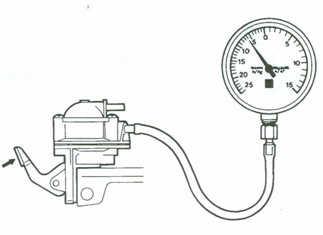
Credit: sucarb.co.uk
If you lack a safe way to perform that test, have a workshop do it. Watching fuel pulse from an open line is not a controlled substitute. Ask the technician to record both the measured quantity and the specified test conditions.
Separate supply restrictions from pump or drive faults
When delivery is inadequate, follow the diagnostic sequence for the fuel path and the pump’s mechanical actuation. A pump cannot be assessed fairly if the required inlet supply or drive condition has not been established. The applicable manual determines how those checks are performed.
Avoid adding an electric helper pump as a first response to an unexplained failure. That changes the system before identifying the cause and introduces new control and regulation questions. Establish what failed in the existing arrangement first.
Restore the system and verify the result
After testing, restore all connections using the correct procedure and inspect for leaks before returning the vehicle to use. If a component is replaced, repeat the relevant checks and confirm that the original complaint is resolved under safe conditions.

Credit: www.youtube.com
Keep the specifications and actual results together. For the broader distinction between a measured delivery problem and an assumed failed pump, see fuel-pressure testing. A sound diagnosis explains the fault instead of relying only on the pump’s age or sound.


Automotive reference information. Confirm specifications in the manual for your exact vehicle. Original replacement guides link to their research sources. About us


