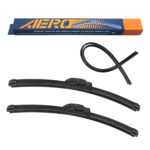

Beam wiper blades support the wiping rubber with a curved, flexible structure running along the blade rather than an exposed, jointed frame. They are also commonly described as flat or bracketless blades. Their construction aims to distribute the arm’s force along the glass while keeping the assembly relatively low in profile. The name identifies a design approach, not a guarantee that any beam blade will fit your vehicle or outperform every other type. The correct application remains essential.
There are three parts to keep separate: the vehicle’s wiper arm, the blade assembly attached to it and the flexible edge that removes water. A beam replacement normally concerns the middle of that list, including its fitted wiping element and connector. It does not replace the motor, linkage or arm spring. This distinction matters when a product advertises better contact: a new assembly still relies on the surrounding system being in suitable condition. A damaged arm cannot be diagnosed from the style printed on a replacement box.
Despite the name, a beam blade is not simply a straight strip and need not contain only one supporting spring. For example, Bosch’s XpressFIT PRO description specifies dual tension springs. That is why counting visible ribs or interpreting the singular word “beam” literally is a poor identification method. Look for the manufacturer’s construction description and part reference. An unloaded curve is part of a designed assembly, not an invitation to bend a purchased blade until it resembles the one removed.
DENSO describes its flat blades as bracketless assemblies with supporting vertebrae and an integrated spoiler. It separately identifies retrofit products for certain U-hook applications. Those details explain both the structure and the need to select an actual application: “flat” does not mean suitable for a flat-only windshield, and “retrofit” does not mean that every arm accepts the same part. A catalogued change from a conventional blade can be legitimate without making the two construction categories universally interchangeable.
Credit: ancowipers.com
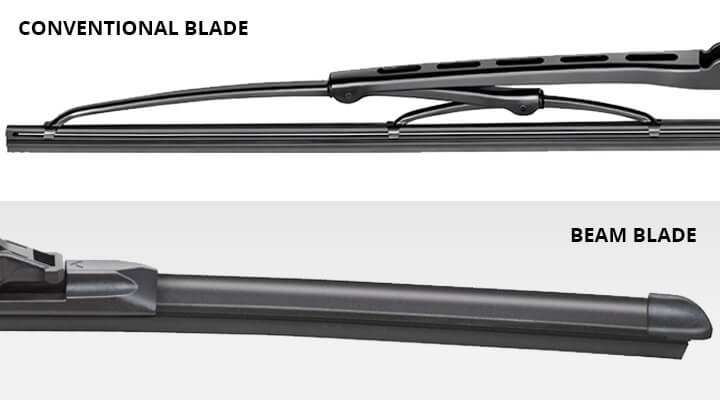
How a beam differs from a conventional or hybrid blade
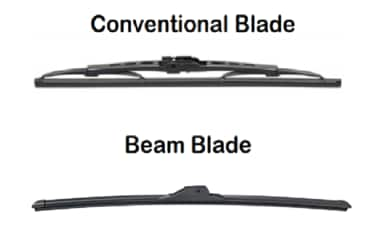
A conventional blade uses a visible frame and linked supports to carry the wiping element. A beam assembly takes a different approach to support along its length. A hybrid adds a streamlined covering to a supporting structure, with the details varying by manufacturer. Our hybrid construction guide explains that third category. These names describe the assembly; none tells you the rubber compound, the exact attachment or whether a replacement insert is supported. Keep those questions separate when comparing packages.
Contact design is more useful than a category ranking
TRICO’s beam-versus-conventional explanation contrasts a jointed frame’s discrete support locations with a beam’s distributed support. The practical objective is consistent contact over the intended wiping area as the blade travels. Manufacturer language about pressure points should not be read as a measurement of infinite force or proof of perfect contact on every windshield. The blade, its prescribed curvature and the vehicle application work together. A badly chosen beam can still leave an unwiped section, and that symptom deserves investigation rather than an assumption that the entire category is defective.
Read five features on the actual product
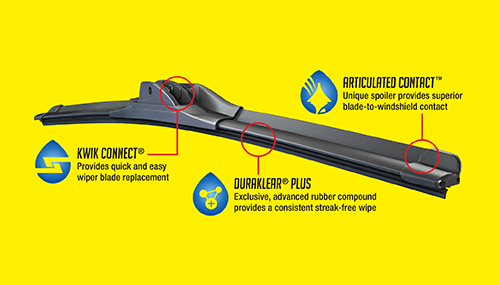
- Supporting structure. TRICO Drive’s product page identifies a steel beam and a low-profile one-piece arrangement. This is a description of that range, not evidence that the connector, rubber and support are one inseparable material. When comparing products, find what carries the wiping load and how the manufacturer describes its intended contact. You do not need to dismantle a blade to answer that question. The published design and the correct part application are more useful than guessing from a photograph of the underside.
- Spoiler or aerodynamic profile. A shaped upper surface can be intended to manage airflow around the assembly. It is not a license to use a non-listed length, exceed safe driving conditions or assume wind lift is impossible. Ask whether a performance claim refers to the named blade and its tested configuration. If the original blade lifted or smeared at speed, report that symptom accurately. A shopping label cannot establish whether the cause was worn rubber, incorrect installation or another system issue.
- Wiping material and coating. Bosch’s cited XpressFIT PRO information describes a graphite treatment on its wiping element. Other beam products may specify different materials or treatments. Therefore, beam and silicone are not synonyms: one concerns construction, the other the wiping material. The material-comparison guide addresses that separate choice. Read the product’s cleaning directions before scrubbing away dark surface material, and do not assume that every coating transferred to a cloth is unwanted dirt.
- Connector and fitting method. An adapter system can let a product family serve several arm types, while another reference arrives with the relevant connector already fitted. Neither arrangement establishes fit for an unidentified car. Bosch’s XpressFIT PRO page lists different arm connections and notes that one is restricted to selected lengths. This makes the point concrete: coverage belongs to the specified combination of part and attachment. Check the complete reference, position and required adapter before comparing how easy the installation looks.
- Service and package contents. Confirm whether you are buying one complete blade, a matched pair or a refill for an existing assembly. Then check whether later insert replacement is supported for that particular product. A flexible edge that appears removable is not enough evidence. The number of products on a shelf, or the word premium in a listing, does not settle the service method. Keep the product instructions so a future owner can distinguish a documented maintenance option from an improvised strip replacement.
Decide whether the change addresses your needs
- Compare complete, compatible purchases. Establish the required parts for each position before comparing cost. A single beam blade beside a pair of conventional blades is not a like-for-like price comparison, and a discount does not resolve a doubtful connector. Include any fitting assistance needed and inspect what is actually supplied. If both candidate products are correctly listed, compare their documented features and service options. There is no useful universal claim that every beam is either worth a premium or an unnecessary expense for every driver.
- Keep winter expectations realistic. Eliminating an exposed framework reduces one place where snow or ice can accumulate; TRICO describes that intention for its Drive design. It does not make the blade an ice scraper or prevent the wiping edge from becoming frozen to the glass. Bosch’s maintenance sheet warns against operating on a frozen windshield and against sweeping coarse debris. Prepare the glass and follow the vehicle’s cold-weather instructions. Winter suitability needs the product application and operating conditions, not just the absence of a metal frame.
- Look for evidence behind durability and noise claims. DENSO’s development description treats geometry, wiping, noise and durability as distinct assessments. A cycle claim from one test does not directly establish years of service in your climate. Likewise, a quieter demonstration on another vehicle does not show what your installation will do. Ask which product was compared, what changed and what the manufacturer actually measured. For persistent streaking or chatter, assess condition and fit instead of repeating purchases solely to move up a marketing tier.
Install the specified assembly and assess its clearing
DENSO’s installation guide calls for checking the replacement and connection before removal, using a required service position and controlling the arm so it cannot strike the windshield. Use the particular fitting procedure rather than treating all beam adapters alike. A connector that needs force is a reason to stop and verify the part. The guide also requires a washer-fluid operating check after fitting. Our compatibility checklist covers the purchase-stage information that should already be resolved before this work begins.
Credit: www.firestonecompleteautocare.com
What a beam label lets you conclude
The label tells you to expect a flexible longitudinal support approach and a relatively streamlined assembly. It does not tell you the correct size pair, material, service interval or guaranteed noise level. For an original beam installation, start with the specified replacement. For a style change, use a manufacturer-listed alternative and preserve the position details. After fitting, look for secure attachment, unobstructed travel and effective clearing. If those conditions are missing, resolve the problem rather than accepting it as a normal break-in period.
Keep the reference and instructions with your maintenance record. When the next replacement is due, they provide a better starting point than remembering that the previous blades looked sleek or cost more. This explanation compares published construction information and application guidance; it does not claim that our publication tested these products on your vehicle. A well-supported selection is a specific part doing its intended job, with the design label supplying context rather than making the decision by itself. Suppose two catalog results show the same nominal length: one specifies your arm and position, while the other has no application information. The shared beam label adds no evidence that the second will fit. Ask the supplier to identify its listing and connector before accepting the substitution. If both are listed correctly, then investigate the feature that matters to you, such as a documented coating or the availability of a supported refill. That sequence keeps the technical comparison connected to the purchase instead of allowing an attractive product-family name to stand in for missing details.


Automotive reference information. Confirm specifications in the manual for your exact vehicle. Original replacement guides link to their research sources. About us