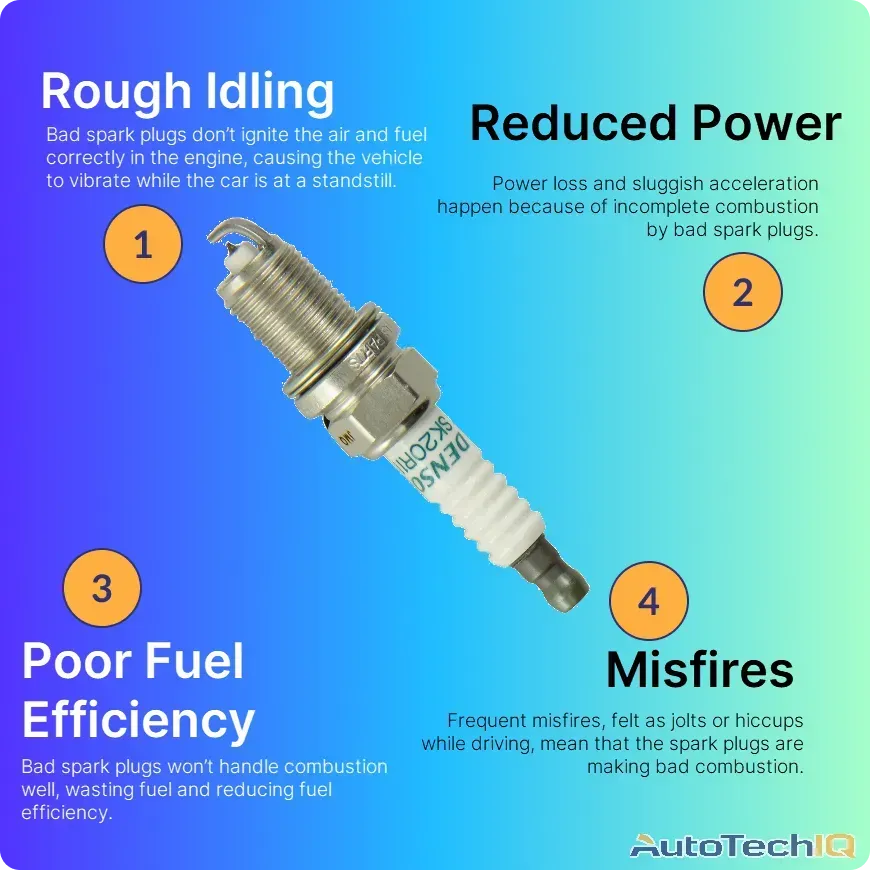
A misfire can feel like an uneven tremble at idle, a short interruption in acceleration or repeated jerking as the engine tries to pull. Sometimes the change is subtle. Those sensations can accompany a faulty spark plug, but you cannot identify the failed component by feel alone.
A useful distinction is between noticing an engine-running problem and proving its cause. DENSO describes misfire symptoms that include rough idle, hesitation and lost power. Its discussion also makes clear that more than one component can be involved. Calling every shake a spark-plug misfire starts the diagnosis too narrowly.
First consider whether the car remains safe to control and whether any warning requires stopping. Once safely parked, record what happened in ordinary language. A clear description of the timing and sensation often helps a workshop more than a confident guess about which part needs replacing.

Credit: www.reddit.com
Three ways an irregular combustion event may be felt
Normally, successive combustion events contribute to relatively smooth engine output. A missing or weak contribution can disturb that pattern. NGK explains the plug's ignition role, including how a fouled insulator can divert the discharge. That is one possible mechanism, not a diagnosis from a vibration.
These descriptions are possibilities, not three tests every driver must pass. Some faults occur only briefly, some persist, and a vehicle can compensate enough that the change is hard to notice. Compare the event with that same car's usual behavior rather than with a different engine's normal vibration.A brief interruption in the pull
A stumble can feel like the car briefly stops pulling and then resumes, even though you did not deliberately lift your foot. State whether it was a single interruption or a series. That distinction communicates more than saying the car ran badly, while still leaving open causes other than a spark plug.An uneven idle while the vehicle is stationary
At a stop, the engine may feel less even than usual, with irregular movement through the cabin. Report whether it happened in the conditions you normally encounter, such as waiting at a junction after the engine warmed. A small routine change when an accessory engages is not automatically a misfire; a new persistent change still deserves assessment.Repeated hesitation when more power is requested
During ordinary acceleration, the response may arrive in uneven pulses instead of a steady increase. You may notice it while joining a road or climbing a hill, but do not repeat those maneuvers to confirm the symptom. Note the original circumstances after stopping safely and arrange an inspection if the response is unreliable..jpeg)
Credit: www.davesautomotivepa.com
Describe the pattern rather than rating the shake
Two people may describe the same event as a stumble, judder or hesitation. Instead of trying to select the perfect term, explain whether it happened once or repeatedly and whether the engine had been running smoothly immediately beforehand. The surrounding conditions give those words meaning.
Where you feel it is a clue, not a cylinder locator
You may notice movement through the seat, steering wheel or body of the car. That location does not tell you which cylinder is affected. Vehicle structure, mounts and operating conditions influence how vibration reaches the cabin, so there is no reliable rule that a particular seat sensation identifies a particular plug.
Note whether passengers felt the same change and whether it was accompanied by an engine-speed fluctuation or warning. Do not dismiss a new repeated disturbance because it is mild; equally, do not assume a stronger shake proves more plugs have failed.
Separate a stumble from consistently weak acceleration
An intermittent break in power is different from an engine that pulls smoothly but has less performance throughout the journey. Both deserve attention, but that distinction helps define the complaint. Our guide to spark plugs and slow acceleration examines the broader loss-of-performance question.
There is no need to deliberately reproduce the event with hard acceleration, a steep hill or overtaking. If it already occurred, describe that occurrence. Testing a suspected fault in traffic can remove the safety margin needed when the vehicle unexpectedly fails to respond.
Use sound as supporting information
A change in engine rhythm may accompany the sensation, but not every misfire produces an obvious noise. Cabin insulation, background sound and the duration of the event can obscure it. Hearing nothing unusual does not exclude an engine-running fault.
Use recordings only when they can be made safely while parked or by a passenger without distracting the driver. A recording can preserve timing, but phone microphones alter sound and rarely establish where a fault originates. Do not lean into a running engine bay or stand close to an exhaust outlet to obtain better audio.An irregular rhythm is more useful than a sound imitation
Describe whether the usual engine note became uneven at the same time as the shake. A repeated pause, an isolated cough and a continuous rattle are different observations. Sound alone cannot distinguish a spark-plug problem from fuel delivery or mechanical trouble, and the absence of a dramatic popping noise is not reassuring evidence by itself.A bang does not identify a bad plug
A loud pop or bang can have several causes and should not be treated as the required soundtrack of a misfire. Do not rev the engine to reproduce it. Note whether it happened at starting, acceleration or another already-observed moment, along with any warning or loss of power. This gives the repairer context without creating another hazardous event.Conditions that can make the complaint intermittent
A car that runs normally at the workshop may still have had a real problem earlier. Intermittent symptoms make an accurate timeline valuable. Describe the conditions already observed, without turning the trip to the workshop into an attempt to provoke the fault again.
Cold start, warm running and restart are different observations
Distinguish roughness immediately after an overnight start from roughness after a warm restart. Record whether it faded, persisted or appeared only later. Do not deliberately leave the engine running with severe symptoms to find an exact duration; the purpose is to capture information already available safely.
Load can expose more than a plug problem
Delphi's coil guidance connects ignition demand with operating conditions and describes overlapping misfire symptoms from coils. Therefore, a stumble when accelerating does not distinguish a worn plug from a coil or connection problem. Testing must establish which part of the ignition system, if any, is responsible.
Combine the sensation with the warning display
The dashboard adds information about the event; it does not label the failed component. Record the symbol, its color and whether it was steady or flashing while the engine was running. An exact message is more useful than remembering that a light appeared.
A light seen during the normal pre-start display is a different observation from one that starts flashing during rough running. Check the owner's manual for that symbol and situation rather than applying an instruction for another car's dashboard.
A steady light is not a certificate of a minor fault
Treat severe shaking, stalling, overheating or difficulty controlling speed seriously regardless of lamp behavior. Mazda's dashboard guidance, for example, directs drivers to stop safely and seek assistance when the check-engine light flashes. Follow the instructions for your actual vehicle and arrange recovery when continuing is unsafe.
A code records a detected condition
A misfire-related code can guide the next tests, but it does not automatically order a spark-plug replacement. A cylinder reference narrows where the control system detected irregular operation, not necessarily which part caused it. See spark plugs and check-engine warnings for the separate code-and-lamp question.
Other faults can produce a similar shudder
The fact that something feels like a misfire does not establish that combustion was interrupted. A useful assessment considers whether the disturbance follows engine operation, road speed, a transmission event or braking. These are observations for a repairer to evaluate, not roadside tests to perform deliberately.
Tire and wheel vibration
Michelin's handling guidance identifies wheel imbalance as one possible source of speed-related vibration. A vibration noticed at a particular road speed therefore deserves a wider inspection. Do not speed up to see whether it disappears, particularly if steering or vehicle stability feels abnormal.
Report where the disturbance was felt and whether it accompanied a change in engine power. Neither a steering-wheel shake nor a seat vibration is specific enough to clear the tires, suspension, driveline or engine by itself.
Transmission shudder
American Honda's May 2019 automatic-transmission job aid describes using recorded speed data to assess suspected torque-converter shudder. It is a concrete example of why a shaking sensation can require transmission diagnosis rather than new plugs. The document is a Honda workshop aid, not a universal road-test recipe.
The significant point is the need to compare the complaint with appropriate measurements. The word shudder is not enough to select a transmission repair either. A workshop should establish that its proposed cause matches the event before recommending a component replacement.
A symptom associated with braking, cornering or a road impact also deserves that context in the repair description. Do not omit it because an online symptom list mentioned spark plugs; it could change the direction of the inspection substantially.
Build a useful account for the workshop
Keep the description short enough to use on a repair order. Include the first occurrence, whether the engine was cold or warm, what you were doing and any warning behavior. Add recent repair or refueling history without claiming it caused the fault.
State what changed after recent work
If the issue began immediately after plugs, coils or an intake component were serviced, say so and provide the invoice or part numbers. This makes disturbed connections and installation details worth checking. It does not prove the replacement part is defective or justify replacing every related component again.
Preserve diagnostic information
Snap-on distinguishes stored codes, pending codes and freeze-frame information in its OBD-II service-mode documentation. When available, these records can add context to an intermittent event. Save the complete scan report instead of remembering only a short code description.
Avoid clearing codes simply to see whether the light returns before assessment. Erasing diagnostic information can remove useful context without fixing the cause. A report should distinguish codes present at inspection from a symptom you observed earlier, especially if the car currently feels normal.
Credit: www.autotechiq.com
What a sound assessment should establish
The first question is whether the reported disturbance corresponds to a combustion misfire. The next is its cause. Those are separate findings. Inspection, relevant scan data and tests chosen for the engine should support the conclusion instead of a parts list generated from the word hesitation.
A plug can be the cause or show another problem
Wear, contamination or damage found on a plug can be relevant evidence. However, repeated contamination may reflect something happening elsewhere in the engine. Ask whether the diagnosis explains both the misfire and the plug's condition, particularly if new plugs previously helped only briefly.
A photograph may document an observation, but it does not measure every aspect of ignition performance. Likewise, a plug that looks ordinary does not prove that its coil, connector and associated circuit operated correctly when the symptom occurred.
Keep electrical testing appropriate to the system
Do not pull ignition leads or coils from a running engine to compare how much it shakes. Ignition systems involve high voltage, and improvised testing can create additional faults. A technician can select an appropriate test method without asking an owner to handle live ignition components.
A generic resistance number or a visible spark outside the engine is not a complete diagnosis for every ignition design and operating condition. Ask what the test establishes and what remains untested rather than accepting a single reading as proof that the entire system is healthy.
If the symptom cannot be reproduced, a clear next-step plan is more useful than guessed replacements. Agree how to report a recurrence and what warning or driving behavior requires stopping, using the vehicle's own instructions.
Judge the repair against the original complaint
After repair, compare the result with the conditions recorded before service through normal, safe operation. A smooth idle alone does not resolve a complaint that occurred only during acceleration, and a cleared warning does not by itself demonstrate that the cause was corrected.
Keep the repair findings and replaced-part details with the symptom record. If the problem returns, that history helps distinguish a recurring cause from a new event without restarting the investigation from a vague memory.
The most useful description is specific and cautious: what you felt, when it happened and what the vehicle displayed. Leave the component verdict to evidence.


Automotive reference information. Confirm specifications in the manual for your exact vehicle. Original replacement guides link to their research sources. About us