
New brake pads can squeak because the pad and surrounding brake components vibrate, because the new friction surfaces are interacting with the rotor, or because something in the installation or existing brake assembly needs attention. The word new does not identify the cause or prove that the brakes are safe. Report noise that begins after a brake job to the installer, especially if it persists. Do not assume that every squeak will disappear after a fixed number of kilometres.
Deal with braking problems before noise diagnosis. Stop safely and arrange assistance if the car no longer brakes normally, the pedal suddenly behaves differently, there is smoke, or a serious brake-system warning appears. Grinding or a persistent metal-contact sound needs prompt professional inspection. Ford distinguishes occasional brake noise from continuous grinding or squealing that requires checking. A recently paid invoice does not cancel a new symptom, and neither a sound recording nor an online description can establish that continued driving is safe.
For a noise without those urgent symptoms, prepare a useful history for the workshop. Note when the pads were changed, which axle was serviced, whether the rotors were replaced or reused, and whether the sound was present beforehand. Describe whether it happens on the first stop, after the brakes warm up, in reverse, or with light pedal pressure. State what you actually noticed instead of choosing a diagnosis. A technician can use a repeatable pattern more effectively than a description such as bad pads.
A useful complaint might be: the noise began after the front pad change, occurs during the first gentle stop after overnight parking, and was absent during the previous week. This is an example of a description, not a normal-noise test. If you do not know which wheel makes the sound, say so. Avoid recording on a handheld phone while driving; a passenger can note conditions if it is safe, or you can write them down after parking.
Credit: www.youtube.com
What a squeak can tell you about new brakes
Akebono describes brake squeal as vibration transmitted through the brake assembly. That explains why a fresh friction block does not guarantee a quiet vehicle: the pad works with the caliper, rotor and mounting parts. It also explains why loudness alone is an unreliable measure of pad wear. A driver can identify when the noise occurs, but the workshop must locate the vibrating parts and determine whether the condition is an expected characteristic or a fault requiring correction.
Weather is useful context. Ford identifies temperature, moisture and road contamination as possible influences on intermittent brake noise. If a brief noise appears after an overnight stop or a wash, record that pattern and whether it changes during ordinary use. This does not prove that moisture caused this particular squeak. Avoid repeatedly driving just to make the sound disappear, and do not let an environmental explanation override a change in stopping performance, persistent noise or a warning message.
The rotor matters even when only the pads were replaced. Raybestos bulletin BPI 13-10 discusses uneven friction-material transfer and rotor wear patterns, including the role of runout and related components. Ask whether the workshop inspected the retained rotors and whether their measurements met the applicable requirements. A shiny surface is not a measurement of thickness or runout. Likewise, saying a rotor is warped from a photograph skips the diagnostic work needed to identify the actual condition.
Noise that occurs while rolling without pressing the pedal deserves that exact description. Tell the technician whether it changes when steering, reversing or touching the pedal lightly during normal driving. Do not perform improvised road tests on a public road or reach near a rotating wheel to locate a sound. The observation helps define the complaint; it does not prove the pads, wheel bearing or dust shield are responsible. An inspection should follow the evidence rather than starting with a replacement part selected from the noise alone.
What the installer should verify
Pad identity and orientation. Match the fitted part to the vehicle's actual brake package, not just its model name. Some pads have an inside/outside position, an arrow or a directional feature. Ferodo explains that directional pads and certain backing-plate details need specific positioning. Ask the installer to check the supplied instructions and part number. Do not copy the orientation from an unrelated vehicle or assume that two pads with the same outline can be swapped. Keep the box or invoice if it identifies the exact product.
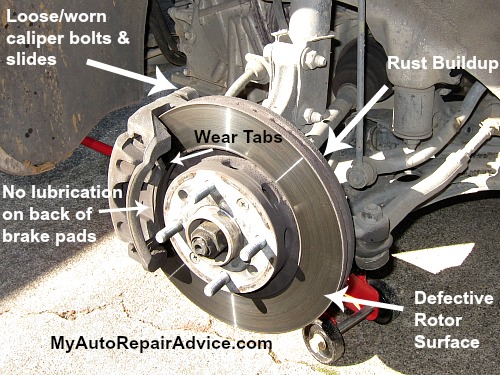
Movement and noise-control hardware. The Ferodo brake noise guide lists causes including sticking caliper movement, fitting errors, incorrect shims and disc problems. A useful inspection therefore covers the assembly, not merely the amount of lining left. Ask whether pads move as their design requires and whether the required shims, clips and retaining pieces are present and correctly fitted. The appropriate corrective action depends on the finding. Bending a clip until the noise changes is not a substitute for confirming its intended position and condition.
Lubrication at approved contact points. Ferodo explains that suitable brake grease belongs at specified contact areas, not on the friction surface. Do not spray general-purpose lubricant through the wheel to silence a squeak. The friction face and rotor must not be made slippery. Different designs specify different products and locations, so more grease is not automatically better. If a shop says lubrication was the problem, ask which component needed attention and whether it checked for sticking or contamination as well.
The complete service history. Confirm whether the work was a pad replacement, a pad-and-rotor job or a larger caliper repair. Those descriptions are not interchangeable. Ask for the measured results supporting any recommendation to reuse or replace a component. Our pad thickness guide explains why both inner and outer linings must be considered. A complete receipt also helps distinguish noise on the serviced axle from a wear warning or another fault at an axle that was not touched.
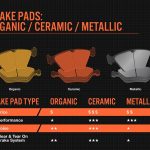
If the invoice says only ceramic pads, request the manufacturer and part number. A material category does not identify the exact formulation, the intended brake package or the required accessories. Equally, price alone cannot establish a fitting fault. Before buying a different compound, ask what evidence shows that the present product is incorrectly specified or responsible for the complaint. This keeps the decision tied to the vehicle rather than an unsupported ranking of pad materials.
The correct bedding instructions. Do not apply a universal sequence of aggressive stops from a video. Instructions vary with the friction product and vehicle: for example, Akebono describes its EURO pads as requiring no break-in, while other products have their own bedding procedures. Ask the installer what the exact fitted parts require and whether that work was completed. Any procedure must follow the product and vehicle instructions in suitable conditions. Emergency stopping needs always take priority over advice to avoid hard braking during routine use.
Avoid home fixes that hide the evidence. Do not sand the pad face, file its edges, remove a shim or disconnect a sensor because someone reports that it stopped a similar noise. These changes can obscure the initial fault and create a new one. The EPA brake-dust guidance also cautions against releasing dust by dry brushing or compressed-air cleaning. If you cannot safely identify the components and use the required procedures, leave disassembly to the workshop and bring a clear account of the symptoms instead.

Credit: www.wikihow.com
Agree on a repair and a follow-up check
Ask for findings in plain language: which wheel produced the noise, what was inspected, what was out of specification, and what correction is proposed. Where no fault was found, ask what observation supports treating the noise as a characteristic of that exact brake package. For example, Lexus bulletin L-SB-0008-12 Rev1 addresses a specific low-speed squeal on 2010–2013 LS 460 Sport Package vehicles and identifies an updated pad kit. That bulletin is an example of application-specific evidence, not a repair instruction for other cars or a promise of present warranty coverage.
If inspection finds contamination, the remedy must address its source. Ferodo recommends identifying and repairing the cause of pad contamination and replacing the pad set; simply waiting for the material to wear away is not its remedy. Other findings may call for correcting hardware, servicing movement or addressing the rotor. Ask why the proposed work matches the defect. Replacing another set of pads without explaining what was wrong can leave the same noise complaint unresolved, even when the replacement parts are new.
Before collecting the car, ask how normal braking operation was verified and whether the reported noise was checked under the conditions you described. Get the applicable care instructions in writing, along with the next step if the sound returns. Do not accept an unexplained instruction to tolerate noise indefinitely. If it recurs, record the elapsed distance, conditions and any accompanying changes; do not make repeated high-speed stops to reproduce it. Ceramic, semi-metallic or another material label alone cannot settle the diagnosis. What matters is correct application, installation, component condition and verified operation. For future replacement planning, use the inspection record and the condition-based maintenance approach rather than guessing pad life from the sound.


Automotive reference information. Confirm specifications in the manual for your exact vehicle. Original replacement guides link to their research sources. About us