Brake caliper covers cannot be declared safe as a category without checking the exact product, brake assembly, wheels and installation. A purpose-made kit with documented compatibility still needs secure retention and the manufacturer’s required clearances. An unidentified cover, improvised mounting or contact with a moving part is not acceptable merely because the car can roll. When compatibility or attachment remains uncertain, leave the accessory off until the uncertainty is resolved.
The cover is an appearance accessory, not the hydraulic caliper itself. It cannot repair a leak, improve a damaged mounting or substitute for correctly functioning pads and rotors. Nor does a larger-looking exterior prove stronger braking. This assessment makes no independent claim that covers improve cooling, stopping distance or brake life.
Those are performance questions that require relevant testing, not a visual impression. The useful safety question is therefore specific: can this cover be fitted to this vehicle’s actual brake and wheel combination, retained as designed, checked for interference and maintained without concealing an unresolved fault? This guide helps you evaluate that question before purchase or after discovering covers on a used car. For the separate installation workflow, see caliper-cover installation checks.
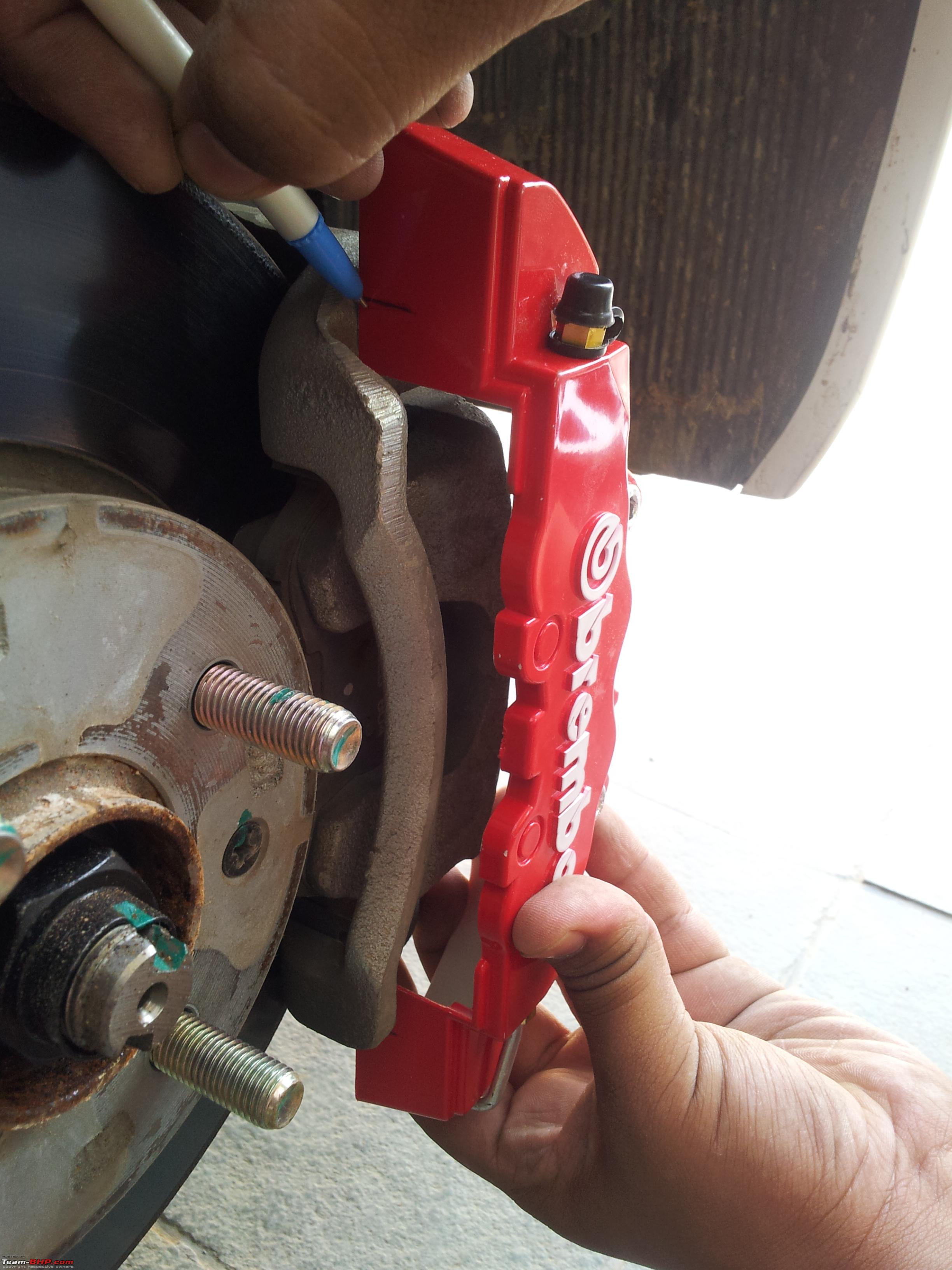
Credit: www.team-bhp.com
Evaluate the product, clearances and failure consequences
Begin with traceable product identification and a published application. Record the maker, part number and intended vehicle and brake option. A seller’s broad claim that a cover fits most cars is not equivalent to a manufacturer’s application listing. The brakes actually installed may differ from the original factory equipment. Check that difference instead of assuming a model-year search has settled the matter. The wheel is part of the fitment decision.
Two wheels with the same nominal diameter can have different inner shapes and spoke clearances. MGP’s fitment guidance distinguishes wheel requirements and clearance checks at different locations. That guidance applies to its products and applications; it is not a universal measurement that approves every brand. Use the exact kit information and obtain clarification for aftermarket or unusual wheel arrangements. Separate cover-to-wheel clearance from attachment-to-rotor clearance. The first concerns the accessory near the wheel’s inner surfaces; the second concerns retaining hardware near a rotating brake component.
Passing one check does not establish the other. Neither can be judged reliably from a photo taken through a spoke opening. The required inspection must reach the relevant locations and use the manufacturer’s method. Retention matters even when the cover is not rubbing. A loose component near the wheel and brake can shift into a different position. The correct clips, fasteners and attachment points must be present, undamaged and installed as designed.
Adhesive, cable ties or a substitute piece of wire should not be treated as acceptable repairs for missing engineered hardware. Ask the product maker for the specified replacement or remove the unsupported accessory through the proper procedure. Do not modify the caliper or bracket to accommodate a cosmetic cover without explicit application-specific authorization. Grinding a structural feature or disturbing a hydraulic connection is not ordinary cosmetic fitting. Brembo’s component instructions warn that modification or unintended use can affect safety. That warning does not evaluate every cover product, but it explains why the underlying brake must not be altered casually to make an accessory fit.
Likewise, a wheel spacer is not automatically justified because it creates room for a cover. It changes a separate wheel-fitment arrangement that needs its own compatibility and fastening assessment. Do not combine an uncertain accessory with another unverified modification. If the required clearance cannot be achieved within an approved setup, an uncovered brake is a valid and simpler outcome. Consider the consequence of hiding part of the assembly. A cover should not become a reason to skip inspection of boots, fittings or mounting hardware.
Future service may require its removal to obtain the necessary view. If the seller cannot explain removal and reinstallation, the maintenance implications remain unresolved. Appearance should not reduce access to information needed to assess the brake. Existing brake faults come first. A wet caliper, dragging wheel, cracked component or damaged hose needs diagnosis before an accessory is placed over it. A cover does not contain a hydraulic leak safely or make exterior corrosion irrelevant.
- On a used car, ask whether the covers were fitted for appearance and request any preceding brake repair records. A new-looking cover says nothing conclusive about the condition behind it. Be cautious with marketing language about heat. A maker’s statement about its own product is a claim within the conditions it tested, if those conditions are provided. It does not establish the thermal behavior of an unknown cover on a modified brake package.
- Do not infer overheating simply because a cover exists, but do not promise improved cooling without suitable evidence either. For a demanding use such as repeated track braking, obtain product-specific suitability information rather than assuming a road-accessory listing covers that use. Product warranty is another distinct issue. MGP publishes warranty and fitment conditions for its covers. Read the actual terms, purchase-channel requirements and exclusions rather than treating the word warranty as proof that every installation is safe or every resulting cost is covered.
A replacement accessory warranty is not the same as approval from the vehicle manufacturer or independent certification of braking performance. Ask the supplier to resolve uncertainties before paying. Provide the brake package, wheel make and model, any modifications and the specific part number under consideration. Request the current instructions and return conditions if fitment cannot be confirmed. A clear written answer is more useful than a generic photograph or a promise that slight bending always solves contact.
Do not rely on someone else’s successful installation unless their relevant hardware genuinely matches yours. There is no need to accept a cosmetic risk to complete the look of a vehicle. The decision may be to fit a documented compatible product through its required process, postpone the purchase for better information or leave the calipers uncovered. All three are legitimate outcomes. A cover should earn its place through verified fitment and secure attachment, rather than becoming something the brake system must be altered to accommodate.
Check installation quality and preserve future inspection
MGP’s installation page directs buyers to application-specific instructions and separate front and rear arrangements. This illustrates why a general video cannot certify an unfamiliar kit. If you are inspecting covers already installed, obtain the matching document and compare the hardware and location with it. A cover that appears centred from outside can still have the wrong retaining parts behind it. Have the vehicle supported safely for any inspection requiring wheel removal. Do not reach behind a hot wheel or crawl beneath a car resting only on its jack.
A qualified installer can check the required gaps and attachment without turning the inspection into an improvised brake repair. If you lack the equipment or cannot identify the kit, arrange that assessment rather than experimenting around moving components. The finished installation should have documented clearance at every required location, secure specified hardware and no trapped hose, cable, boot or sensor lead. The wheel must be refitted and tightened under the vehicle’s separate instructions. No accessory torque should be transferred to wheel or caliper fasteners.
If a printed dimension or unit is ambiguous, ask the manufacturer; a guess about inches versus millimetres is not a minor detail. Do not use a road test to grind away a rubbing point or wait for an accessory to settle. Scraping, new noise, visible movement or contact requires stopping safely and inspecting the installation. A change in braking deserves brake-system assessment, whether or not the cover is ultimately responsible. Continuing to drive until the noise disappears can destroy the evidence and worsen a mechanical problem.
After any correction, verify the same failed check again and examine whether contact damaged adjacent parts. Merely repositioning the visible cover does not establish that a retaining clip or wheel surface is unaffected. If the kit cannot satisfy its requirements, remove it by the appropriate procedure and restore any disturbed parts. The safety objective is a serviceable vehicle, not preserving the accessory at all costs. Retain the instructions and tell future technicians that covers are installed.
Removal may be necessary for normal brake inspection or repair, and subsequent fitting must follow the cover instructions again. Do not assume that the last successful check remains valid after changing pads, calipers, brackets or wheels. Even a seasonal wheel swap can change the relevant clearance combination. Follow the product maker’s inspection and care instructions without inventing a universal retightening interval. Check any reported looseness or damage promptly.
Keep the accessory’s identifying information with the vehicle record so replacement hardware and support advice can be matched to the correct version. An unmarked secondhand kit with missing instructions creates uncertainty that a fresh coat of paint cannot solve. If buying a car fitted with covers, request an ordinary brake inspection that can see the underlying components. Ask whether the technician removed the covers where needed and whether retention and clearance were checked after reassembly. Do not confuse a vehicle inspection limited to visible pad thickness with a complete cover-fitment assessment.
Know what the inspection actually included before relying on its conclusion. The evidence needed for a reasonable decision is concrete: a known compatible kit, the correct hardware, a sound underlying brake, measured or verified specified clearances and an installation that remains serviceable. This does not guarantee every future condition or establish a performance benefit. It provides a basis for evaluating the actual accessory instead of answering with an unsupported blanket yes or no. If any essential element is missing, leave the covers off until it is resolved.


Automotive reference information. Confirm specifications in the manual for your exact vehicle. Original replacement guides link to their research sources. About us