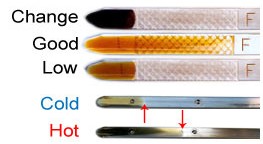

Check engine oil at the temperature and after the waiting period specified in your vehicle's owner's manual. Some procedures permit a check before starting; others call for warming the engine, switching it off and waiting. Electronic systems can have additional conditions. There is no universal answer of always hot or always cold. A valid reading depends on the complete procedure, including level parking, engine state and measurement method, not temperature alone.
If a low-oil-pressure or stop-engine warning is active, follow its emergency instructions first. Do not run the engine to warm it for a routine check, and do not drive to refresh an electronic display without the applicable warning guidance. Our oil-warning response guide addresses that situation. The comparisons below concern routine measurement in a vehicle that can safely undergo the manufacturer's procedure. They are not instructions to continue operating an engine with a suspected lubrication failure.
The useful question is not which temperature wins an argument online. It is which set of conditions makes your engine's measurement meaningful. Find the manual for the exact model, year, engine and market, then locate the oil-level checking section. Read neighboring notes about the dipstick or display and the separate instructions for adding oil. A routine that works for another engine in the same model range may still be wrong for yours.

Credit: www.youtube.com
Manufacturer examples show why the whole sequence matters
Ford E-Series: before starting or a specified wait after warm-up. The 2025 E-Series manual allows checking before starting, or after warming and shutting down with a fifteen-minute wait. It warns that checking too soon may produce an inaccurate reading. This is a documented choice for that application, not a universal fifteen-minute rule.
If your manual offers two methods, choose one that fits the circumstances and repeat it consistently when comparing readings over time. Do not quietly combine the cold option from one manual with the waiting period from another. Keep the actual reference available so another driver or a workshop can reproduce what you did. An entry such as checked normally is less informative than an entry that records the method used.
Mazda MX-5: warm, stop and allow oil to return. The 2023 Mazda MX-5 oil-inspection instructions specify a level surface, normal operating temperature, shutdown and at least five minutes before the dipstick check. This establishes a warm-then-stopped procedure for that example. It does not mean reaching into a running engine or rushing because the oil is hot.
Separate the engine temperature requested for measurement from the temperature of components you might touch. A waiting requirement is not a declaration that every surface is cool enough to handle. Read the owner's under-hood precautions and stop if you cannot perform the check safely. The goal is to meet the checking conditions without creating an access or burn risk in the process.
Toyota Corolla: the engine is warm but switched off. The 2020 Corolla US manual specifies checking at operating temperature with the engine stopped and waiting more than five minutes for oil to return before reading the dipstick. The distinction between warm and running is essential. The fact that a manual says warm does not mean the dipstick should be pulled while the engine operates.
When extracting a procedure for later use, write down its verbs in order: park, prepare the temperature if required, switch off, wait, then measure. Preserve terms such as more than or at least instead of shortening every instruction to five minutes. The conditions are part of the method, not optional background that can be discarded after finding a familiar number.
Honda CR-V: a different stated wait. The 2025 CR-V oil-check page specifies approximately three minutes after shutdown on level ground. Its stated interval differs from the Ford and Mazda examples. This illustrates why waiting instructions should remain attached to the exact vehicle rather than becoming a universal brand-independent habit.
Hyundai Palisade: read the detailed preparation. The 2026 Palisade LX3 US procedure calls for warming until the coolant temperature reaches its normal steady condition, stopping and waiting fifteen minutes as part of a specific checking sequence. It also describes handling the filler cap and dipstick before that wait. Read the full application procedure; this comparison is not a reason to copy those additional steps into another car's instructions.
Volvo V60: identify which measuring system the engine has. The 2016 V60 guidance for specified engine variants distinguishes dipstick-equipped and electronic-sensor variants. It favors a cold pre-start reading for the dipstick application, while electronic variants have their own conditions and may show an unavailable reading when those are not met. Therefore, identifying only the model name may not be sufficient.
Do not assume a digital level display is an instant replacement for looking at a stick. Read the permitted measurement conditions and update behavior for the exact system. If it does not provide a current result, record that limitation instead of substituting a guessed quantity. A stale reading or an unavailable message should not prompt repeated additions without knowing what the manufacturer directs.
Make a short measurement card for your car. Record five things from the applicable instructions: the permitted parking surface, the required engine state, the temperature or preparation condition, the shutdown wait, and the actual reading method. Add a sixth item for electronic systems: when a displayed result is considered current. Keep the relevant manual page or link with the card.
This is an organizational aid, not a replacement procedure. Do not shorten it so much that an exception disappears. If the instructions require a fully seated dipstick, a particular menu or a condition before adding oil, retain it. A person helping with the car should be able to distinguish a routine check from a service refill and from the response to an urgent dashboard warning. For a household with several cars, label each record with the vehicle and engine identifier. A shared garage note saying wait five minutes can easily migrate to the wrong car. Keep the original manual reference so a shortened personal checklist can be checked against the complete instruction.
Why a quick reading after parking can be misleading. In a routine warm-engine procedure, the specified wait allows the reading to be taken under the intended conditions. Seeing a low-looking mark before that wait has elapsed is not enough to decide how much oil is missing. First repeat the approved method, if it is safe to do so. Do not compensate for an uncertain measurement by guessing a volume.
Also do not treat an overnight reading and an immediate post-drive reading as directly comparable simply because both used the same dipstick. Record which procedure was followed. If the two readings differ, the first question is whether the method changed. If a difference remains under consistent, correct conditions, have it investigated instead of choosing whichever result best fits an expectation.
Credit: www.paulsautorepair.com
Resolve inconsistent readings without changing the oil quantity
Use a controlled recheck. Suppose one reading was taken on a sloping driveway immediately after arriving and another on a flat surface after the manual's wait. Those are different measurement conditions. Before concluding that the engine consumed or gained oil, repeat the documented method at a safe, suitable location. This is a hypothetical comparison, not an experiment performed on a vehicle for this article.
Change only what is needed to follow the instructions. Do not add oil between every attempt, rotate through several unrelated methods and then compare the results as if the quantity had stayed fixed. If the dipstick cannot be read consistently even after correct preparation, seek help with that problem. Our guide to confirming a low level covers the marks and appropriate follow-up without assuming every wet streak is the measurement.
Keep level checking distinct from draining and refilling. Advice about the best temperature for an oil change addresses a different operation. Do not turn it into a measurement rule, and do not remove a drain plug merely to investigate a confusing dipstick result. A full service also has its own quantity, filter and final-check instructions. The published service capacity is not the amount to add when only topping up.
If a shop's reading differs from yours, ask which conditions it used and which vehicle instruction applies. Bring the date, mileage, parking conditions, wait and any added quantity. This lets both readings be assessed on the same basis. Asking for the method is more productive than insisting that every warm reading is wrong or that a cold check is always superior.
Use the result only for the decision it supports. A properly performed level check indicates where the oil stands within the specified measuring system's range. It does not directly measure remaining service life, establish oil pressure or diagnose the source of a leak. Avoid using color or a dashboard maintenance percentage to fill in those gaps. Different observations answer different questions.
Once the checking method is clear, use the prescribed range and top-up instructions for your engine, and select the correct lubricant if an addition is needed. Keep the service schedule separate; annual oil-change timing depends on applicable maintenance requirements rather than whether today's level was checked cold. The practical answer remains specific: follow the exact warm, cold or electronic method documented for the vehicle, reproduce its conditions and investigate uncertainty before adding oil. No universal oil temperature, wait time or reading correction factor is invented here.


Automotive reference information. Confirm specifications in the manual for your exact vehicle. Original replacement guides link to their research sources. About us