
The reliable way to tell whether your car's engine oil is low is to perform the oil-level check specified in its owner's manual and compare the result with the permitted range. Depending on the vehicle, that means a dipstick or an electronic measurement. Noise, oil color and the date of the last service cannot establish the quantity. If an oil-pressure or stop-engine warning is active, stop safely and follow that warning's instructions first; this routine checking guide does not authorize further driving.
Start by identifying the exact model, year and engine. Find the engine-oil checking section and the engine-compartment diagram, then read the whole procedure. Confirm the required parking surface, engine state and waiting time. A correct procedure for a transmission dipstick is not automatically correct for engine oil. If temperature is the point causing confusion, our hot-versus-cold oil-checking guide compares documented manufacturer examples and shows why a single wait time cannot be applied to every car.
It helps to separate three records. The oil-level reading describes quantity relative to the vehicle's marks. An oil-life percentage or service date concerns maintenance. An oil-pressure warning concerns a different operating condition requiring its own response. One cannot be substituted for another. A recent service does not make a new level check unnecessary if the manual calls for it or a warning appears, and a full-looking dipstick does not clear a pressure warning. Our oil-warning guide handles that immediate decision.
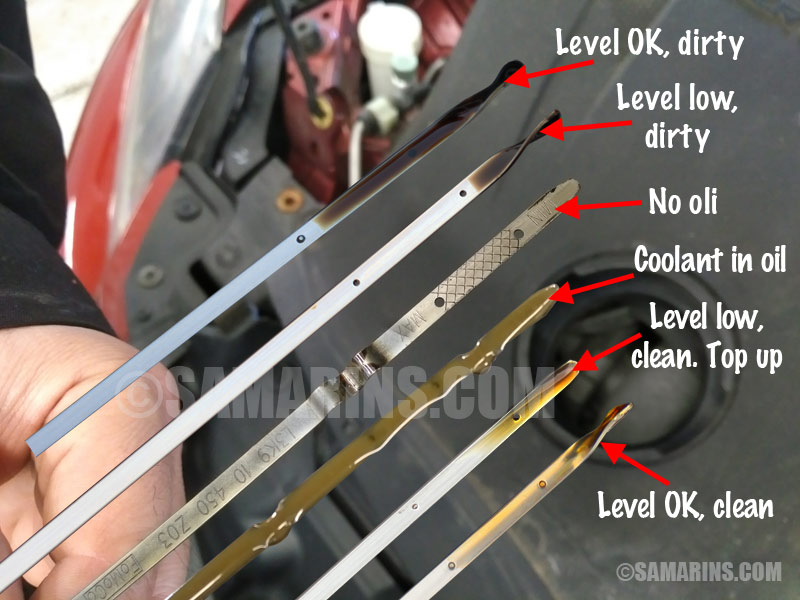
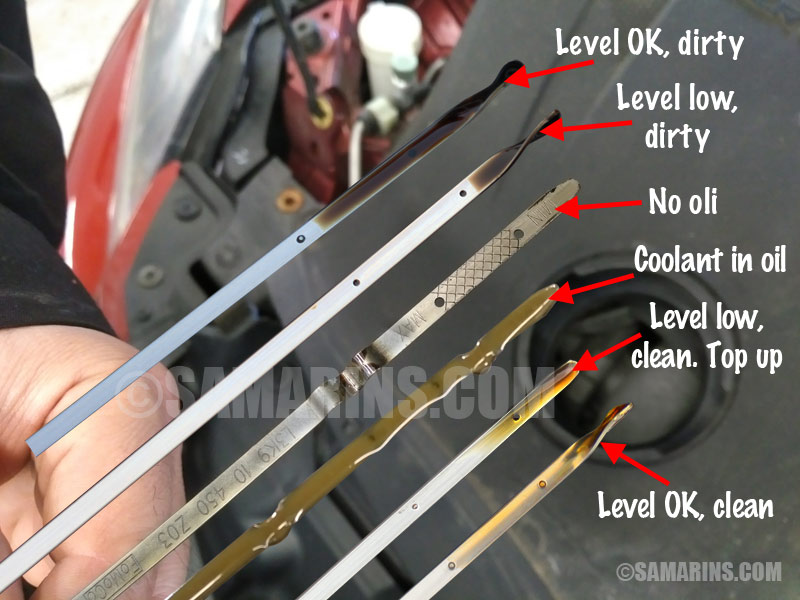
Credit: www.samarins.com
Confirm the reading before deciding how much to add
Use the actual engine diagram. Locate the correct dipstick rather than relying on a remembered handle color. For instance, the 2025 Honda CR-V oil-check instructions identify an orange dipstick, level parking, an approximately three-minute wait after shutdown, and a wipe-and-reinsert check. Those details belong to that CR-V procedure. Another car may have a different handle, waiting requirement or electronic system.
Before starting the check, make sure you can reach the component safely and understand the under-hood precautions. Do not move hoses, electrical connectors or covers simply because a generic picture puts the dipstick underneath them. If the handle or tube appears damaged, or the stick cannot be seated normally, report that problem instead of treating an uncertain reading as accurate.
Read the marked range, not just whether the stick is wet. Find the lower and upper reference points shown in the manual. They may be lines, holes or a marked region, so identify the relevant part of the actual stick. Follow the manufacturer's cleaning and reinsertion sequence and compare the resulting oil level with that range. A streak farther up the metal is not automatically the measured level.
The 2023 Mazda MX-5 instructions describe the acceptable region between MIN and MAX, direct an addition when near or below MIN, and warn against overfilling. This is an example of reading the manufacturer's action threshold, rather than inventing a rule that every reading below the top requires a full bottle. The correct target and procedure must still come from your own vehicle documentation.
Do not invent a universal volume between the marks. A line or a percentage of the dipstick's range does not tell you the engine's full capacity. If the manual specifies a volume associated with the range, use that exact application information. Otherwise, do not assume the difference is always a quart or a liter. Those units are also different, so keep the bottle markings and instructions consistent.
The full oil-and-filter service capacity is a drain-and-refill figure, not the amount needed to top up an engine that already contains oil. Write down what the level actually showed before adding anything. That small pause prevents a common reasoning error: converting a vague observation of low into a large, unverified amount. If the correct reading or amount remains uncertain, ask a workshop to establish it.
A reading within range may need no addition. The 2025 Ford E-Series oil-check section expressly says not to add when the reading is between its minimum and maximum marks. Other manuals provide their own wording and thresholds. Follow the rule for your engine rather than making maximum the objective at every inspection.
For an unclear dipstick, repeat the manufacturer's sequence without changing several conditions at once. Confirm that the vehicle is level and the stick is fully seated. If successive readings still cannot be interpreted, describe the difficulty to a technician. Do not repeatedly add small amounts to make the line easier to see; that changes the quantity while leaving the original measurement problem unresolved. A photograph of the marks can help explain the uncertainty, but does not replace correct checking conditions.
Electronic systems need their own measurement conditions. In Volvo's 2016 V60 guidance for specified engine variants, different engine variants use different checking systems, and an unavailable electronic reading can reflect unmet conditions. This does not supply a checking procedure for every Volvo. Find the exact system in your manual and read its instructions for valid readings and top-up messages.
Do not translate an unavailable screen into empty or full. Also do not interpret an unchanged display immediately after adding oil as proof that more is required. Record the message, the amount already added and whether the system's stated update conditions were met. If a pressure warning is present, its stop instructions take priority over completing a routine measurement cycle. Driving solely to refresh a display is not an acceptable assumption in that situation.
If low oil is confirmed, use the specified product. Compare the required viscosity and approvals with the bottle before opening it. Our engine-oil selection guide explains that comparison. Follow the manual's filling point, quantity, waiting and recheck instructions, and retain the container so you can identify the product later. A familiar brand name does not establish that every oil it sells fits this engine.
Do not overfill to create a reserve for the next journey. Do not pour into a coolant or other fluid reservoir because its cap is easier to reach. Stop if you cannot confidently identify the filler or if hot components make access unsafe. After the directed addition, securely refit the cap and dipstick where applicable, clear away tools and cloths, and note what was added.
A high reading or a warning that persists needs a different response. Stop adding oil if the valid reading is above the permitted range. Ask for the appropriate correction and diagnosis; do not assume that running the engine will use up the excess safely. A high level that reappears without intentional additions should be described as a change requiring investigation, not automatically dismissed as generous servicing.
Similarly, the absence of an obvious leak does not explain repeated low readings. Do not declare that the engine is burning oil, that a gasket has failed or that a sensor is defective from one observation. A workshop needs the history, a reliable measurement and vehicle-specific inspection. If there is a stop-engine instruction, an urgent warning or a new abnormal noise, follow the applicable warning response rather than continuing this routine checklist.

Credit: www.hondaofbaycounty.com
Build a useful record if the level keeps falling
Record quantities and distance together. A note saying the car needs oil often is less useful than dated entries showing the odometer, a comparable level check and the amount added. Keep readings in the same units. Include the exact lubricant, recent service work and any visible leak or warning. This helps a workshop distinguish a one-time uncertain reading from a consistent pattern.
For a hypothetical record, write: September 22, 62,400 miles, checked using the manual's method, level near the lower mark, specified top-up completed, and final recheck recorded. Add the actual amount instead of leaving it as one bottle, because containers vary in size. At the next check, repeat the same method. Do not use this example as a target amount or frequency; its purpose is to make the information reproducible.
A top-up schedule and an oil-change schedule are different. The 2026 Hyundai Palisade LX3 US oil instructions explicitly distinguish maintenance intended to address oil deterioration from checking and replenishing quantity. Keep the last complete service date separate from subsequent additions. A series of top-ups is not evidence that the filter has been replaced or the prescribed service completed.
Ford's UK maintenance guidance also flags frequent top-ups as a possible sign of an engine problem and advises checks between services. Use your own vehicle's checking frequency and seek application-specific advice about an observed pattern. Do not decide that a universal consumption number proves every engine is healthy or faulty. Exact operating history, measurement consistency and the manufacturer's criteria are needed before making that judgment.
Make the next check a comparison rather than a guess. Save the relevant manual page, the product specification and the location of the last verified service record. Keep a clean checking cloth where appropriate and a dated record accessible to anyone who drives the car. If another driver adds oil, ask them to record the product and amount rather than assuming the quantity stayed unchanged.
The essential evidence is a valid measurement against the engine's prescribed range. Sounds, smells and dashboard percentages can be information to report, but they cannot replace that measurement. Once the amount is confirmed, use the manufacturer's action threshold and topping-up procedure. If the reading, warning or consumption pattern remains uncertain, get that specific uncertainty resolved. This is a research-based guide to checking and recording oil level, not a diagnosis of a particular vehicle or a guarantee that it is safe to operate.


Automotive reference information. Confirm specifications in the manual for your exact vehicle. Original replacement guides link to their research sources. About us