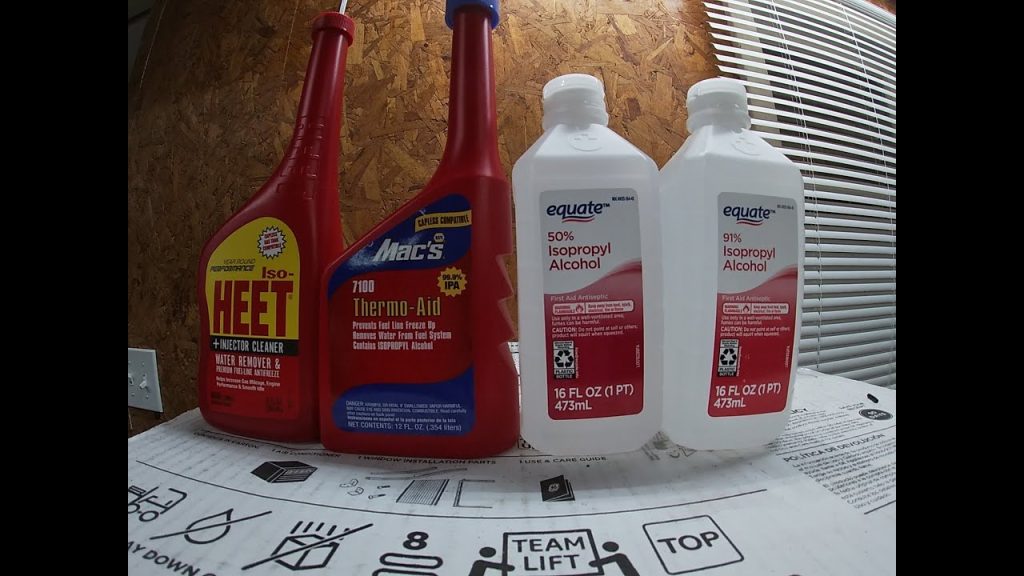

Do not use household rubbing alcohol as a substitute for a specified fuel injector cleaner. Its ability to act as a solvent does not establish compatibility with the vehicle, a correct concentration or a controlled cleaning result. A bottle intended for external antiseptic use supplies none of the vehicle-specific instructions needed for injector service. For example, the DailyMed label for a 70% isopropyl rubbing-alcohol product identifies water among its ingredients and describes an external-use product.
That formulation is not a universal fuel-system treatment. Higher labeled alcohol concentration would not by itself solve the missing compatibility and procedure questions. Identify the actual fault and follow the vehicle’s approved service guidance instead.
Dissolving a material is not the same as repairing an injector
A cleaning claim needs to identify which deposit is present and whether the procedure removes it without harming the component. Watching a substance disappear from a sample does not show how an installed injector will perform afterward. Electrical operation, metered delivery and sealing still need their own evidence.
An injector may have a circuit fault or mechanical damage rather than a removable deposit. A solvent cannot establish which condition exists.
If the engine has symptoms, ask for a diagnosis before selecting a chemical. The appropriate repair follows the finding, not the apparent strength of a cleaner.
A smoother idle after an experiment does not prove the cause
Refueling, engine temperature and other simultaneous changes can affect how a vehicle behaves. If someone reports an improvement after adding alcohol, that observation does not isolate injector cleaning as the mechanism. It also does not prove the mixture was suitable for every component. A lack of immediate symptoms is not a durability test.
Use a documented baseline and a vehicle-appropriate diagnostic procedure when investigating rough running. Our rough-idle article explains when deposit treatment is a plausible direction and when other causes need attention. Do not repeat an uncontrolled experiment solely because an online account sounds convincing.
Low purchase price leaves important questions unanswered
A cheap household bottle is not an equivalent substitute merely because both products contain a solvent. The concentration can differ.
Water content can differ. Other ingredients can differ.
The intended use can differ. The vehicle’s fuel system has its own requirements.
- Its seals and other materials matter. Its pressure and operating conditions matter.
- Its control strategy matters. The actual defect matters.
- A suitable repair method addresses those factors. A home mixture does not become suitable through a price comparison.
- Ask what procedure the vehicle or injector manufacturer permits.
- Obtain the specified product if a treatment is supported.
- If no treatment is prescribed, do not invent one to avoid the cost of diagnosis.
- The cost of a bottle also says nothing about the cost of correcting a wrong-fluid event.
- Keep optional maintenance decisions separate from attempts to rescue an already malfunctioning system.
Neither is improved by hiding an unknown chemical mixture from the technician.
The word alcohol covers different substances and uses
Ethanol in a specified fuel blend, isopropyl alcohol in a formulated automotive product and household rubbing alcohol are not interchangeable instructions. The complete formulation and application matter.
A shared chemical category does not establish the same concentration or compatibility. Do not reduce a fuel specification to one familiar ingredient.
Likewise, E85 approval is a vehicle-level fuel requirement, not permission to add arbitrary alcohol to any tank.
Our E85 guide explains the flex-fuel distinction.
Use the actual fuel specification for the car rather than inferring approval from another engine’s allowed blend.
Water content deserves attention, but not a home separation test
A household product can include water as part of its intended formulation. That does not mean it is designed to manage water in a vehicle’s fuel system.
Do not pour it into a tank to test whether water disappears. The correct response to suspected contamination depends on the fuel and system.
GM’s diesel-additive bulletin for specified applications distinguishes water-handling approaches and warns against unsuitable formulations. Its lesson here is application-specific selection.
It is not a recipe for blending household products.
Have water-related warnings or contamination findings assessed using the vehicle’s service procedure.
Compatibility cannot be inferred from a bottle percentage
A “70%” or “99%” label describes only part of the product identification. It does not certify injector seals, fuel-pump components or the rest of the system for that use.
It does not define a safe vehicle dose. It does not supply a cleaning exposure time.
Changing the percentage therefore does not turn the bottle into an approved injector service.
Read the intended use and the applicable vehicle instructions together.
| If a seller claims equivalence to a specified treatment, ask for evidence tied to the exact application. |
Do not treat broad marketing language as a substitute for that evidence.
If alcohol has already been added, preserve the facts
Keep the original container. Record the approximate amount added and the amount and type of fuel present. State whether the engine has been started or driven.
| Contact a qualified repairer or the vehicle manufacturer for advice specific to that situation. Do not add another chemical in an attempt to neutralize the first. Do not assume a universal top-up ratio will resolve every case. |
The amount, formulation and vehicle are necessary context. If the engine has not been started, avoid starting it merely to see what happens while obtaining advice.

Credit: www.99boulders.com
Do not remove an injector simply to try a solvent
Injector removal can require controlled pressure release, specific tools and new installation components. It may also introduce contamination if performed incorrectly.
A household-cleaning idea does not supply those requirements. Do not open a high-pressure connection to inspect or rinse the injector.
Delphi’s common-rail service guidance emphasizes correct servicing and diagnostic assessment. The practical owner decision is to use a provider equipped for the actual injector type.
Ask what test will identify the problem before removal and what will verify the component afterward. Removal is not automatically the first diagnostic step.
Avoid improvised spray and battery setups
Do not combine household solvent, an exposed injector and loose battery leads to make a spray demonstration. Fuel-system residues and ignition sources are a hazardous combination.
An uncontrolled pulse also may not match the injector’s electrical requirements. A visible spray would not establish calibrated flow or sealing.
Use the manufacturer’s approved equipment and procedure through a suitably equipped workshop. Our battery-test limitations guide explains why a click is a narrow observation.
It cannot certify a complete injector or justify an improvised cleaning rig.
External appearance is different from internal performance
- A dirty exterior does not prove the injector’s metering passages are restricted. A clean exterior does not prove the internal components are sound.
- Keep cosmetic cleaning separate from a functional diagnosis. Ask which measured behavior is outside specification.
- Likewise, a photograph of a deposit needs context. Where was it found?
- How was the component tested? Does the relevant procedure call for cleaning or replacement?
These questions are more useful than assuming every visible mark should be dissolved with the strongest available household solvent.
Maintenance should follow the vehicle’s actual schedule
Use the prescribed fuel and complete scheduled service items. Do not create a routine alcohol treatment because a mileage milestone has arrived. An injector-cleaning interval needs an applicable basis.
A vehicle running normally does not automatically need a chemical intervention. If a workshop proposes cleaning, ask whether it is optional prevention or a response to a documented fault. Identify the exact procedure and product.
Ask what the manufacturer says for the engine. This makes the decision specific enough to review rather than relying on a generic claim that all injectors benefit from any solvent.
A stronger or purer bottle is still not a service instruction
Do not try to solve the compatibility problem by shopping for higher-purity alcohol. Purity alone does not define the treatment’s intended use, dose or effect on the full system. A suitable laboratory or workshop use of a chemical does not make it an appropriate owner procedure.
Context and controls are part of the method. Nor should a safety data sheet be read as proof of vehicle approval. It explains handling and hazards for a product, not necessarily a validated injector-cleaning application.
Look for the actual manufacturer instruction supporting the intended service. If it is absent, do not invent the missing procedure.
Choose a supported diagnosis and repair route
Describe the symptom and preserve any scan information. Tell the workshop about every additive or solvent already used.
Ask how it will distinguish an electrical problem from a delivery or sealing problem. Request the relevant findings before authorizing parts.
If a permitted cleaning procedure is proposed, ask for its purpose and verification. If replacement is proposed, ask what failed the applicable check.
If the diagnosis is uncertain, agree on the next investigation rather than buying another product.
Keep the repair record with the invoice.
Rubbing alcohol’s household usefulness does not make it a universal injector cleaner.
The missing ingredients are not simply more concentration or a longer soak; they are application approval, a defined procedure and evidence of the actual fault.
Use those requirements to choose the next step, and avoid adding an unknown mixture to an already uncertain diagnosis.


Automotive reference information. Confirm specifications in the manual for your exact vehicle. Original replacement guides link to their research sources. About us