
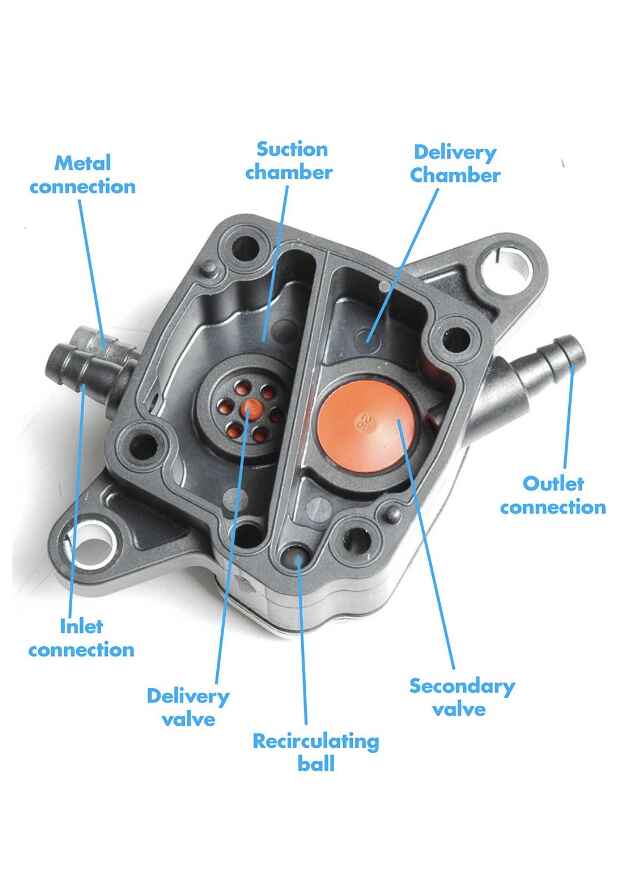
A pulse fuel pump uses changing air pressure from an engine to move a flexible diaphragm. Check valves make the resulting fuel movement flow in one direction, from the tank toward the carburetor. The pump normally has a fuel inlet, a fuel outlet and a pulse connection. That last connection supplies the operating signal; it is not an extra fuel outlet. Many small-engine installations use this arrangement because the tank cannot supply the carburetor reliably by gravity alone. Calling it a pulse pump does not mean a vehicle computer sends electricity to a fuel-pump relay.
The distinction matters when diagnosing an engine that stops after a few minutes. Looking for a fuse will not fix a disconnected pulse hose on a purely pneumatic pump. Conversely, a modern electric vehicle pump with speed control does not become a diaphragm pump because its voltage is pulsed. Identify the engine and pump before applying any explanation. This article covers the air-pulse diaphragm type, not common-rail injection pumps, direct-injection high-pressure pumps or electronically controlled in-tank modules.
A useful first sketch has three labels: fuel entering, fuel leaving and pressure signal. Keep the signal path separate from the fuel path on that sketch. If a replacement has different port positions, those functions still determine its connections. The orientation of a photograph, the color of a hose or a nipple's apparent size cannot reliably identify its purpose. The engine maker's drawing and the pump's markings take priority.
Credit: forums.kartpulse.com
Follow one pumping cycle and identify what can interrupt it
Briggs & Stratton: pulse fuel pump operation and service describes pumps operated by varying vacuum associated with the crankcase or intake, depending on the engine. Think of the diaphragm as a movable wall separating the driving side from the fuel chamber. Its movement changes the chamber's volume. One part of the cycle permits fuel to enter; the other delivers fuel through the outlet. The check valves prevent that fuel simply moving backward and forward along the same hose. This explanation describes the operating principle, not a specification for every internal spring or valve arrangement. The engine supplies repeated pressure changes while it turns. That is why an otherwise sound pump may not deliver fuel while the engine is stationary.
A hand-operated vacuum tester or a continuously applied vacuum is not automatically equivalent to the signal the installation requires. Test equipment, pulse characteristics and test limits must match the manufacturer's procedure. Sucking on a hose with your mouth is neither an appropriate test nor an acceptable way to start fuel moving. The pulse hose connects the engine's approved source to the driving side of the pump. A split hose can lose enough signal to reduce diaphragm movement without leaking liquid fuel. A loose fitting may produce the same problem. The visible absence of a fuel drip therefore does not prove that this line is intact. Inspect routing, attachment and physical condition with the engine stopped and cool.
Do not move it to a random manifold nipple merely because that nipple has vacuum. The inlet side must provide usable fuel. A closed shutoff valve, obstructed filter, kinked hose or unsuitable tank arrangement can prevent delivery even when the diaphragm is moving correctly. Trace the complete route on the engine's parts drawing before ordering a pump. Where an installation contains a filter, use the specified replacement rather than choosing one solely because its hose connections fit. A filter selected for another fuel-delivery arrangement may introduce an unsuitable restriction. The outlet side feeds the carburetor or other intended receiver.
It does not set the entire engine's fuel mixture by itself. An inlet needle problem in the carburetor can cause flooding even when the pump is correct. A restriction downstream can limit delivery even when fuel reaches the pump inlet. Separating these possibilities is more useful than treating every wet spark plug or dry carburetor as proof that the pump has failed. A diaphragm defect may reduce pumping, allow internal leakage or affect separation between chambers. Those possibilities require the engine-specific diagnostic process. If liquid fuel appears where the manual expects an air-only pulse connection, stop running the engine and investigate the failure.
Do not continue testing by routing that hose somewhere else. Fuel contamination of an engine's lubrication system, where the design permits it, also needs attention before restarting; replacing a pump alone is not a complete response to contaminated oil. Check valves must seal as well as open. Debris can interfere with that function, but this does not make every sealed pump a cleaning project. Whether the pump can be dismantled depends on its design and the availability of an approved service kit. A glued or crimped body should not be forced apart as an experiment. Compare the replacement policy and service instructions with the actual part number, especially when a visually similar aftermarket unit has different internals.
Fuel height and mounting position can matter because the pump has to draw fuel through the inlet route. A pump that works in a factory installation is not automatically suitable for a relocated tank on a modified machine. Do not infer a permissible lift height from a generic online diagram. Ask the engine or pump supplier to confirm the intended arrangement. A longer hose is not just an installation convenience; its routing can change restriction, heat exposure and vulnerability to air entry. Symptoms become useful when recorded with conditions. Note whether the engine runs normally when cold, loses power only under load, stops at a particular fuel level or fails after a hose replacement.
Record whether the complaint began after storage or after the machine was tipped. These details help choose the next inspection without deliberately running an engine until it stalls. A static visual check and a properly specified delivery test answer different questions. An electrical clicking noise is not a required sign of life for this design. Nor is a quiet pump automatically defective. Diaphragm movement may not be audible outside the assembly. Listening can help locate a symptom, but it is not a calibrated delivery test.
Similarly, fuel seen in a transparent filter does not establish adequate flow through the entire system. Avoid deciding that the pump is good or bad from a single visual cue without checking the relevant operating condition. For comparison, Carter: mechanical pump guide, archived manufacturer instructions describes mechanical designs that use engine-driven actuation. That is a separate way to move a diaphragm. The shared presence of a diaphragm does not make the mounting, operating signal or test procedure interchangeable. A cam-driven automobile pump, an air-pulse mower pump and an electrically driven transfer pump may all move fuel, but they require different fault-finding methods. Identify the mechanism before selecting tools or interpreting a result.

Credit: www.youtube.com
Use the mechanism to choose the next check
A sensible diagnostic record starts with the engine model, pump identification and a simple connection diagram. Add the symptom, the operating condition and what has actually been inspected. For example, a note that the pulse hose is cracked is useful evidence. A note that the engine stopped and therefore needs a pump is a conclusion that has not yet been tested. Keep observations separate from replacement decisions so the next person can understand the reasoning. If the problem appeared immediately after replacement, first compare port assignments, hose routing and the replacement's application listing. If it developed gradually, inspect the supply route and the pulse line before assuming internal wear. If a pressure or delivery test is required, obtain the exact procedure and rated equipment or have a small-engine technician perform it.
Avoid open containers of fuel near ignition sources and never operate the engine with loose fuel connections. One useful workshop question is what would disprove the pump diagnosis. If restoring a specified pulse connection restores delivery, the original pump may not have been the failed component. If the inlet supply is blocked, testing the outlet alone cannot isolate the pump. If the engine has a separate carburetor defect, adequate pump delivery will not necessarily restore running. Writing down these alternatives makes the inspection purposeful. It also prevents a sequence of unrelated replacements from being mistaken for diagnosis. The objective is not to collect the largest number of checks, but to select checks whose outcomes distinguish the remaining plausible causes.
The repair is complete only when the cause has been corrected and normal operation is verified without leaks. Replacing a pump while retaining a damaged pulse hose can reproduce the original complaint. Installing an incompatible pump may create a new one. Keep the old part number and the new part's documentation with the service record; this makes a future diagnosis much easier than relying on a photograph alone. A pulse pump is best understood as a chain: engine pressure changes, diaphragm movement, directional valves and a clear fuel route. A failure at any link can look like a bad pump from the driver's seat. Following those links in order produces a more defensible diagnosis than adding electrical parts, changing hose connections or replacing assemblies simply because the engine is not receiving enough fuel.


Automotive reference information. Confirm specifications in the manual for your exact vehicle. Original replacement guides link to their research sources. About us


