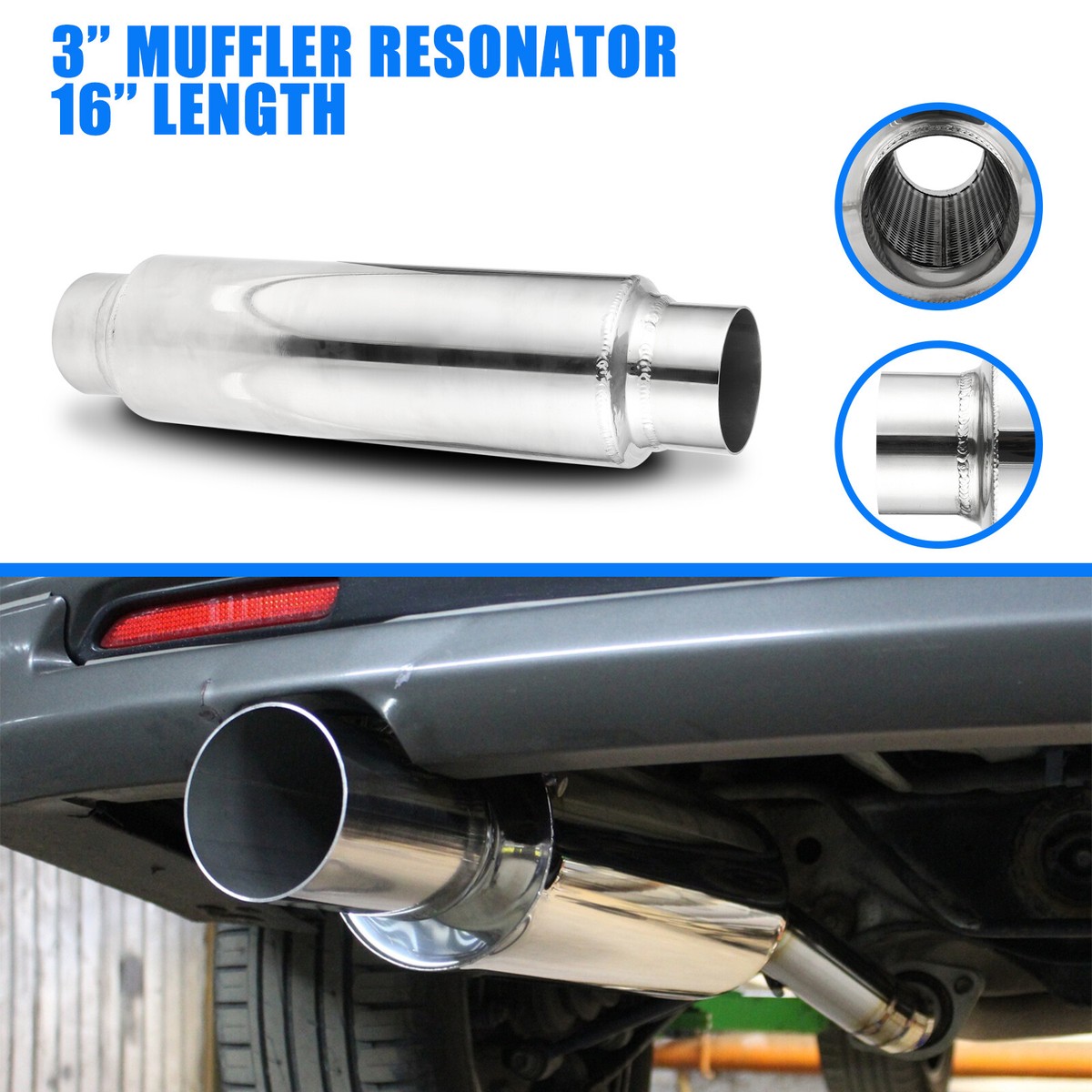

A muffler reduces the pressure fluctuations that we hear as exhaust noise while allowing exhaust gas to leave the engine. Depending on its design, it uses internal passages and chambers, sound-absorbing material, or a combination. It does not simply plug the exhaust pipe.
The useful distinction is between gas flow and sound. The exhaust gas must keep moving out of the vehicle, but the acoustic pressure waves traveling through that system can be reflected, combined and attenuated before reaching the tailpipe.
Why the engine produces exhaust pulses
Combustion events and exhaust-valve opening produce repeated pressure changes rather than a perfectly steady stream. Their timing changes with engine speed, while engine layout and firing order influence the sound. Pipes, junctions and the rest of the exhaust system further shape what reaches the rear of the car.

Credit: www.amazon.com
That is why the same muffler can sound different on different engines. A product description such as “deep tone” does not predict the cabin sound of every installation, and the exhaust note is not a reliable measurement of engine power.
How internal chambers and tubes reduce sound
Walker’s explanation of muffler operation describes perforated internal tubes and reflected waves that reduce the outgoing noise. In a chambered design, changes in passage shape and volume influence which frequencies are reduced most effectively. The effect is designed around the complete assembly, not just the size of its outer casing.
Sound waves can interact so that pressure changes partially oppose one another. This does not mean all sound disappears or that every muffler uses an identical cancellation pattern. Engine speed varies, so a road-car exhaust must manage a range of operating conditions rather than a single tone.

Credit: www.ebay.com
What sound-absorbing designs add
Other designs expose sound to a suitable absorbing medium around a perforated passage. Walker describes how absorptive devices dissipate acoustic energy. Some mufflers combine this approach with chambers, allowing engineers to balance the desired sound with packaging and flow requirements.
A straight-looking internal route is therefore not necessarily an unsilenced pipe. Conversely, a large casing does not prove a muffler will be quiet: internal construction, material condition and the frequencies it targets matter. Product selection should use vehicle fitment and stated acoustic purpose rather than appearance alone.
Muffler, resonator and catalyst have different priorities
A resonator is commonly used to address particular sound characteristics, including unwanted tones, while a muffler provides broader noise control. The distinction can overlap in integrated exhaust assemblies. Our muffler versus resonator guide explains why replacing one with the other is not automatically equivalent.
A catalytic converter primarily treats pollutants. It may influence exhaust sound, but removing it is not a legitimate substitute for selecting the correct muffler. A compliant replacement preserves the required emissions equipment, fits the vehicle and meets applicable noise requirements.
Why a louder exhaust needs more than a muffler guess
A sudden change can come from an opening anywhere in the exhaust, a failed connection or loose hardware. Walker recommends inspecting the whole exhaust system, including joints and welds. Replacing a sound muffler cannot repair a leak farther forward.

Credit: www.420spotshop.com
Compare the change with the vehicle’s previous sound and note whether it occurs at idle, under load or over bumps. A rattle and a deeper exhaust note are different clues. For the next diagnostic step, see signs of a bad muffler and look-alike faults. Avoid running the vehicle in an enclosed area while investigating noise.


Automotive reference information. Confirm specifications in the manual for your exact vehicle. Original replacement guides link to their research sources. About us


