
An OBD2 scanner can help investigate a suspected fuel-injector fault, but a basic code reader cannot prove that an injector flows correctly or seals when closed. It retrieves the engine controller's reports.
Those reports can identify a circuit concern, a misfiring cylinder or an abnormal mixture correction, each of which requires a different follow-up. Start by preserving the evidence rather than erasing the warning light.
Record the vehicle, engine, symptoms and when they occur before connecting the tool. A useful scan ends with a reasoned next test, not a shopping list of injectors inferred from one code.
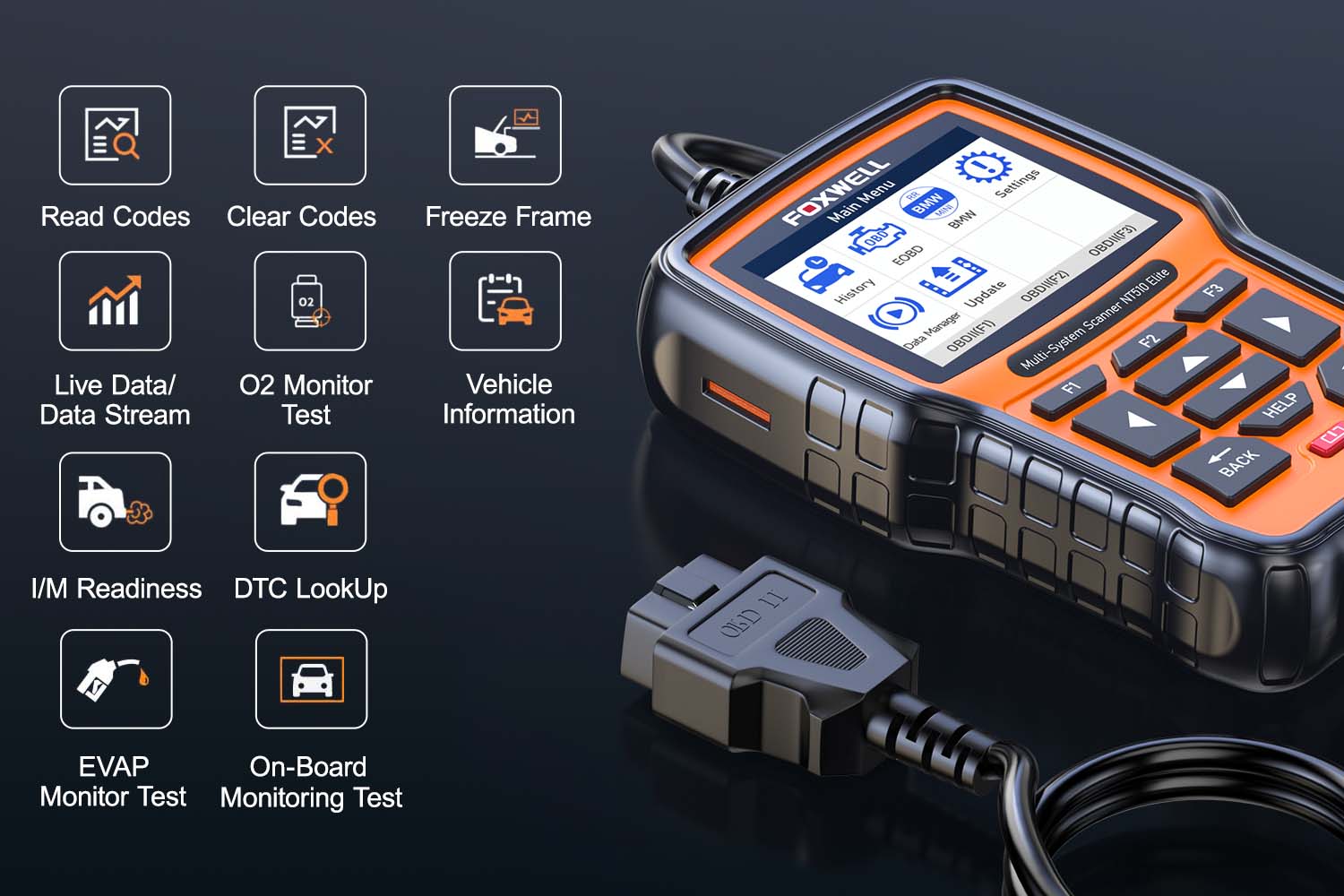
Credit: www.foxwelldiag.com
What the scanner can establish
Separate communication, stored faults and measurements. Successful communication establishes that the tool can reach a supported controller, not that every component is healthy.
A reported fault records a condition detected by that controller, while live data describes supported inputs, commands or calculations. None of those categories is a direct photograph of fuel leaving a nozzle.
A command is not a measured fuel quantity
An injector pulse-width field, where supported, describes how long the controller commands injection. It does not independently measure the volume delivered. A restricted nozzle, incorrect pressure or electrical interruption can create a difference between the intended event and what actually happens in the cylinder.
Generic and manufacturer-specific coverage
A generic reader may provide emissions codes and selected engine parameters. Enhanced coverage can add cylinder information or manufacturer tests, but availability depends on the exact vehicle, engine and tool software. Do not infer an injector balance function from a product simply advertising live data or bidirectional capability.
Use the scan to narrow the investigation
A scan is valuable when it separates a single-cylinder complaint from an engine-wide condition or captures circumstances that are difficult to reproduce. Save complete code numbers and status labels, not only the shortened description. The resulting record helps a technician choose between electrical, mechanical, pressure and mixture tests without repeating the initial work.
Identify the injection system first
Port injection, gasoline direct injection and common-rail diesel systems require different test equipment and safety precautions. Identify the engine using reliable vehicle information before applying a procedure.
A resistance value or test connection appropriate for one design cannot be carried across to another.
Some engines use more than one injection arrangement, which makes a generic description especially inadequate.
Electrical operation and fuel delivery are different
An injector needs the correct electrical control and a suitable fuel supply, but a functioning circuit alone does not establish correct spray or sealing. Conversely, a mixture problem need not originate inside the injector. Keeping those questions separate prevents an apparently reassuring electrical observation from ending the diagnosis too soon.
Why specialist waveform testing differs
Pico Technology’s MPI injector voltage guide evaluates the control circuit and switching behaviour using suitable oscilloscope equipment. That is a different measurement from reading a generic PID. The guide also warns about hazardous test voltages; it does not justify probing an unidentified injector circuit with an ordinary improvised lead.
Symptoms are leads rather than confirmation
Rough running, difficult starting, reduced power and abnormal exhaust can accompany injector problems, but ignition, compression, air leaks and fuel-supply faults can overlap. A symptom that appears only during a cold start should be recorded as such. It should not be silently converted into a warm-idle diagnosis because that is when the scanner was connected.
Decide whether the vehicle should run
Fuel leakage, a strong raw-fuel smell, severe misfiring or a flashing malfunction indicator changes the priority from gathering more readings to preventing damage or a hazardous situation. Follow the vehicle warning instructions and arrange professional assistance when appropriate. Do not repeatedly start a leaking or badly misfiring engine just to obtain a cleaner data graph.
Write a focused diagnostic question
For example, ask whether the controller reports a cylinder-specific circuit fault or whether multiple cylinders show a shared operating problem. These questions select useful evidence. Asking the scanner to tell you whether all injectors are good invites a yes-or-no answer that most tools cannot provide.
Keep intermittent evidence
Note whether the complaint follows refuelling, a recent repair, an overnight stop or engine warming. These observations are context, not automatic causes. Preserve them alongside the code status so a technician can distinguish a recurring current problem from a historical event that happened under different circumstances.
Avoid routine erasure as maintenance
Clearing codes does not clean an injector, correct its calibration or repair wiring. It can remove the conditions stored with a fault and reset emissions-monitor readiness. A clean screen immediately after erasure therefore supplies less diagnostic information than a properly saved initial report.
Prepare a read-only scan
Begin with identification, code retrieval and data viewing. Keep actuator tests, coding and reset menus outside the first inspection unless the vehicle-specific procedure requires them and you have the equipment and training. Similar menu wording can conceal very different commands, especially when the tool covers multiple manufacturers.
Equipment and information to have ready
Use a compatible scanner, the correct operating instructions and a way to save or photograph results. Obtain the engine identification and service information for interpreting cylinder numbering and codes. Do not purchase electrical test adapters until you know the injection system and the measurement the diagnostic procedure actually calls for.
Control movement and ventilation
Park safely, apply the parking brake and keep the transmission in the specified stationary position. Run an engine only with adequate ventilation and keep people, leads and equipment away from moving or hot parts. If a road-condition recording is required, the driver must not handle or watch the scanner while driving.
Connect without damaging the diagnostic socket
Follow the scanner and vehicle instructions for ignition state during connection. Inspect the connector visually and align it without forcing it. A damaged socket or unstable supply can interrupt communication and create misleading sessions, so solve that connection issue before interpreting incomplete or frozen data.
Find the documented diagnostic connector
Use the owner's information if the socket is not readily visible. Do not connect to an unrelated accessory or maintenance connector because it has a similar shape. Leave individual diagnostic pins untouched; retrieving ordinary codes requires the proper connector, not a jumper wire or exploratory electrical test.
Save the first report before changing anything
Identify the vehicle accurately and retrieve the supported stored, pending and permanent categories. Save freeze-frame information where available.
Record whether the warning lamp was commanded on and whether the engine was running during the scan. If the tool offers an automatic clear option, decline it while collecting the initial evidence.
Interpret codes in their exact application
Use the full code, its status and the manufacturer's diagnostic information for the identified engine. A code description names the detected condition, not necessarily the failed part. Several related codes may share a supply or wiring issue, while an isolated cylinder code may still need ignition and mechanical checks.
Circuit codes are not injector replacement instructions
A P020x-family report can direct attention to an injector circuit, but the circuit includes wiring, connectors, control electronics and the injector. Delphi’s common-rail electrical testing guidance distinguishes specialised electrical checks from simply reading a code. Its solenoid-injector equipment and model-dependent results are not universal resistance specifications for every injector.
Misfire and mixture codes need broader reasoning
A cylinder misfire code does not discriminate reliably between missing fuel, missing ignition and inadequate compression by itself. Likewise, a mixture correction may reflect air measurement or a shared fuel problem. Use the code to choose the next diagnostic branch rather than treating the word cylinder or lean as proof of a blocked nozzle.
Build a small, relevant data set
Choose only parameters that relate to the question and are actually supported. The OBD Auto Doctor parameter reference shows that fuel trims, pressure-related fields and fuel-system status are separate items with vehicle-dependent support. An absent field is not a zero measurement, and a calculated field should not be described as an independently measured injector output.
Compare conditions before comparing numbers
Record engine temperature, speed, load and fuel-system operating state alongside a suspect reading. A cold start and a warmed idle are different tests. Compare repeat observations under the same safe conditions, and use the specified service procedure for acceptable ranges instead of a universal internet threshold.
When to move beyond the scanner
A persistent complaint with inconclusive scan evidence can require pressure testing, electrical waveform analysis, cylinder contribution checks or mechanical diagnosis. Those tests should follow the vehicle procedure. High-pressure fuel systems must not be opened to see whether fuel is present, and an injector should not be energised using a battery and loose wires.

Credit: www.youtube.com
Verify the repair with the original question
After a confirmed repair, repeat the relevant checks under the conditions that previously produced the complaint. Save the new report separately from the original. A warning lamp that stays off during a brief idle does not prove that an intermittent fault has been resolved or that all emissions monitors have completed.
Make the handover useful
Provide the technician with the exact code list, status categories, freeze-frame record and a concise description of the symptom. Include recent work and fuel history without asserting that either caused the failure.
Ask which test will distinguish the leading possibilities and what result would justify injector replacement.
This makes the next step reviewable rather than speculative.
Do not use cleaner as a diagnostic shortcut
An additive cannot repair an open electrical circuit or damaged wiring.
It also cannot establish whether an injector is leaking mechanically.
Follow the vehicle and product instructions if an appropriate cleaner is used for a separate maintenance purpose.
Do not increase the dose because a scanner reports a fault.
If the symptom changes after adding a product, record the observation without treating it as proof that deposits were the original cause.

Credit: www.ancel.com
What a defensible result looks like
The strongest outcome is a saved scan that identifies the affected system and supports a specific follow-up test. It may establish that further injector testing is justified, or it may point away from injectors entirely.
For broader interpretation, use the guide to reading OBD2 live data. Keep the distinction between a controller report and a confirmed component failure throughout the diagnosis.


Automotive reference information. Confirm specifications in the manual for your exact vehicle. Original replacement guides link to their research sources. About us


