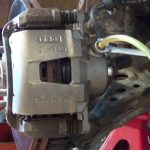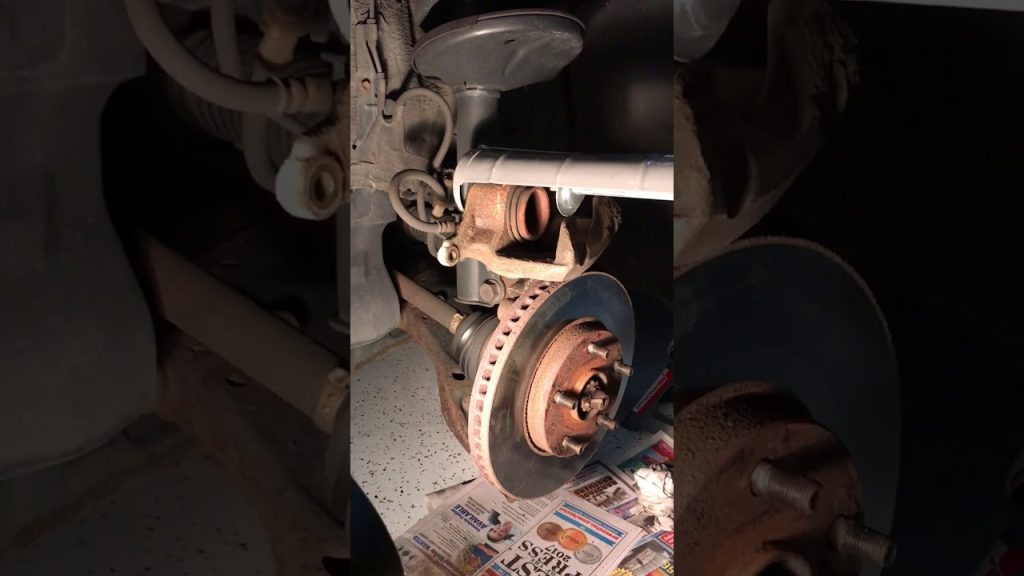

Before pushing a brake caliper piston back, identify its mechanism and obtain the correct service procedure. Some pistons retract under controlled straight pressure; others incorporate a mechanical parking-brake adjustment that requires a specified wind-back action. Electronic parking-brake systems may need a maintenance state before mechanical work. A larger clamp is not a substitute for identifying which arrangement is fitted.
If the piston resists the correct method, stop and investigate instead of adding force. This guide explains the decision process and the checks surrounding retraction. It does not prescribe one rotation direction, tool or pressure-handling method for every vehicle.

Credit: www.reddit.com
Why the piston type changes the procedure
New pads occupy more space than worn pads, so service commonly requires returning pistons to the position specified for reassembly. The motion must respect the caliper’s internal design. A plain hydraulic piston and a piston connected to an integrated parking-brake mechanism are not interchangeable. Location alone is insufficient: not every rear caliper uses the same system, and a cabin parking-brake switch does not identify every component at the wheel. TRW’s brake-service guidance distinguishes conventional piston retraction from an integrated mechanical parking-brake method and explicitly separates EPB considerations.
This is why advice such as always turn rear pistons clockwise is unreliable. Use the vehicle and caliper identification to obtain the actual instructions. Visible slots can help identify a feature, but they are not a complete service specification. The tool must suit both the required movement and the piston contact area.
HELLA’s retraction guidance describes using appropriate reset tools to apply controlled force. A tool that slips or loads the piston unevenly can damage parts. A C-clamp that opens wide enough still may be wrong for the mechanism or assembly geometry. Select the method first, then the tool.
A controlled sequence for planning the work
Read the entire procedure before removing the caliper. Check the vehicle support, parking-brake preparation, fluid management, piston movement and completion requirements. Obtain the correct pads and any hardware that must be renewed. Plan how the caliper will be supported without loading the hose or wiring. If a required diagnostic function or tool is unavailable, arrange service before dismantling. Make the vehicle safe using its lifting and restraint instructions.
- Never rely on a jack alone when working around a raised vehicle. Account for the parking brake being released or placed in maintenance mode. Keep other people from operating controls while the assembly is apart. Electronic systems can have activation behavior that must be handled according to the service information. Inspect the accessible piston boot and surrounding parts before applying pressure. Look for damage or contamination that changes the repair decision.
Do not treat a torn boot as merely a cosmetic problem, and do not push a visibly damaged component inward to hide it. The appropriate inspection may reveal that the caliper needs service or replacement rather than routine pad work. Position the specified tool correctly and apply the prescribed motion gradually. Keep the contact centered and prevent the tool from bearing on a vulnerable edge, bleeder or hose fitting. Where the procedure uses a pad or plate to distribute force, follow that instruction. Multi-piston assemblies require a method that controls the relevant pistons rather than forcing one while another moves unexpectedly.
Do not improvise a lever against the disc or sealing boot. Manage brake fluid as the vehicle procedure requires. Piston movement changes fluid displacement, so reservoir condition and level matter. Do not let fluid overflow onto vulnerable surfaces. Do not open a bleeder or clamp a hose solely because an unrelated video did so. If the hydraulic circuit is opened, the relevant bleeding and verification requirements apply.
Minimizing visible fluid loss does not prove air has been excluded. Stop at abnormal resistance, a twisting boot, tool instability or unexpected leakage. Confirm that the parking mechanism is in the correct state and that the tool is providing the correct motion. An obstruction or seized part needs diagnosis. Additional leverage may damage the piston, adjustment mechanism or caliper body while leaving the underlying cause unresolved. A tool’s capacity is not an instruction to use all of it.
What resistance can and cannot tell you
Resistance is a finding. It does not automatically prove corrosion. It does not identify a hose restriction by itself. It does not prove that the piston must be rotated.
It does not justify opening a connection at random. It does not mean the replacement pads are necessarily wrong. It requires checking the method and system condition before the next action. If the caliper was retracting normally until the tool tilted, correct the setup rather than assuming the internal mechanism failed.
If the correct method still produces abnormal resistance, inspect according to the diagnostic procedure. Mechanical binding and retained hydraulic pressure are different possibilities. A technician may use appropriate isolation checks to distinguish them. Those checks should not be reduced to a roadside instruction to loosen a bleeder and drive away.
On a floating caliper, guide and pad movement also affect the completed brake. HELLA’s guide-pin information describes how restricted guides can impair operation. Successfully moving the piston does not establish that the complete assembly will slide and release correctly. Conversely, a guide problem is not repaired by pushing the piston harder.
Inspect each relevant function separately. If the vehicle has an electronic parking brake, see the EPB preparation guide. TRW’s diagnostic-tool manual illustrates maintenance entry and exit requirements for supported systems. Releasing the normal switch is not automatically equivalent to that service state.
Do not power a motor directly or remove it to bypass an unsupported procedure. If a mechanical wind-back process is specified, use the correct adapter and direction for that application. Keep the boot from being damaged and follow any piston-position requirement for pad installation.
Do not infer direction from a different vehicle on the opposite side of an online comparison. Left and right components, mechanisms and service instructions can differ. The exact procedure resolves the uncertainty.
Complete the brake job before judging success
Retract the piston only as required. Fit the correct pads and hardware. Restore all supports and retainers. Use the specified tightening requirements.
Check hose and wiring routing. Complete any required parking-brake setup. Perform the prescribed hydraulic and operating checks. Do not move the vehicle until the assembly is ready for service.
A piston pushed fully inward is an intermediate service position, not proof that the brake is safe. The pads and pistons must be brought to their correct operating relationship using the vehicle’s completion procedure. A long or abnormal pedal afterward means the work needs attention before driving. The parking function must also be restored where it was disturbed.
A warning reset alone does not complete those mechanical and hydraulic checks. If the caliper was opened or replaced, follow the appropriate bleeding process and inspect for leakage. If it was only repositioned, still verify that the hose was not strained and all fasteners are correct. A road test, when specified, follows the static safety checks; it is not a way to discover whether the brakes can stop the vehicle at all.
Any remaining drag, pull or abnormal noise should be assessed before normal use. Keep a clear record of what was done. If the piston was difficult to retract and the caliper was replaced, the invoice should state the finding that justified replacement.
If the issue was an incorrect service state or tool setup, that is a different result. This distinction prevents future repairs being based on a vague history that the brakes were seized when they were never diagnosed that way. Consider two hypothetical cases.
A conventional piston accepts smooth centered pressure and the rest of the assembly passes inspection; routine pad service can proceed through the prescribed checks. Another piston resists because its integrated mechanism has not been prepared correctly; adding force risks damage without advancing the repair. The cases may look similar at the beginning, but identification determines the correct response.
For tool-size questions, consult the C-clamp selection guide only after confirming that straight-pressure retraction is appropriate. For abnormal braking before disassembly, use the sticking-caliper diagnostic guide. Choosing the correct information in that order prevents a service-tool question from replacing diagnosis of the actual brake condition. A useful preparation note lists the exact caliper identification, required piston movement, tool adapter and completion procedure. Keep that note with the service information rather than relying on memory from a previous vehicle. This is particularly helpful when working on different brake designs in the same household. The same tool kit can contain adapters for several mechanisms, and selecting the adapter that happens to fit the visible slots does not establish the correct method. If a tool leaves a mark or damages a boot during an attempted retraction, assess the damage before proceeding. Do not assume the assembly is serviceable merely because the piston eventually moved. The repair now includes whatever was affected by the attempt. Tell the technician what force and tools were used if the job is transferred to a workshop. An accurate account helps them inspect the relevant areas without guessing what happened during the incomplete service.


Automotive reference information. Confirm specifications in the manual for your exact vehicle. Original replacement guides link to their research sources. About us