
A brake described as locked up may be mechanically binding, held applied by hydraulic pressure, or affected by a parking-brake problem. It may also mean the tire briefly stopped rotating during braking, which is a different event from a caliper that will not release afterward. Clarify what happened before diagnosing the part. If a wheel remains locked, the brake smokes, the vehicle pulls severely or braking ability changes, stop safely and arrange recovery. Do not keep driving to see whether the caliper frees itself. This guide focuses on a disc brake that remains applied or drags after it should have released.
The cause must be established before choosing a caliper, hose or other replacement. The most useful first distinction is between resistance inside the wheel-brake assembly and pressure still being held in the hydraulic circuit. Those conditions can feel similar to the driver but require different repairs. Replacing a caliper without making that distinction can leave a brand-new part dragging. Equally, assuming every hot brake has a hose restriction can overlook a seized guide or incorrect pad fit. Treat the description locked caliper as a symptom report until inspection supports a specific diagnosis.
Do not confuse temporary release with a repair. Cooling down or opening part of the hydraulic system can change a symptom without correcting its cause. A vehicle that rolls again may still be unsafe. The assessment should consider both the original fault and any heat-related effects on pads, discs, fluid or nearby components. The appropriate repair scope follows those findings rather than a fixed list of parts for every case.

Credit: www.lesschwab.com
Record the pattern without creating another event
Note which wheel or wheels appear affected. Record whether the problem started immediately or after warming up. Include recent brake or master-cylinder work. Describe whether the parking brake had been used. State whether the wheel stayed restricted after releasing the pedal. These details help select diagnostic checks; none proves the failed component alone. A problem limited to one corner can direct attention to local hardware, the caliper and its supply path.
Several wheels affected together can make shared hydraulic or control conditions more relevant. The pattern still needs careful interpretation because system layouts differ. Do not infer a universal cause from front versus rear position. A repairer should relate the observations to the actual circuit and parking-brake design. Recent work is especially useful context. A complaint beginning after pad replacement may warrant inspecting pad fit, hardware orientation, guide condition and piston preparation.
A complaint after master-cylinder work raises different questions about correct installation and return. Classic Performance Products warns about master-cylinder preload in its installation instructions, because an incorrect setup can leave braking pressure applied. That warning concerns the manufacturer’s covered installation, not a universal adjustment specification. That source supports considering the upstream mechanism; it does not diagnose every warm brake or authorize casual adjustment of the pushrod. Heat comparison can be useful to a trained technician, but touching a wheel or disc is not a safe measuring method. Do not pour water onto a hot brake to free it.
Do not repeat a drive until smoke appears just to establish which side is hotter. Provide the observations already available and let the workshop choose a controlled method of assessment. If the vehicle cannot move safely, transport is part of the repair plan. Record any warning messages accurately. A parking-brake or stability-system warning may provide relevant context, but a lack of warnings does not prove the brake is healthy. A mechanical problem may not generate a neatly matching code.
Save diagnostic information before clearing it. The technician needs both electronic records and physical inspection rather than one replacing the other. For example, “the right rear wheel was hard to turn after parking-brake use” is a useful observation. “The right rear piston is seized” is a conclusion requiring evidence. Another useful report is “several brakes began dragging after a master-cylinder replacement.” Keeping the facts separate from the proposed explanation helps prevent an early assumption narrowing the inspection too much.
Separate the possible causes and verify the repair
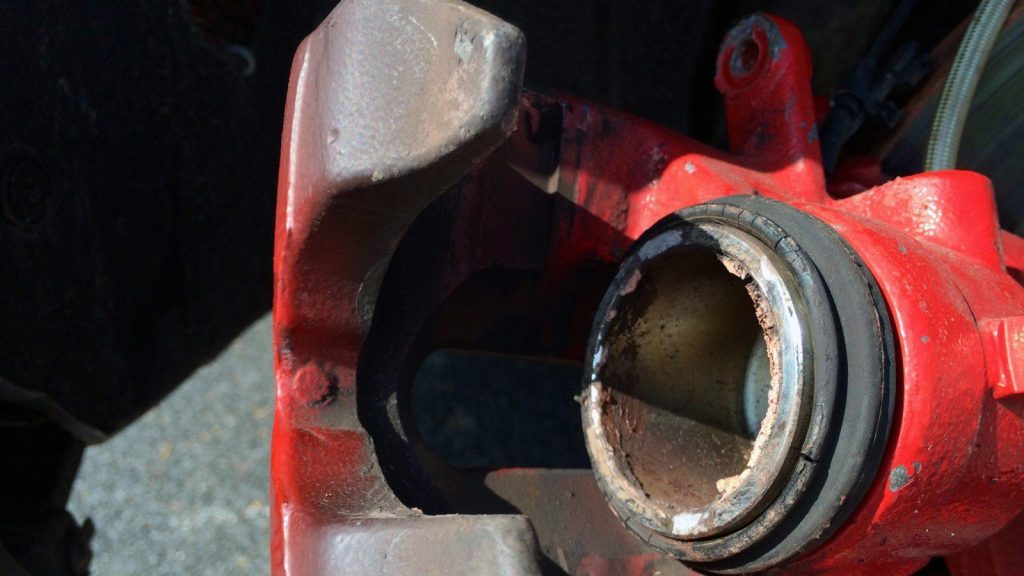
| Mechanical resistance can involve the piston, floating-caliper guides, pad movement or damaged hardware. The inspection must identify which part cannot move as intended. HELLA describes the effects of sluggish or seized guide elements, including abnormal wear and heating. A guide fault is not corrected merely by replacing friction material. Nor does successful piston retraction prove that the guides and pads are free to operate correctly. Pad fit deserves attention after service. The correct application parts, clean and serviceable contact areas, hardware placement and assembly method all matter. Do not grind a pad or bend a clip simply to make the wheel turn without finding why it binds. An incorrect part or damaged carrier may require a different repair. A freely moving assembly before final tightening can also change if the installation is incorrect, so checks need to cover the completed state. |
A piston may be impaired by damage or corrosion, but retraction method must be verified first. Integrated mechanical parking brakes and electronic parking-brake systems can require specific preparation. A piston resisting the wrong tool action is not proof of seizure. See the piston-retraction guide and use the actual vehicle procedure. If the proper method still reveals abnormal movement, the caliper needs further assessment. Retained hydraulic pressure is a different branch of diagnosis. A restricted hose or another upstream condition can interfere with release even when the caliper is mechanically serviceable. Wagner distinguishes hose restriction from internal caliper binding. Its professional diagnostic context should not be reduced to an instruction to loosen a bleeder and then drive. A change when pressure is relieved helps guide investigation but must be interpreted within the circuit before assigning the precise cause.
An external hose inspection is necessary but cannot establish every internal condition. Conversely, a worn-looking hose is not proof that it caused the current drag. Ask what test supports the diagnosis and whether other relevant components were checked. Do not pinch a hose with locking pliers to see what happens. Any isolation procedure must use approved equipment and be permitted for the system being tested. Parking-brake mechanisms form another diagnostic branch. A mechanical cable, integrated adjustment or electronic actuator may need assessment according to the design. An electronic switch being in the released position does not prove every wheel mechanism has returned correctly. A maintenance state may also need proper completion after service. Do not power actuators directly or repeatedly command them with a dismantled assembly to force a release.
When the cause is confirmed, address any resulting damage as well. A severely overheated pad or disc cannot be declared serviceable solely because the original drag has stopped. The technician should assess the affected parts against the manufacturer’s limits and condition criteria. Ask why each additional replacement is recommended. That keeps the scope grounded in evidence without ignoring consequences of the initial fault. The final checks should show that the brake applies and releases correctly under the required conditions. If the hydraulic system was opened, complete the appropriate bleeding process and leak checks. If the parking function was disturbed, complete its specified setup and verification. Static checks must pass before any safe road verification. A warning light cleared from memory or a wheel that turns once on a lift is not the entire acceptance test.
Keep a repair record distinguishing the symptom, confirmed cause and corrective work. If a hose was replaced because pressure release was delayed, the record should say so. If a guide was seized and the hydraulic system was sound, that is a different finding. This detail matters if a later complaint develops at the same wheel. It prevents the next technician inheriting only the vague history that a caliper locked up. For early signs before severe lockup, see the sticking-caliper checks. If the question concerns air and pedal feel, use the separate air-in-brake-lines explanation rather than treating all hydraulic faults as the same. The correct repair is the one that resolves the demonstrated application-and-release fault and its consequences. A component name in the driver’s description is the beginning of diagnosis, not its result. Ask how the diagnosis distinguishes normal contact from abnormal drag. A disc brake is not judged by a universal hand-spin count, and driveline resistance can affect what is felt at a raised wheel. The supported inspection considers the actual assembly and conditions. A mechanic should be able to explain why the observed resistance is abnormal for that vehicle and which check narrowed the cause. If the problem appears only when warm, a cold inspection that finds the wheel free may leave the complaint unresolved. That does not authorize repeatedly overheating the brake. It means the workshop needs a controlled plan to investigate the reported conditions safely. Record how long the original journey lasted and what changed as the symptom developed. Avoid adding an exact temperature or distance if it was never measured. Finally, distinguish the driver's report of locking under a hard stop from a wheel that remains restrained afterward. The first can involve tire grip, braking demand or control-system behavior; the second is the release problem addressed here. Using the same word for both can lead to the wrong diagnostic path. Describe the sequence in ordinary language if the terminology is uncertain.


Automotive reference information. Confirm specifications in the manual for your exact vehicle. Original replacement guides link to their research sources. About us