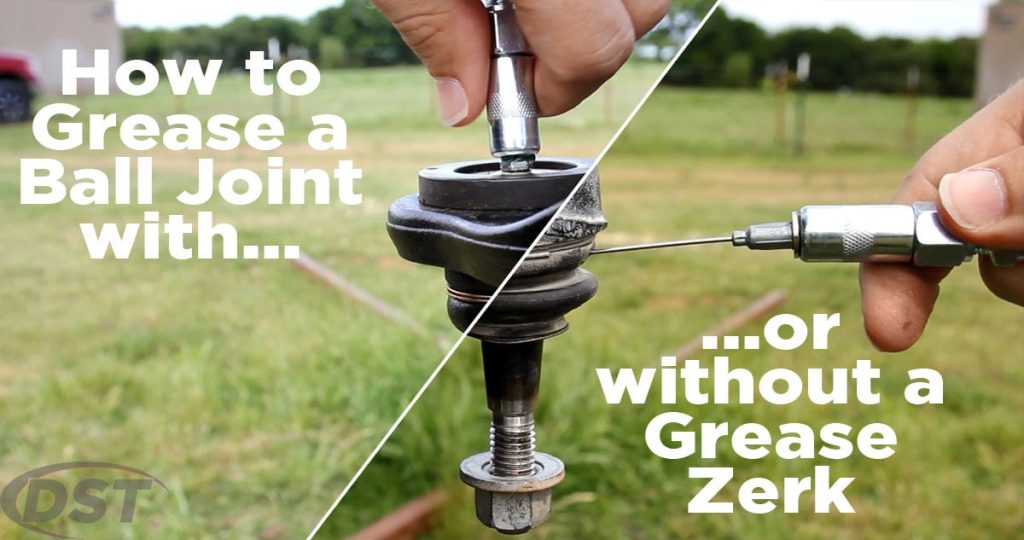

Ball joint lube usually means the grease specified for the bearing surfaces inside a serviceable suspension ball joint. It is not a special universal liquid that can be sprayed onto any noisy suspension component. The correct product depends on the installed joint and its instructions.
Some joints are sealed and have no routine lubrication provision, while others have a manufactured fitting for scheduled service. Identifying that distinction comes before buying a cartridge. Grease selection is a specification question.
A product can look suitable, carry a familiar color and be marketed for demanding work without meeting the requirement of the part on your car. Conversely, an ordinary-looking product may be appropriate when its documented properties match the instructions. This guide explains the terminology on the container and the information needed to make that match.
The separate ball-joint lubrication guide covers deciding whether and how the component is serviceable. A lubricant also has a limited purpose. It supports movement at the working surfaces; it does not replace worn material, tighten a loose mounting connection or restore a damaged boot.
If the car has a steering change, clunk or known excessive play, diagnosis comes before an attempt to quiet it with grease. Do not treat a temporary improvement in noise as evidence that the suspension is safe.
What grease contains and why the distinction matters
NLGI’s technical explanations describe grease as lubricating fluid combined with a thickener and performance additives. The thickener gives the product its semi-solid character. This is different from simply making a liquid oil unusually thick, and it explains why two products that seem similar on a finger may have different formulations. Do not use touch or appearance as a compatibility test. For an owner, the practical value of understanding the components is knowing which questions to ask. What consistency is specified? Is a particular grease type or performance classification required? Does the manufacturer address compatibility with seals and existing lubricant?
The answer should come from the installed component’s guidance and the lubricant supplier’s documentation. It should not come from a guess that any automotive grease will work because the joint moves slowly. The fluid and the thickener describe different aspects of the product. A label may mention a synthetic base fluid and a particular thickener system at the same time. Those descriptions are not necessarily competing categories. Read the complete specification instead of treating one prominent word on the packaging as the whole identity of the grease. If a seller cannot explain how the product meets the actual requirement, obtain that confirmation elsewhere before service.
Read a specification rather than choosing by color
- The NLGI number is a consistency classification. NLGI’s grade definition bases it on a standardized worked-penetration measurement. It is not a ranking in which a larger number automatically means a better grease. A specified grade should be matched, not exceeded on the assumption that a firmer product provides extra protection. Consistency also does not by itself identify every performance property needed for an application.
- MOOG’s chassis-grease guidance recommends a suitable heavy-duty NLGI number 2 lithium or synthetic grease for its covered steering and suspension parts. That is a useful example of a manufacturer stating a requirement. It is not permission to apply one recommendation to every sealed factory joint or every aftermarket design. Confirm that the guidance covers your actual component and read any more specific instructions supplied with it. Color is particularly weak evidence.
- Do not assume two red products are compatible, or that a change from one color to another necessarily represents an upgrade. Product names such as marine, racing or heavy duty describe intended positioning without replacing the technical data. A useful purchase decision records the exact product and the requirement it meets. The cartridge should remain identifiable after it has been installed in a grease gun. Performance classifications and consistency grades answer different questions.
- If your instructions require an automotive chassis classification as well as a consistency grade, confirm both rather than accepting one as a substitute for the other. Likewise, a product sold for another automotive component is not automatically suitable for a ball joint. Brake hardware, a constant-velocity joint and a suspension joint can have different requirements despite all being close to a wheel. When the current grease is unknown, mixing deserves a specific answer from the component or lubricant supplier.
- Do not infer compatibility from color or from a single shared word such as lithium. A seller’s general suggestion to keep adding fresh grease is not necessarily a supported changeover procedure for the installed assembly. Ask what information is needed and whether the existing service history changes the recommendation. If there is no reliable identification, explain that uncertainty rather than concealing it with a confident product choice.
What noise and expelled grease cannot prove
- A squeak may prompt an inspection, but it does not prove that a ball joint simply needs more lubricant. The sound might originate elsewhere, and a joint can have damage that grease will not correct. A quiet joint may also be worn. Our symptom and diagnosis guide separates those observations from confirmation of a component fault. Lubrication is maintenance for an appropriate serviceable part, not a substitute for that inspection. Grease visible outside the joint needs context too. It may relate to a designed service outlet, excess from previous maintenance or a damaged seal. Its presence alone does not show that the internal surfaces received the right product or that the boot remains sound.
Before further service, identify the source and the component’s intended behavior. Do not keep pumping simply because a photograph online showed grease emerging from a different type of joint. The condition of an old sample is not a complete laboratory assessment. Dirt on the outside can contaminate what you see while wiping the fitting. An unusual appearance may justify investigation, but the observation does not automatically identify a chemical incompatibility or establish that every suspension part needs replacement. Record the actual finding and seek a supported service decision. That keeps a useful inspection clue from becoming an unsupported diagnosis.
Match the lubricant to a defined maintenance job
Start with the installed part, not the vehicle badge alone. A previous repair may have fitted a greaseable replacement where the original joint was sealed. Read the invoice, part marking or supplier record where available. Confirm which side and location the information describes.
- The opposite side may still have a different component and a different maintenance requirement. Then locate the lubrication instruction that applies to that part. Record the required product properties and any specified maintenance conditions. Check the current cartridge label and technical information against those requirements.
- Keep the gun clean and clearly labeled so the correct choice is not lost when someone later picks up an unmarked tool. A grease gun is a delivery device, not evidence of what product it contains. Do not create a service point in a sealed boot. A specified adapter for a purpose-made fitting is different from piercing rubber with a needle.
- Drilling a housing or adding an unknown fitting changes the component and can introduce contamination or damage. If the design has no documented service provision, resolve that question with the manufacturer or repairer. Buying the right grease does not authorize an unsupported method of putting it into the assembly.
- The amount and stopping indication are separate from product selection. Correct grease can still be delivered incorrectly, and excess pressure can damage protective components. Follow the joint and tool instructions rather than counting an arbitrary number of pumps.
- Keep lubricant away from tires and brake friction surfaces. For priming, coupling and abnormal-resistance questions, use our grease-gun guide. Finally, document what was done and what remained uncertain.
A record naming the component, product, date and abnormal observations is more useful than chassis greased. If service was interrupted by a damaged fitting or boot, say so. The purpose of the record is to help the next inspection, not simply to create the appearance that every lubrication point was completed.
Credit: www.nyelubricants.com
Common product questions answered precisely
Is ball joint lube the same as any multipurpose grease? Not necessarily; the actual product must meet the component’s requirement. Does synthetic mean universally compatible?
No; the full formulation and application guidance still matter. Is a higher NLGI number better? No; match the specified consistency rather than treating the scale as a quality ranking.
Can penetrating oil replace chassis grease? It is not a substitute for the prescribed product and service method.
Can I grease a sealed joint through its boot? Do not improvise a service opening.
Will fresh grease repair play? It cannot replace worn bearing material.
Does a louder joint need more pumps? Noise is not a filling instruction.
Can different colors be mixed? Color cannot establish compatibility.
Can I use the same gun for several products? Only with a controlled process that prevents incompatible or unidentified contents; a clearly identified dedicated setup is easier to manage.
The useful definition of ball joint lube is therefore specific: the documented lubricant suitable for the identified joint, used through its approved service provision. Anything less leaves unanswered questions about both the product and the task.


Automotive reference information. Confirm specifications in the manual for your exact vehicle. Original replacement guides link to their research sources. About us