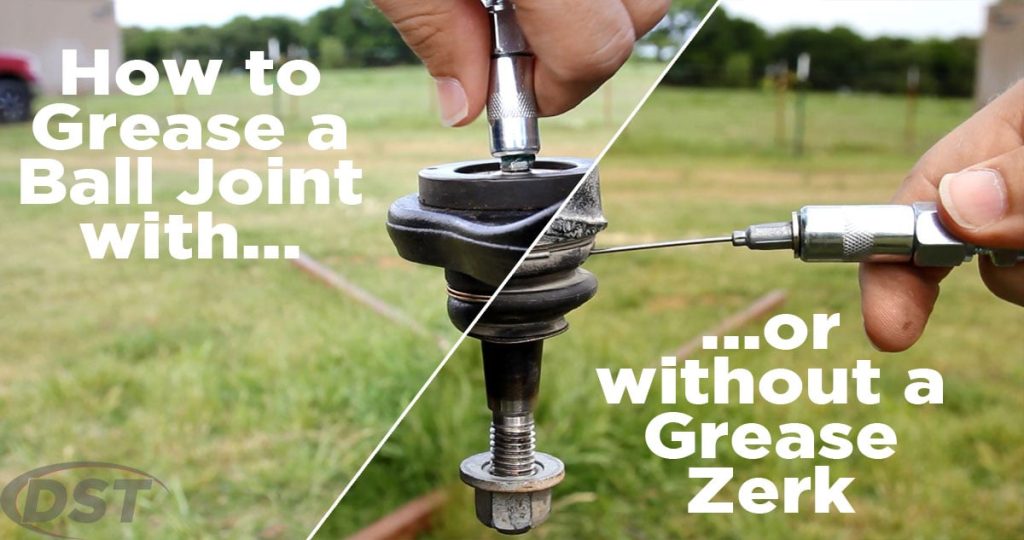

Grease a ball joint only if its installed design provides for lubrication, using the lubricant and filling procedure specified for that part. A grease fitting is a service connection; a sealed rubber boot is not an invitation to inject grease through it. If the joint is loose, damaged or binding, adding lubricant is not a substitute for evaluating and repairing the fault.
This guide explains the maintenance decisions that come before connecting a grease gun. For coupling, priming and delivery problems, use the separate ball-joint grease-gun guide. A vehicle can have replacement joints that differ from the original factory equipment, so the instructions for the installed component matter as well as the vehicle manual.
Start with identification, condition and access, then choose the correct service procedure. Do not begin by counting pumps or trying to make every boot look equally full. Those shortcuts cannot account for differences in joint construction, existing lubricant or gun output.

Credit: m.youtube.com
Identify the joint and decide whether it is serviceable
A suspension ball joint connects moving suspension components through a pivoting stud and socket. Lubrication belongs inside the working assembly, not merely on the exposed outside of its protective boot.
MOOG’s construction overview distinguishes sealed original-equipment joints from greaseable replacement designs. That distinction is the first reason a general maintenance video may not match the component under your vehicle.
Locate the installed part number from a receipt, repair record or accessible marking where possible. Check whether the upper and lower joints, or the left and right replacements, are actually the same product family.
- A previous repair on one side does not prove that both sides have the same lubrication provisions. Record any uncertainty before obtaining grease or planning access.
- A familiar raised zerk fitting normally provides a recognizable coupling point, but dirt, position and low-profile designs can make identification difficult. Clean the surrounding exterior enough to see what is present without damaging the boot.
- Do not mistake a retaining fastener or housing feature for a removable lubrication plug. If the part has no documented service point, stop and confirm its design with the manufacturer or repairer.
- Drilling the housing or piercing the boot creates a modification with contamination and damage risks; it is not ordinary scheduled lubrication. A special adapter specified for a manufactured low-profile fitting is also different from a sharp needle pushed through rubber.
Identify the intended fitting before selecting either tool. Assess the component before filling it.
- Check visible boot condition, displaced seals, missing hardware and evidence of a prior repair, without treating an outside glance as a complete suspension inspection. A clunk, steering change or uneven tire wear calls for diagnosis rather than an automatic grease service.
- The ball-joint symptoms guide explains why a symptom needs confirmation against the correct inspection method. Do not make a test drive simply to see whether fresh grease masks a concerning symptom.
-
Likewise, a quiet joint is not necessarily free of excessive play. Lubrication can reduce friction; it cannot replace metal lost from worn bearing surfaces or restore a damaged mounting connection.
- Plan access using the vehicle’s lifting and support instructions. Some fittings are reachable without lifting; other installations require a supported vehicle or a particular suspension position.
- These situations cannot be reduced to one instruction to jack beneath a control arm. Never work under a vehicle supported only by its lifting jack, and do not reposition suspension components without understanding their loading.
- Keep hands away from pinch points and do not have another person turn the steering while your hand or hose is trapped in the mechanism. If safe access requires tools or facilities you do not have, ask a workshop to include the service during an appropriate inspection.
-
Easy access to a fitting is useful only when the vehicle and suspension are securely positioned. Fitting location can be intentional.
- Mevotech’s solid-axle service bulletin describes specific part numbers with a side-mounted fitting to preserve clearance near the axle yoke. It is an example of why a fitting should not be relocated or replaced with a taller type solely for convenience.
- Check the exact application before changing a fitting’s size, angle or projection. A hose that reaches today must not leave hardware that interferes when the suspension or driveline moves.
- Stop if the fitting itself turns in the housing, appears damaged or will not hold the correct coupler. Repairing that problem is a separate task, with its own part and thread requirements.
-
With an intact, confirmed serviceable joint, follow the component instructions for slow filling and the specified stopping indication. Observe the boot and intended outlet rather than relying on a fixed number of strokes.
- A split seam and a designed grease-relief outlet are not interchangeable.
- If the response differs from the instructions, disconnect safely and investigate instead of increasing pressure.
- Remove expelled lubricant from nearby surfaces and keep it away from brake friction components.
Check for an obvious new boot problem after service and note anything requiring inspection.
The result should be a serviced, intact component, not a large external pile of grease that conceals whether the seal remains sound.
Choose grease by specification, not color
Use the installed joint manufacturer’s lubricant requirement, checked against the actual cartridge or container label. A red, blue or black appearance is not a reliable compatibility specification. Marketing terms such as heavy duty or multipurpose are not enough when the component instructions call for a particular grade or performance classification. MOOG’s grease guidance recommends a suitable NLGI number 2 lithium or synthetic product for its covered chassis parts and stresses inspection before service. Treat that as guidance for those parts, not proof that every ball joint in every vehicle needs an identical formulation. Keep the product label with the maintenance record so the next service does not begin with a guess about what is in the gun. A second important question is what lubricant is already present.
If the history is unknown, do not assume that two products mix acceptably because they share a color or broad description. Ask the component or lubricant supplier for compatibility guidance where it matters. Repeatedly adding different products is not a controlled method of changing the grease specification. Do not use penetrating oil, engine oil or brake lubricant as an improvised substitute for the specified chassis grease. A spray reaching the exterior boot cannot establish that the internal bearing has received the required lubricant. If the specified product is unavailable, delay routine service long enough to identify an appropriate equivalent rather than improvising.
Keep clean grease clean during storage and loading. A cartridge left open on a dusty bench or a dirty coupler can undermine careful fitting preparation. Label a dedicated gun with its contents, especially if the same workshop services equipment requiring different lubricants. Before using an unfamiliar shared gun, confirm its actual contents rather than its barrel color. Wipe exterior dirt away before opening the container, use the gun’s loading instructions and keep the outlet protected between uses. Choosing a correct product and preventing contamination are separate requirements; satisfying one does not compensate for neglecting the other.
Recognize normal filling versus boot damage
Read the part instructions before expecting grease to purge from a particular location. Mevotech’s lubrication bulletin describes slow service for its Supreme and TTX components, monitoring the relief outlet and boot while avoiding overfilling. This does not authorize forcing every sealed assembly to discharge grease. If the manufacturer specifies a filling endpoint, use that endpoint and stop when it is reached. Do not continue solely because a different online example showed a larger amount coming out. The gun delivers lubricant; it does not measure remaining bearing life or certify the quality of the seal.
Boot construction also varies. Mevotech’s boot-design information shows distinct sealing and retention arrangements, which is why a rubber edge should not automatically be lifted to make an escape path. A damaged, detached or twisted boot deserves attention even when the joint still accepts grease. Photograph the location before cleaning if that helps a technician identify the problem. Do not hide a tear beneath fresh lubricant and consider the maintenance complete. When grease appears somewhere unexpected, distinguish an incorrect connection, an intended outlet and an actual seal failure before making any further attempt.
If pumping becomes difficult or the boot starts distorting, stop delivery and follow the gun’s safe pressure-release procedure. More force is not a diagnostic test. A blocked fitting, unsuitable adapter, trapped pressure or internal problem can require different remedies, so the next step is identification rather than continued pumping. Do not use fingers to find a pressurized leak. Where the cause cannot be established without disassembly, have the assembly assessed. Completing fewer joints correctly is preferable to recording a full lubrication service that damaged a seal or left one component unserviced.
Set an interval and keep a useful service record
Use the installed part’s maintenance schedule together with the vehicle’s applicable service requirements. A lifetime-sealed original joint and a greaseable aftermarket replacement can require different ownership routines on the same vehicle. Driving conditions and the component maker’s instructions matter more than an arbitrary internet mileage rule.
Ask the workshop whether lubrication is included in its quoted service and which actual fittings it will service. An oil change invoice alone does not prove that suspension maintenance occurred. If the shop cannot access a fitting, the record should identify that limitation rather than simply mark the whole chassis lubricated.
A useful entry names the date, mileage, component location, lubricant and any abnormal observation. Include the part number when known, and distinguish inspection from lubrication.
For example, noting that the right lower joint accepted the specified grease normally is more informative than writing that the front end was serviced. If a boot was torn or a fitting would not accept grease, record the referral for repair and its outcome.
A follow-up visit can then resolve the identified fault instead of restarting with vague noise complaints. Do not extend the interval merely because a joint became quieter after greasing.
New symptoms between scheduled services still need investigation, and confirmed wear is not cured by more frequent filling. Conversely, do not puncture a sealed joint to imitate the maintenance routine of a greaseable replacement.
The correct endpoint is modest and specific: the right component received its specified service, stayed intact, and any fault was recognized rather than concealed. That is the distinction between maintenance that supports service life and a temporary noise change mistaken for a repair.


Automotive reference information. Confirm specifications in the manual for your exact vehicle. Original replacement guides link to their research sources. About us