
Use only a lubricant approved for the specific brake component and contact point by the vehicle or brake manufacturer. Brake grease does not belong on the pad’s friction face or the rotor’s working surface. More grease is not a cure for noise, and there is no universal product that belongs everywhere in a caliper.
The important distinction is between pad contact points, guide-pin mechanisms, rubber parts and hydraulic seals. They can have different requirements. A tub labeled high-temperature does not by itself establish compatibility with all of them.
Start with the component, then choose the product
Read the vehicle service procedure and the instructions supplied with the pad and hardware. Identify exactly where lubrication is called for and whether a surface must remain dry. Some assemblies arrive with coatings or insulators whose treatment differs from an older design.
Do not copy the previous repair automatically. A greasy surface may show an earlier mistake rather than a required lubrication point. When instructions conflict or are incomplete, ask the manufacturer about the exact part combination.
Brake-specific does not mean universally compatible

Credit: www.ferodo.com
Wagner’s lubrication guidance calls for suitable high-temperature brake lubricant and warns about rubber compatibility and excess material. A product intended for an external metal contact must not be assumed suitable for every pin boot or internal seal.
Check the product’s technical instructions for the materials and use involved. Color is not a specification. Neither silicone, ceramic nor synthetic on the label eliminates the need to verify the intended application.
Where pad lubrication may be specified
Depending on the design, instructions may call for a small amount at selected pad-to-carrier or other external contact points. Apply only at the identified places and only in the amount specified. The goal is appropriate movement or contact behavior, not coating the assembly.
Keep the compound controlled. If excess can migrate onto friction surfaces, nearby rubber or unwanted areas, the application needs correction before service is completed. Do not treat every exposed metal surface as a grease point.
Some pad backs and insulators must remain untreated
Do not assume the entire backing plate needs a smear. Wagner gives a specific no-compound instruction for the insulator area on certain TQ pad designs in its brake-noise guidance. That example illustrates why pad-specific instructions override a generic habit.
A preattached shim is also not an invitation to add adhesive or paste. Determine whether the supplied arrangement is complete and whether any additional treatment is explicitly required.
Guide pins and piston seals are different jobs
A sliding guide pin may have its own lubricant and service procedure, including requirements for boots and sleeves. Do not transfer a compound recommendation from pad ears to the pin bore without checking.
An internal piston seal is part of the hydraulic assembly, not an ordinary external grease point. If the problem is a seized piston, leakage or a damaged boot, applying pad grease from outside will not establish a safe repair. Diagnose the component and follow its rebuild or replacement procedure.
Why spraying through the wheel is inappropriate
You cannot reliably identify, clean and inspect the relevant contact surfaces by spraying lubricant through a wheel opening. The spray can reach the rotor or friction material, and a reduction in sound would not prove the underlying fault has been corrected.
Do not attempt this as a shortcut for squealing. Proper service requires controlled access and inspection. If you cannot perform that work safely, have the assembly serviced rather than introducing a contaminant into the braking area.
Noise does not always mean insufficient lubricant
Noise can come from wear indicators, hardware, rotor condition, contamination or other faults. Lubrication should follow diagnosis, not replace it. Grinding, pulling, heavy drag or unusual heat warrants attention to the whole system.
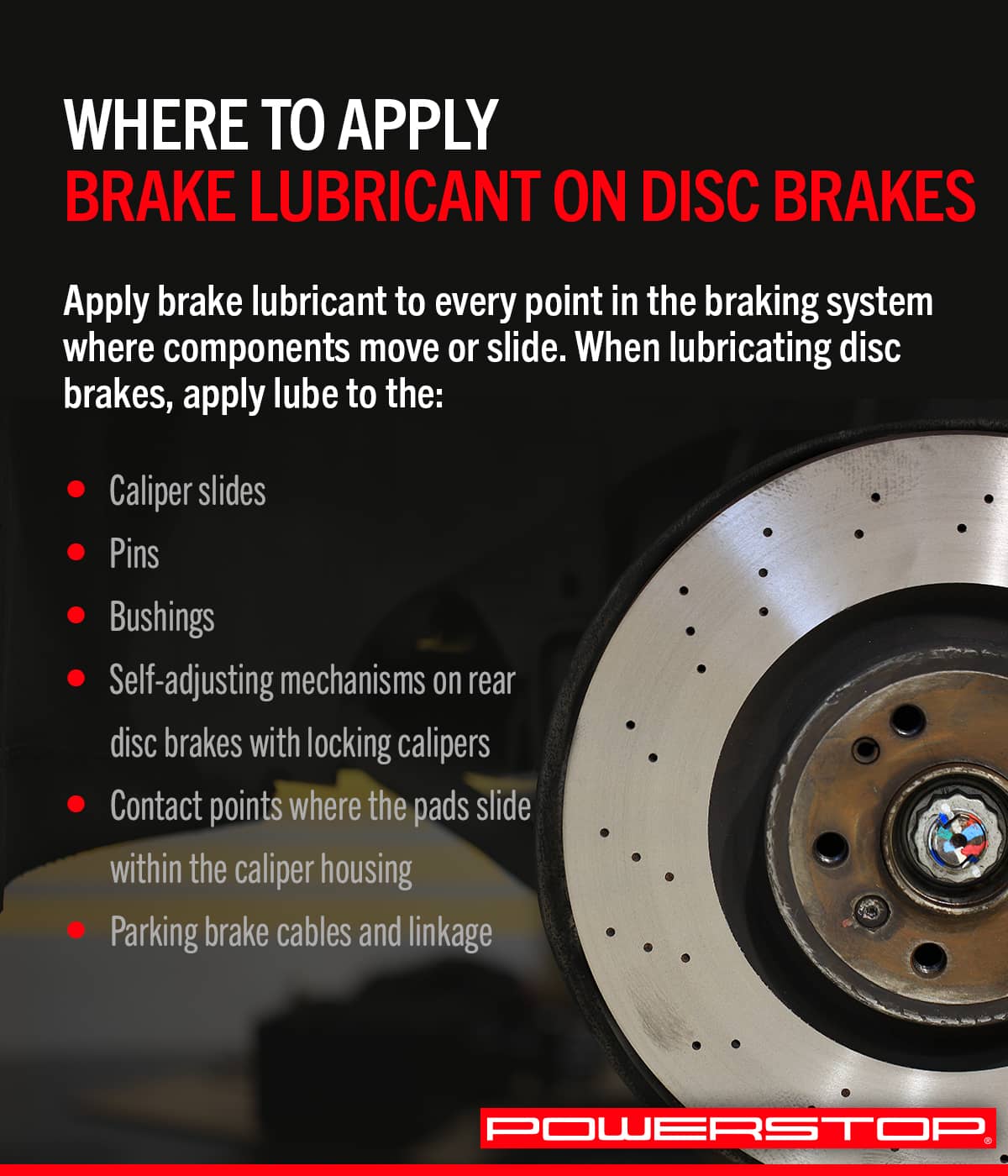
Credit: www.powerstop.com
For hardware identification, see the guide to brake-pad clips. A missing or incorrectly seated clip is not repaired by adding paste.
If lubricant reaches the friction surfaces
Stop the job and follow the component manufacturer’s contamination guidance. Do not assume that wiping the visible surface restores a contaminated pad or that driving will burn the material away safely. The required remedy depends on what was contaminated and how.
Keep the vehicle out of service until the assembly is corrected and checked. A normal-looking rotor after a wipe is not evidence that every affected friction component remains suitable.
Final checks before returning to service
Confirm the required parts are fitted, permitted lubricant is confined to the specified contact points, and the friction surfaces are clean and suitable for service. Complete the vehicle’s reassembly and brake checks, including restoring normal pedal operation where required.
Keep the product name and instructions with the repair record. The correct answer is a compatible compound used sparingly at a verified location—not the most expensive grease and not the largest amount.


Automotive reference information. Confirm specifications in the manual for your exact vehicle. Original replacement guides link to their research sources. About us


