
Choose a fuel pump by the flow it can deliver at your system's required pressure and actual operating voltage, using the correct fuel and engine-power assumptions. A free-flow number or a headline horsepower rating is not enough. Two pumps advertised with the same flow can perform differently once pressure rises. The right size also depends on whether the engine is naturally aspirated or boosted, what fuel it uses and how the rest of the system is configured. For a 500 hp example, start by defining whether that figure is engine output or wheel output.
Then obtain an appropriate fuel-consumption assumption from the engine builder or tuner. Multiply power by brake-specific fuel consumption to estimate fuel mass per hour, convert units if necessary and include the design margin agreed for the application. Finally, compare that requirement with a published pump curve at the intended conditions. The calculation estimates demand; the curve tells you whether a particular pump can supply it.
This is a selection framework, not a recommendation that every 500 hp engine needs the same pump. It also does not replace engineering review of a modified fuel system. Wiring, control, filtration, pickup arrangement, regulator capacity and fuel compatibility can limit a pump that looks adequate on paper. Resolve those details before purchasing or changing the vehicle's fuel-delivery hardware.

Credit: www.snakeeaterperformance.com
Calculate demand, then check the conditions behind the rating
Aeromotive TB-501: selecting a fuel pump identifies power, fuel type, brake-specific fuel consumption, operating pressure and available voltage as important selection variables. The useful lesson is that horsepower alone leaves several essential assumptions unstated. Ask a supplier what conditions its horsepower claim represents. If it cannot provide the flow data and application limits behind the claim, comparing that pump with a well-documented alternative becomes difficult. Brake-specific fuel consumption, usually abbreviated BSFC, expresses fuel mass used per unit of power over time. It is not the same as a vehicle's road fuel economy. The appropriate value depends on the engine and operating point. Do not borrow a value from an unrelated engine simply because its power number is similar. For a real build, the engine builder or tuner should supply a defensible assumption and explain whether it includes the intended fuel and power-adder combination. Here is a deliberately hypothetical gasoline example.
Assume 500 engine horsepower and an assumed BSFC of 0.50 pounds per horsepower-hour. The estimated demand is 500 multiplied by 0.50, or 250 pounds of fuel per hour. If the design then calls for a 20 percent allowance, the illustrative requirement becomes 300 pounds per hour. Those inputs are chosen to demonstrate arithmetic, not to prescribe a universal BSFC or safety margin for a 500 hp engine. If a catalog uses volume rather than mass, the conversion requires the density of the actual fuel under the relevant conditions. For illustration only, dividing 300 pounds per hour by an assumed 6.2 pounds per US gallon gives about 48.4 US gallons per hour. Multiplying by approximately 3.785 gives about 183 liters per hour. Different fuel density changes that result. Do not silently reuse this conversion for ethanol blends, methanol or another fuel. That 183-liter-per-hour illustration is not a pump recommendation.
It is a demand estimate under stated assumptions. The pump must provide the required delivery at the system's working pressure and available voltage, with the intended filters, lines and installation accounted for. A pump advertised as 190 liters per hour at an unspecified pressure cannot be declared adequate from those two numbers alone. The missing test conditions are essential to the comparison. Pressure is especially important in boosted applications where the chosen system may require pressure to change with manifold conditions. Establish the maximum pressure the pump will have to work against in the intended design. Do not select from a curve only at a convenient base-pressure point if the system requires more under peak demand. The engine builder and fuel-system supplier should agree on the complete pressure requirement before interpreting the curve. Flow generally changes with operating pressure, and the published curve shows that relationship for the tested pump. Read the axis labels and units carefully.
A free-flow value refers to a different condition from delivery against system pressure. A rating at one test voltage also cannot be compared directly with a competitor's rating at another without accounting for that difference. Preserve the original curve and its notes with the design record. Voltage should represent what the pump actually receives under the relevant load, not simply the alternator's nominal rating. Wiring and connection losses can reduce available voltage. Electronic control may also change the operating conditions. The installation must meet the pump and controller requirements without bypassing vehicle protection. Increasing voltage beyond the approved range is not a substitute for choosing an appropriate pump or repairing an inadequate electrical supply. Crankshaft horsepower and wheel horsepower are different reference points. If your only figure is a wheel-dynamometer result, agree on how the engine-output estimate will be established.
A fixed percentage conversion is only an assumption and may not describe every drivetrain. Record that assumption explicitly instead of presenting the resulting number as measured engine power. Uncertainty in the input should be reflected in the design discussion, not hidden by precise-looking arithmetic. Fuel compatibility is a separate pass/fail requirement. A pump that delivers enough flow is unsuitable if its materials or design are not approved for the intended fuel. Check the manufacturer's actual compatibility statement for the part number. Do not infer compatibility from the brand name, a similar product or a seller's broad description. The same check applies to hoses, seals, filters and other components that the fuel contacts. The regulator and return arrangement must suit the pump and system. A larger pump is not automatically harmless.
If the rest of the installation cannot manage its delivery, pressure control and heat may become concerns. Aeromotive: fuel system design questions discusses fuel-system matching and why pump selection cannot be separated from the surrounding design. The practical response is to have the supplier confirm the complete combination rather than buying the largest unit that fits. The inlet arrangement also matters. A pump cannot provide its catalog performance if it is starved at the inlet or installed outside its approved conditions. Tank pickup design, mounting requirements and filtration should be reviewed together. An external pump and an in-tank pump may have different installation constraints. Do not assume that relocating a component changes only the bracket. Motorservice: electric fuel pump designs and damage analysis provides background on operating conditions and failure mechanisms that can undermine an otherwise sensible selection.
For a replacement on an unmodified production vehicle, the best starting point is normally the correct approved application, not a custom horsepower calculation. The original system's control and module design may not accept a generic high-flow substitute. Use the vehicle identification and verified part listing. The calculation approach is most useful when the engine's requirements have changed and the system is being designed or professionally evaluated as a whole. Build a comparison sheet for candidate pumps. Include part number, approved fuel, flow at required pressure, test voltage, current requirement, controller compatibility, installation type and any duty limitations. Record unavailable information as unavailable. A blank field is a question for the supplier, not an invitation to assume the most favorable answer. This makes the purchasing decision reviewable and prevents a headline rating from dominating more important constraints.
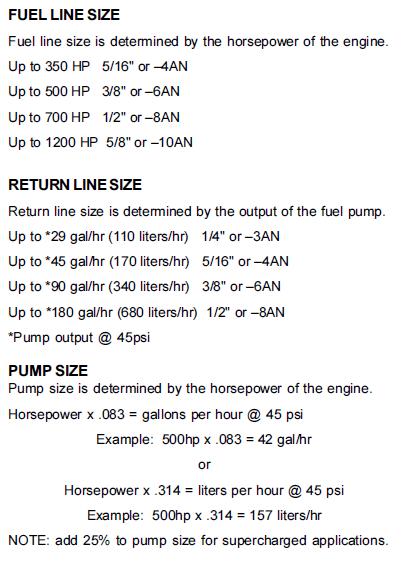
Credit: garage.grumpysperformance.com
Validate the selection before relying on it
Ask the engine builder or tuner to review the assumptions and the supplier to confirm the hardware combination. The two reviews answer different questions: how much fuel the engine requires, and whether the proposed system can deliver it reliably. Include future power plans only if they are realistic and compatible with the rest of the design. Excess capacity chosen without considering control and regulation can create its own compromises. After installation, a qualified technician should verify fuel delivery and pressure control under the intended operating conditions using suitable equipment. A calculation cannot prove that wiring, pickup, regulation and installation are correct. Do not perform an uncontrolled full-load road test to see whether the engine runs lean. The validation plan should be agreed before operation and should protect the engine as well as the occupants. Also record whether a published flow figure describes one pump or an assembled multi-pump module.
Comparing those figures without checking the configuration can create a large error even when pressure and voltage match. Keep the calculations, curve, fuel specification and test results. If a future change adds boost, changes fuel or raises power, revisit the assumptions rather than assuming the original selection remains adequate. A different filter, controller or supply voltage can also alter the conditions. The record makes it possible to reassess the system without starting from a vague statement that the pump is rated for 500 horsepower. The decisive comparison is required fuel delivery versus verified available delivery at the same pressure, voltage and fuel conditions. The worked example shows how to estimate one side of that comparison. It does not eliminate the need for the other side. A correctly sized pump is one whose documented performance and installation suit the complete application, with uncertainty and design allowances stated clearly.


Automotive reference information. Confirm specifications in the manual for your exact vehicle. Original replacement guides link to their research sources. About us


