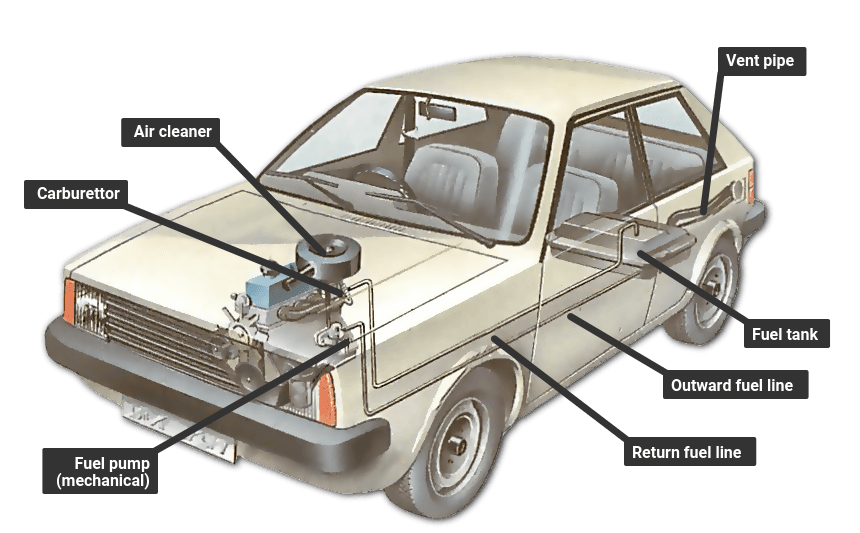

The fuel pump may be inside the fuel tank, mounted outside it, or attached to the engine. Some vehicles have more than one pumping stage, so finding an engine-mounted pump does not establish that there is no pump in the tank. The reliable answer comes from identifying the year, model, engine and fuel system, then checking the matching component-location drawing.
Looking under a rear seat is not a universal locating procedure, and removing an interior cover is not the same as safely opening a fuel system. This guide helps you identify the component you are looking for before dismantling anything.
It also separates the pump from its relay, electrical controller and filter, because those parts can appear in the same repair discussion while occupying different places. If your immediate problem is a fuel smell or a visible leak, stop operating the vehicle and arrange an appropriate inspection rather than searching with the ignition switched on.

Credit: www.e85fuelpump.com
The pump location depends on the fuel-system design
An in-tank electric pump is commonly supplied as part of a larger module. That assembly can include a reservoir, strainer, electrical connections and a fuel-level sender. A parts listing may therefore show a tall plastic assembly even though the pumping element itself is much smaller. DENSO describes its in-tank products and explains their placement in the tank in its DENSO: fuel pump types and applications. That information supports a common design, not a promise that every car follows it.
The pump inlet has to receive fuel from the tank, but the service opening can face upward and be hidden by the vehicle body. A photograph of the tank underside may consequently show no recognizable pump at all. An external electric pump is installed in the fuel path outside the tank. Its shape alone is not enough to identify it: a fuel filter or damper can look similar in a poor photograph. Use the vehicle diagram and the part label rather than disconnecting a line to find out what flows through it.
Tracing a line safely by sight can help orient the drawing, but do not crawl beneath a car supported only by a jack. Heat shields, undertrays and body structures can hide the route. Their presence is not evidence that the pump was removed or that a universal replacement belongs there. A conventional mechanical gasoline pump is often mounted on the engine and driven by an engine mechanism.
Its location relates to that drive arrangement, not simply to proximity to the fuel tank. This description should not be confused with a modern high-pressure injection pump. Both may be engine-mounted, yet their pressure ranges, control strategies and service precautions differ substantially. Buying a part because it is described as a mechanical fuel pump without checking the engine can therefore be a serious mistake.
Establish the system type before choosing tools or reading a removal guide. On many direct-injection gasoline and common-rail diesel systems, the high-pressure pump supplies the rail while a lower-pressure supply arrangement feeds it. The exact layout varies. HELLA: checking high-pressure fuel pumps illustrates why high-pressure diagnosis treats supply and pressure generation as different stages.
A low rail-pressure complaint does not tell you which stage needs attention. When asking a workshop where the pump is, specify whether you mean the tank supply pump or the engine high-pressure unit. That single clarification can prevent a quote for the wrong component. The fuel pump relay is an electrical switching component rather than a pump carrying fuel.
A fuse-box cover may identify a relay position, but the matching vehicle documentation remains necessary because a similar-looking box can serve different circuits. Some applications use electronic control modules or integrated switching instead of a simple removable relay. The controller may be mounted elsewhere on the vehicle. Finding a label marked fuel pump therefore identifies part of the electrical circuit, not necessarily the physical pump location.
A fuel-level reading is also not a location test. The sender may share a module with the pump, but shared packaging does not mean that a working gauge proves the pump is healthy. Likewise, a failed gauge does not establish a failed pumping element. Keep the component names separate when interpreting a parts diagram: pump, module, sender, strainer, filter, regulator and controller describe different functions, even when several are supplied together.
Find the right diagram before opening a panel
Start with the vehicle identification number and engine designation. Include the production year and market, because a model name can cover several fuel-system designs. If the engine or tank has been replaced, note that history as well. An online drawing for the nearest-looking model is a lead, not verification. The useful drawing labels the pump assembly, its location and the procedure by which it is accessed. A parts catalog can help identify the assembly, while service information explains whether access requires tank removal, an existing service cover or another documented route.
Check whether the procedure actually identifies a removable access panel. Some cars allow service from the cabin or luggage area; others require lowering the tank. DENSO: fuel pump installation and troubleshooting discusses different installation arrangements and directs the user back to the vehicle service manual. The distinction matters because an apparent circular outline in the floor is not permission to cut the body. Cutting near a fuel tank can damage lines, wiring or structural material and introduces ignition hazards. If no factory access exists, use the specified tank-removal process rather than creating one.
Before lifting trim, consider what else passes through the area. Seats can contain electrical wiring and safety-system connectors. Hybrid vehicles may have additional electrical isolation requirements. An access cover can be sealed to prevent fumes entering the cabin; disturbing that seal is part of a repair, not a harmless inspection. You can usually establish the pump location from documentation without opening the fuel system at all. If a workshop requests access, ask which cover or tank procedure applies to your particular vehicle.
Listening for a brief sound near the tank can sometimes help localize an operating electric pump, but silence is not a dependable location or failure test. Operating strategy, ambient noise and fuel level can change what you hear. The control system may run a pump only under particular conditions. Repeatedly cycling the ignition just to chase a sound adds little if you have not identified the circuit. A technician can use the relevant command and diagnostic information without assuming that every pump must hum whenever a door opens or a key turns.
Once you have the diagram, record the exact assembly name and part number rather than relying on a photograph alone. Compare connector style, line arrangement and application notes, but avoid unplugging components merely for identification. A catalog may offer a complete module and a separate pump insert; these are not equivalent repair scopes. An insert may require reuse of a suitable housing and other serviceable components, while a module may include additional parts. Ask what is included before interpreting a price difference as a quality difference.
If the purpose of locating the pump is to diagnose a no-start, preserve the symptoms and trouble-code information first. A cranking engine with no start has many possible causes. Knowing where the pump sits is useful for access planning, but it does not justify replacing it. Record whether the problem occurs hot or cold, after refueling, at a particular fuel level or after recent work. Those details help a technician select tests that distinguish an electrical supply problem from a fuel-delivery problem.

Credit: www.autobutler.co.uk
What to do once you have identified it
A confirmed location should lead to a defined next step: identification, diagnosis or replacement. For identification only, save the correct diagram and stop there. For diagnosis, obtain the specified test procedure and equipment before touching lines. For replacement, establish pressure relief, electrical isolation, safe fuel handling, access support and the required seals. The location of a pump does not tell you how much pressure remains after the engine stops. Opening a line simply to see whether fuel appears is not an acceptable locating method.
Do not mistake an access opening for a work area that needs no precautions. Fuel vapor can accumulate, and a disconnected line can release residual fuel even after a supply pump is disabled. Keep ignition sources away and use equipment intended for the fuel involved. If the tank must be lowered, its remaining contents and attached lines affect the job. A safe plan must account for both the tank's weight and the risk of damaging hoses or connectors while moving it. A useful message to a repair shop is: identify the supply-pump location and explain the evidence that it needs replacement.
Add the year, engine and symptoms. If the quotation refers to a high-pressure pump, ask how the low-pressure supply was checked. If it refers to a module, ask whether the sender and strainer are included. These questions clarify scope without trying to prescribe a repair from a generic online diagram. The practical answer is therefore specific rather than universal: locate your vehicle's documented pump assembly, distinguish it from the electrical controls and any second pumping stage, and follow its intended access route. That approach avoids unnecessary trim removal, unsafe tank cutting and replacement of a component that merely happens to be near the actual fault.


Automotive reference information. Confirm specifications in the manual for your exact vehicle. Original replacement guides link to their research sources. About us


