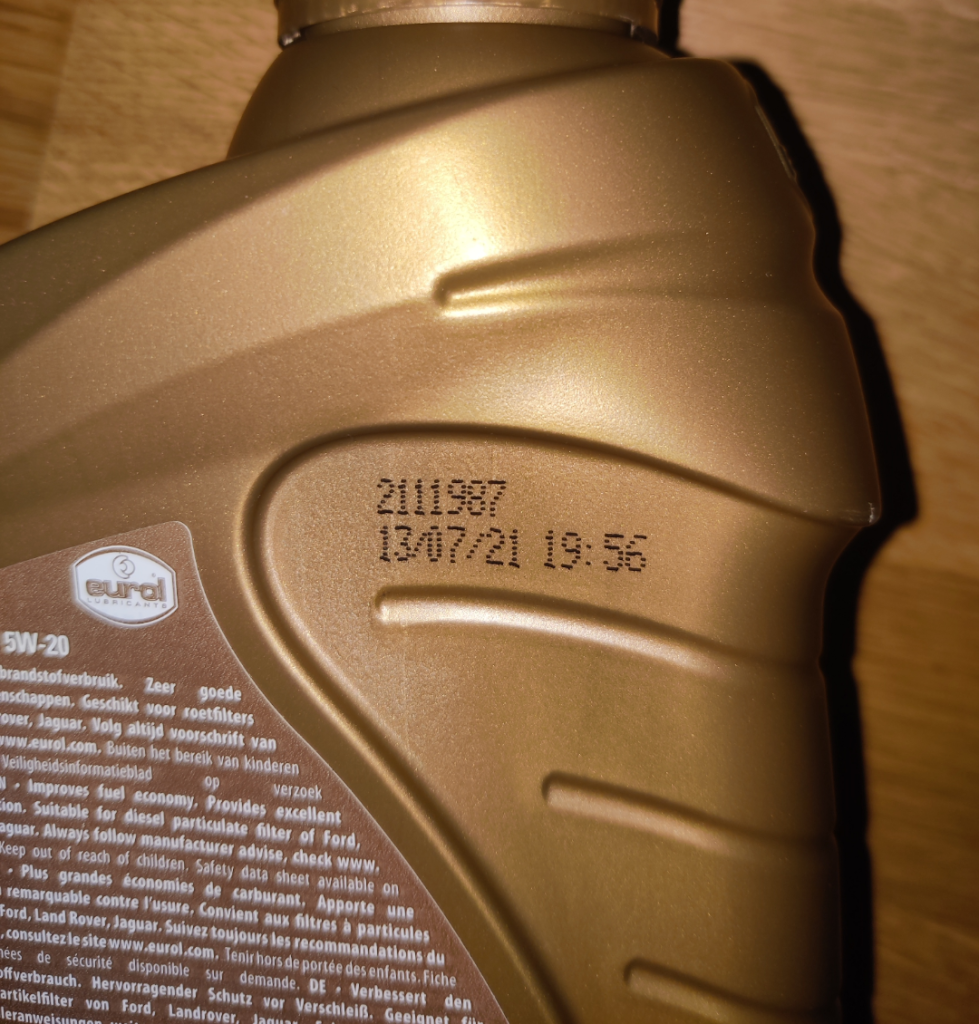

Motor oil can have a manufacturer-recommended shelf life, but there is no universal expiration period for every bottle. Identify the exact product, check its packaging and storage history, and obtain the maker's guidance when a date code or condition is uncertain. A bottle's shelf life is also separate from the oil-change interval once oil enters an engine. Neither clock replaces the other.
Start by separating four questions: What product is this? How old is it? Has it been stored as the manufacturer requires? Does it meet the specification for the vehicle you intend to fill? A favorable answer to one question does not answer the rest. A fresh bottle can be the wrong specification, while an older bottle needs an age-and-condition assessment before its suitability can be established.
This guide concerns unused automotive engine oil held in packaging, including bottles opened for partial use. It does not diagnose a running engine from the appearance of its dipstick oil. If your concern is how long oil may remain in a vehicle, see the separate guide to time-based oil changes and the maintenance instructions for your exact vehicle.
What a shelf-life recommendation means
In its shelf-life technical guidance, Mobil describes a period of storage before quality-control checks are needed to verify performance. Its recommendations assume proper storage in original sealed packaging. This is a quality-assurance boundary, not evidence that every container changes chemically at midnight on a particular birthday. Beyond the stated period, seek the maker's advice instead of inventing an extension.
A named manufacturer's number is not an industry rule
For the specific question of unopened Mobil 1, ExxonMobil recommends a maximum five-year shelf life for engine oils, including that product. Treat this as ExxonMobil's guidance, not permission to assign five years to any lubricant on your shelf. Keep the product name and the assumptions attached to the number whenever comparing advice from different sources.
Confirm whether the guidance covers your packaging
AMSOIL's storage guidance also gives up to five years for motor oil sealed in its original container. It identifies environmental conditions and potential contamination as relevant factors. A similar number from another maker is useful context, but it still does not answer the case of a damaged seal, a partly filled bottle, or an unidentified product. Check the exact scope of the recommendation.
Product identity matters more than an oil-family label
Chevron's published product-specific shelf-life table, dated January 2021, distinguishes individual lubricants by product number and name. It illustrates why an engine oil, grease, and another workshop fluid should not inherit the same storage assumption. Because this is a dated table, confirm current instructions for your bottle with the supplier rather than treating an old catalog entry as a fresh product guarantee.
A batch code is evidence to identify, not to guess
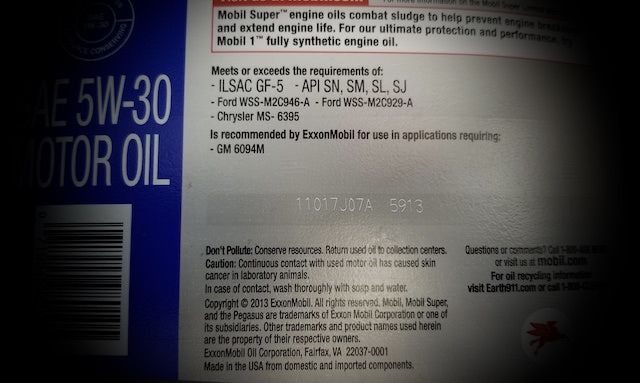
Photograph the front label, back label, cap area, and any printed or embossed code. Retain the full sequence, including letters, spaces, and punctuation. Ask the manufacturer which marks identify manufacture, packaging, batch, or a use-by instruction. A short number can look like a date without being an expiration date. Avoid decoding one brand's code with a forum explanation written for another brand or packaging generation.
Purchase date and manufacture date answer different questions
Your receipt records when you bought the bottle, which may help trace the supplier and order. It does not establish when the product was blended or packaged. When seeking advice, provide both the receipt date and the container code. If the maker specifies a starting point for shelf life, use that starting point. Do not silently substitute your purchase anniversary simply because it is the only date you remember.
Credit: www.reddit.com
Unopened, opened, and unidentified bottles need different checks
An intact seal and known storage history are useful evidence, but neither makes the product appropriate for every vehicle. An opened bottle adds questions about when it was opened, how it was closed, and whether anything entered it. An unlabelled container adds uncertainty about identity itself. Keeping these situations separate prevents a recommendation for factory-sealed stock from becoming advice to use any leftover oil found nearby.
Write the package condition as a description rather than a verdict. Factory seal intact, opened last month for a top-up, and found uncapped are useful descriptions. Good and bad hide the evidence behind the judgment. An accurate short history makes it easier to ask a technical adviser a specific question and to keep different bottles from being confused.Factory-sealed oil: verify the product and its storage history
For sealed stock, locate the complete identifying code before removing or covering packaging. Record where the bottle has been kept and whether that environment matched its instructions. If you moved house or acquired the bottle secondhand, include the period you cannot account for. A continuous history is different from a guess based only on its current storage location.Previously opened oil: explain how it has been handled
For an opened bottle, note why it was opened and whether its contents stayed identifiable afterward. A partial fill from a known service has a different history from an unmarked jug passed between several people. Do not assign an arbitrary opened-bottle deadline without the maker's guidance. Keeping the cap closed is useful handling, but it does not answer every question about prior exposure.What storage can change
In its general storage and shelf-life bulletin, Chevron discusses conditions affecting lubricant stability and estimated life. The practical implication is to assess the bottle's environment, not just its age. A sheltered cupboard and years beside a hot window represent different histories. Describe actual exposure to the manufacturer; avoid claiming that an arbitrary number of hot days automatically proves success or failure.
Seal damage creates a separate uncertainty
Inspect the outside for leakage, cracks, a damaged closure, and a label that no longer identifies the contents. If the package has been compromised, isolate it from stock you plan to use and ask for handling advice. Do not transfer suspect oil into a new bottle to make it appear fresh. A clean replacement container cannot restore the missing history or certify that the contents still meet the original specification.
Reclosing a cap does not recreate a factory seal
When contacting technical support about opened oil, describe the opening date if known, the amount remaining, and the storage location. Mention whether it stayed in its original bottle and whether a used funnel or another liquid contacted it. These are information-gathering questions, not a home test for approval. If the manufacturer cannot establish suitability from that history, choose an identified replacement rather than assuming the unopened-bottle recommendation still applies.

Credit: www.blauparts.com
Why appearance cannot certify old oil
Mobil's technical note identifies haze, strong odor, and significant sediment as possible deterioration clues, while acknowledging that slight sediment can occur without harming some oils. This is a reason to ask the manufacturer about an observation, not a universal rule that every visible deposit means failure. Conversely, clear-looking oil has not passed a performance test. Do not taste it, deliberately inhale fumes, or perform improvised heating experiments.
Do not turn color into an expiration test
An internet photograph of another bottle is a poor reference for your own product. Lighting, the container, the exact formulation, and camera settings complicate comparison. Record what you see if technical support requests it, but avoid treating a color match as authorization to fill the engine. The important evidence remains the identified product, its instructions, its package, and a storage history that supports the recommendation you are applying.
Unknown contents cannot be validated by shaking the bottle
Shaking, straining, or adding fresh oil does not establish the identity or specifications of an uncertain liquid. If the bottle has been reused or left open where other materials could enter, explain that directly. Do not combine it with known usable stock while you investigate. Keeping the uncertain amount separate preserves the option to use the identified product without extending the same uncertainty to a larger volume.
Build a storage routine that preserves useful information
Gulf Oil's storage guidance emphasizes sheltered conditions, readable identification, resealing, inspection, and stock rotation. For household bottles, an easy adaptation is to keep labels facing outward and record the date you first open each one. Use a separate note if needed so that it does not cover original codes or instructions. Keep unused stock clearly apart from containers holding drained oil.
Use the temperature guidance for the exact product
AMSOIL publishes an ideal storage range of 32 to 85 degrees Fahrenheit, or 0 to 29 degrees Celsius, in its lubricant-storage article. This is a named manufacturer's recommendation, not a universal instant-damage threshold for all motor oils. If your storage falls outside the maker's conditions, describe the duration and circumstances when seeking advice. Do not calculate a made-up remaining shelf life by subtracting months for each temperature excursion.
Buy quantities you can identify and rotate
Before buying a case, consider how much you expect to use for the vehicles you actually maintain. Account for different specifications rather than assuming one spare oil fits everything. Place the older suitable stock where you can find it first and check its condition before use. A discounted bulk purchase has limited value if the vehicle changes, the product cannot be identified later, or its storage conditions are unsuitable.
Separate shelf age from engine-service life
Mobil's storage and handling FAQ distinguishes stored-product life from suitability once a lubricant is in service. Oil circulating through an engine faces conditions different from oil sealed on a shelf. Follow the vehicle's maintenance schedule and applicable oil-life system after filling. A bottle with years of permitted storage remaining does not authorize years between engine oil changes.
The following distinctions prevent storage advice from being applied to the wrong problem. They also provide a useful check when reading an online claim: identify what product, condition, application, and time period the author actually discusses. If any of those details is missing, the claim may not answer the question posed by the bottle in front of you.A fresh bottle does not extend the vehicle's service interval
When suitable stored oil is poured into an engine, record the service date and follow that vehicle's maintenance instructions. Do not subtract the bottle's age from an engine-service interval or add unused shelf-life years to it. These calculations combine different kinds of guidance and cannot produce a valid maintenance date.Low annual mileage does not describe unused bottled oil
A car driven infrequently still contains oil already in service. A bottle in a cupboard contains packaged stock. Asking how many miles each has covered therefore cannot establish a shared replacement schedule. Use the vehicle's time and operating guidance for the first case and the lubricant manufacturer's storage guidance for the second.Synthetic branding does not remove storage requirements
Synthetic describes part of a product's formulation and marketing identity; it does not answer whether its package has been damaged, its contents changed, or its required approval matched. Keep those checks even when the label carries a premium product name. No brand adjective supplies the missing history of an opened bottle.An old receipt does not identify the manufacturing batch
Keep receipts as supporting information while asking the maker to interpret package markings. A receipt can identify a retailer and transaction even when a batch code is difficult to read. A clear photograph may help with that code. Do not create a manufacturing date by assuming stock was produced immediately before you bought it.An intact cap does not establish the correct specification
The specification check applies to every candidate bottle, including one purchased today. If the intended vehicle changed since you bought the oil, review the requirements again. A container seal offers information about access to the contents; it does not establish that the product meets the viscosity, performance category, or approval needed for your current engine.Unknown history needs a product-specific answer
Uncertainty is a useful result when it identifies the missing evidence. A support request might need a clearer code photograph, a product number, or a better account of storage. Keep the bottle separate while resolving that issue. Do not convert uncertainty into an unconditional recommendation simply to avoid postponing a purchase.Check compatibility before deciding to use stored stock
Imagine a hypothetical owner with two unopened bottles of the same age. One carries the viscosity and approvals required by the current car; the other was bought for a previous vehicle. Both need the same storage assessment, but only the first is a candidate for that service. The second bottle does not become suitable because it is unused or because someone wants to avoid wasting it.
Read the requirements before the brand name
The API Motor Oil Guide distinguishes viscosity grades from performance categories and directs readers to vehicle-manufacturer recommendations. Read the bottle against your exact manual, including any required manufacturer approval. This is a compatibility check in addition to storage condition. For a fuller selection process, see how to identify the engine oil your vehicle requires.
Write the required specification and the bottle's stated specification side by side. If their wording differs, verify the difference through the vehicle manufacturer or lubricant maker. Do not resolve it by choosing whichever label sounds newer or more premium. A newer container date provides no proof of an approval that is absent from the product information, and a familiar brand name cannot supply that missing evidence.
A useful way to organize the final decision is two independent checks: acceptable stored condition and correct intended application. Both must be resolved. If you are unsure about the first, contact the oil manufacturer with the package history. If you are unsure about the second, use the vehicle documentation and an appropriate technical contact. This avoids asking a single vague question, such as is old oil okay, that hides the actual uncertainty.
Make a support request the manufacturer can answer
Include the complete product name, viscosity, market where purchased, bottle size, batch code, purchase information, seal condition, and storage history. Add the planned vehicle and specification if you are asking about use rather than date decoding alone. Ask which shelf-life guidance applies to that exact container and whether the observed condition changes the recommendation. Keep the response with your maintenance records so the decision remains traceable.
Do not imply that the manufacturer has approved your bottle because a website gives a general shelf-life number. Technical support may need photographs, batch details, or more information. If a specific response cannot be obtained before a scheduled service, use a clearly suitable replacement and keep the uncertain bottle segregated while resolving its destination. This is a practical way to avoid making a rushed compatibility decision.
Laboratory evaluation and a visual check are different things. Mobil's shelf-life document describes recertification after the stated period; a household owner cannot reproduce that process by checking smell or shaking a jug. Whether professional evaluation is worthwhile depends on the quantity and the maker's guidance. Do not describe an untested bottle as recertified, and do not assume a generic test automatically establishes every approval required by your vehicle.
If you decide not to use the oil, tell the receiving service that it is unused or partly used packaged oil, rather than engine-drain oil. Keep it separate from other liquids and follow the local program's acceptance directions. Our oil collection guide explains how to find a route, while the EPA's household waste guidance explains why original labels and separation matter.
Credit: www.gopurepower.com
The decision to make before opening the filler cap
For a stored bottle, verify identity, age guidance, condition, and vehicle compatibility before using it. If any of those is unknown, state the unknown explicitly and investigate that point. Do not turn a shelf-life recommendation into a universal expiration date, or turn a good-looking bottle into proof of fitness. The goal is an informed decision about a specific product and a specific engine.
After the decision, record what you used, when the engine service occurred, and which partly filled bottles remain. Keep the next service interval tied to the vehicle's instructions. Keep future shelf-life checks tied to the manufacturer's package and storage guidance. Those separate records make the next purchase, top-up, and oil change easier to plan without confusing the age of unused stock with time spent operating in an engine.


Automotive reference information. Confirm specifications in the manual for your exact vehicle. Original replacement guides link to their research sources. About us