
A clicking sound near the steering wheel may be an ordinary indicator sound, a documented electrical operating sound or a new mechanical complaint. The timing is more useful than the word click.
Does it follow the flashing turn-signal indicator, occur once at startup, or repeat as the rim turns with the signals off? Record that distinction before buying parts.
A click accompanied by binding, looseness, a warning or changed control should be inspected. Do not remove the airbag cover or spray lubricant into the wheel hub to investigate.
Compare the sound with the signal indicator
If each click follows the illuminated arrow on the instrument panel, it may be the vehicle's normal signal indication. Tesla Model S owner manual: turn-signal indications documents audible clicking during turn-signal operation for the covered Model S. Check your own manual rather than assuming every vehicle uses the same sound. The key observation is whether the click continues when the signal has stopped or occurs independently of it.
Notice whether the signal cancels correctly
A sound and a malfunctioning signal may occur together, but they should both be described. Does the indicator stop as expected, continue flashing, or briefly change direction? Do not force the stalk or dismantle its mechanism. A cancellation complaint can involve model-specific mechanical or electronic behavior. Give the workshop the exact sequence rather than asking it to replace the whole column because you heard a click.
A startup click has a different timing pattern
Hyundai: MDPS operating sounds and warnings explains that a relay click can occur when its described steering system is switched on or off. That is a narrow operating-state example, not a declaration that every steering click is normal. Compare your event with the actual vehicle manual. A repeated click while turning, especially with changed effort or a warning, should not be dismissed simply because a relay can make noise at startup.
Do not jump straight to a clockspring diagnosis
The steering-wheel area contains several functions, and noise alone cannot identify an internal electrical connection or mechanical contact. Horn or button problems and restraint-system warnings are relevant additional observations, but they still require the appropriate diagnosis. Do not probe connectors, bypass an airbag warning or rotate a disconnected assembly as a home experiment. The correct service procedure protects both steering and safety-system operation.
Write down the event before changing anything
A useful note includes ignition state, vehicle movement, signal operation, turning direction and whether the sound repeats at one wheel position. Mention recent work around the column or dashboard. Do not lubricate or tighten an unidentified part before the inspection, because that can change the evidence. A clear short history is often more useful than a long list of suspected parts gathered from unrelated vehicle forums.
Distinguish rhythm from a single contact
An evenly timed indicator tick differs from a click tied to a particular steering angle. A single event when a control changes state differs from repeated noise through the whole turn. Describe what you heard without assigning a component.
If a passenger can obtain a recording safely, include the operating context. Do not record with a phone in your hand while controlling the vehicle.
Keep accessible checks non-invasive
Park safely before looking around the steering wheel. Check for an accessory touching trim.
Look for a loose object near the column or pedals. Note whether a cover interferes with controls.
Do not pry off the center pad. Do not reach around a moving shaft.
Do not put tools into a trim gap.
If the sound seems internal, leave the disassembly to a repairer using the correct instructions.
An accessible accessory check can be useful, but it does not rule out a separate fault when warnings or abnormal steering are present.
A click during a moving turn belongs on another branch
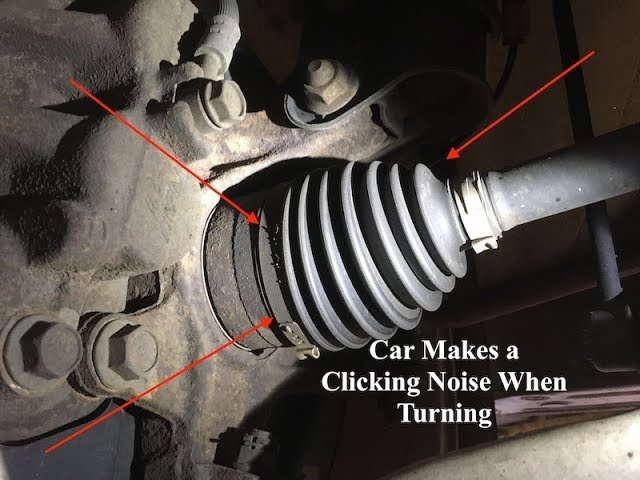
If the sound occurs mainly while the vehicle is moving through a turn, report vehicle speed and whether the wheel itself is still rotating. Road-wheel, driveline or suspension movement may be relevant. That differs from a cabin click reproduced while stationary. The moving-turn click guide focuses on that pattern. Do not assume a sound heard through the column originates inside it.
Bumps can reveal a different complaint
A rattle or click over rough surfaces with the wheel held normally may need a mounting or suspension investigation. It is not automatically a turn-signal issue. Note whether the sound also occurs without a steering input. Avoid deliberately striking potholes to reproduce it. Give the technician the ordinary driving conditions in which it happened and let the workshop choose a controlled inspection.
Weather information helps an intermittent investigation
If the click occurs only when the cabin is cold or after the vehicle warms, record that condition. Do not heat trim with a heat gun or introduce water to reproduce it. Materials and operating systems can respond differently across conditions, but temperature dependence does not identify a failed part. A workshop may need to inspect the vehicle after an appropriate parked period rather than during a brief warm visit.

Credit: www.carmechanicadelaide.com.au
A service bulletin must match the vehicle
GM TechLink: turn-signal and steering-column conditions describes particular turn-signal and column conditions on listed GM models. It shows that similar-sounding complaints can have different corrections. It does not authorize those corrections on another vehicle or prove that your sound has the same cause. Ask the repairer to verify the VIN, current service information and actual behavior before applying a bulletin. A matching symptom phrase alone is insufficient.
Do not tighten column fasteners by guesswork
A click may lead an owner to suspect something loose, but random tightening can damage parts or disturb a safety-critical connection. The relevant fastener, torque, replacement requirement and assembly state belong to the service instructions. Do not use a general torque value found for another vehicle. Ask the workshop what evidence identifies looseness and how the repair will be verified afterward.
Replacement should follow a confirmed finding
A new stalk, clockspring, column or steering gear should not be selected from a sound recording alone. Ask which inspection or diagnostic result supports the proposed part. If several functions are affected, the repairer should explain how they connect. Do not assume that an expensive assembly is the safest choice merely because it contains several possible sources. An unsupported replacement can leave the complaint unchanged.
A workshop should separate function from acoustics
Ask whether the click affects steering, signaling, electrical controls or only cabin noise. A minor trim sound and an impaired control are different repair priorities. The technician should assess the functions you reported, not just make the noise quieter. If a warning is present, preserve its wording and any recorded faults. Clearing a warning does not establish that the related system is working correctly.
Maintenance is not an instruction to lubricate everything
Follow the vehicle's specified maintenance and inspection requirements. The steering-wheel hub and electrical controls are not general lubrication points. Do not apply an aerosol because another owner reported temporary silence. The product can reach unintended surfaces and obscure the original complaint. If the manufacturer specifies a treatment for a confirmed contact, the repairer should identify that instruction and use the correct material.
Pay attention to a change from the usual sound
An owner may know the normal indicator rhythm well. A newly louder, irregular or position-dependent click is useful information even if the car still steers normally. Describe the change and when you first noticed it. Do not assume familiarity with one normal sound means every click in the same area is harmless. Conversely, a normal documented operating sound does not require speculative parts replacement.
Avoid tests that distract or restrict steering
Do not wedge an object against trim, hold a control in an abnormal position or remove a cover while driving to change the noise. Keep normal access to the wheel and pedals. Review settings or manuals only when parked safely. A useful diagnosis should not depend on the driver performing an improvised experiment that reduces control of the vehicle.
Credit: www.youtube.com
Warnings or abnormal effort change the next step
If a click accompanies heavy, notchy or unpredictable steering, stop safely and obtain guidance appropriate to the vehicle. A restraint-system warning or failed control also needs the correct inspection.
Do not keep driving merely to prove that a sound follows a particular angle. The urgency depends on the functional condition, not just how quiet or loud the click is.
Visible damage should be reported immediately
Mention a recent collision, impact, attempted theft or work that disturbed the steering area. Do not assume the damage is only cosmetic because the rim still turns.
A repairer may need to examine connections and mounting condition before any road evaluation. Keep photographs taken safely while parked, but do not remove protective covers to obtain a better view.
Verify all reported functions after the correction
A completed repair should address the original sound and any related signaling, control or warning complaint. Ask what was found and which checks were performed. If the noise was intermittent, agree on what to record if it returns.
A short silent visit does not necessarily confirm a cold-only complaint has been resolved. Keep the service record so a later technician can compare findings rather than repeat guesses.
Credit: www.highlinewarren.com
The useful distinction is timing plus function
Begin by matching the click to signal operation, startup or actual steering movement. Then compare the event with the vehicle's documented behavior and note any functional changes.
Do not diagnose an internal steering-wheel part from noise alone. A clear account helps separate a normal indication from a fault that needs inspection.
If the event cannot be explained, preserve the evidence and request a focused assessment. The objective is correctly functioning steering and controls, not silence obtained by masking an unidentified source.


Automotive reference information. Confirm specifications in the manual for your exact vehicle. Original replacement guides link to their research sources. About us


