
A suspension ball joint and a tie rod end are not the same service part. They can both use a ball-and-socket connection, but they occupy different positions and perform different jobs. The shared joint principle does not make them interchangeable.
In common front suspension layouts, the suspension ball joint connects a control arm to the wheel’s knuckle. A tie rod end connects the steering linkage to the knuckle so steering movement can be transmitted. The exact arrangement varies with vehicle design.
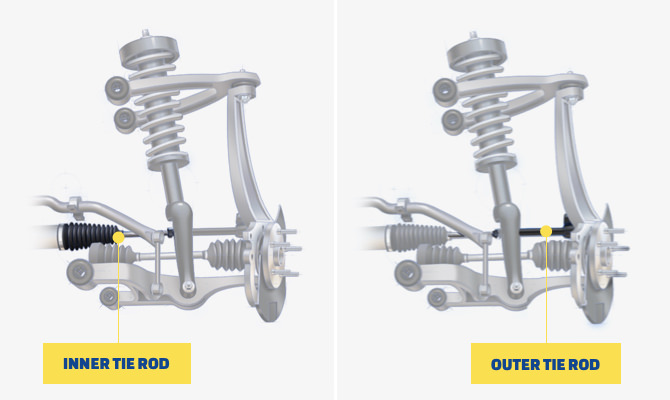
The difference is easiest to see by following the connection
Credit: www.moogparts.com
Trace one side of the part, rather than judging its shape alone. If the joint connects the steering linkage to the knuckle, it is being described as a tie rod end. If it connects a suspension control arm to the knuckle, the repair discussion is usually about a suspension ball joint.
MOOG’s control-arm guide describes how the arm and ball-joint arrangement varies between suspension layouts. Delphi’s tie rod information describes the steering connection. Those roles are the useful distinction when reading an estimate.
Why parts catalogues can use similar language
Credit: www.tirereview.com
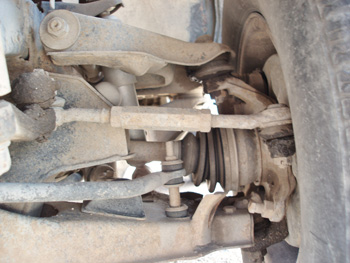
Ball joint can describe a type of articulating connection as well as the familiar suspension component. A technical document may therefore refer to a steering joint using ball-joint terminology. Context and the illustrated location matter.
Ask for the complete component name, side and position. “Front ball joint” is less precise than identifying a lower control-arm joint or an outer steering end. A diagram or photograph from the inspection can prevent ordering a part for the wrong system.
Similar symptoms do not identify the failed part
Clunks, changes in steering feel and uneven tire wear can prompt an inspection of several components. The symptom does not establish which joint has excessive movement or whether another part is responsible. Replacing the most familiar name on the list can leave the original fault unresolved.
A useful inspection report localizes movement and states the relevant test condition. The correct loading and measurement method for one joint may not be appropriate for another. Do not use a single wheel-rocking observation as a universal pass-or-fail test for every steering and suspension component.
The repair methods are different too
A suspension ball joint may be supplied separately or as part of a larger assembly, depending on the application. An outer tie rod end is part of the adjustable steering linkage. The access, attachment and required tools must be established for the specific repair.
A tool advertised for both ball joints and tie rod ends does not mean every one of those parts can be serviced the same way. Separator geometry, pressing requirements and the risk to boots or nearby components differ. Read the actual procedure before choosing the tool.
Do not use lubrication as a compatibility test
Both component families can contain designs with different maintenance requirements. A grease fitting, or the absence of one, does not prove that two parts serve the same purpose. The manufacturer’s part instructions determine the appropriate service.
For the steering side, see sealed versus greaseable tie rod ends. Neither adding grease nor tightening an external nut restores a worn internal bearing. A change in noise after maintenance does not establish that an unsafe condition has been repaired.
How to evaluate an estimate

Credit: www.moogparts.com
Ask which joint is faulty, what evidence supports that conclusion and whether the proposed price includes required hardware and post-repair alignment checks. If a complete control arm is proposed, ask why that assembly is being supplied rather than assuming it is the same part as a tie rod.
Steering or suspension damage can affect control, so uncertain or severe symptoms require prompt professional assessment. The tie rod inspection guide covers the steering-linkage side; it should not be substituted for the vehicle’s suspension ball-joint inspection procedure.


Automotive reference information. Confirm specifications in the manual for your exact vehicle. Original replacement guides link to their research sources. About us


