
On a small-engine fuel pump, vacuum usually describes the engine pressure signal that operates the pump. It does not mean that every hose carries vacuum, that the pump produces vacuum for the brakes, or that any source of suction can operate it correctly. The useful question is not simply whether vacuum exists. It is whether the specified pump receives the right changing pressure signal through the correct connection while the engine is being tested under the prescribed conditions.
This guide helps you interpret those words and the observations around them. The related pulse fuel pump operating-cycle guide explains diaphragm movement and fuel transfer. Here the emphasis is on identifying the signal path, separating evidence from assumptions and deciding what information is missing before blaming the pump. The scope is a compatible small-engine diaphragm fuel pump.
An automotive vacuum pump, a vacuum-referenced fuel-pressure regulator and an electric fuel pump are different devices. Their connections and diagnostic procedures are not interchangeable. Before following an online diagram, obtain the engine model and the installed pump's part number. A familiar-looking plastic housing is insufficient identification when the consequences of connecting a fuel hose incorrectly include leakage or fuel reaching a passage intended for air.

Credit: forums.kartpulse.com
What vacuum and pulse mean when interpreting a fault
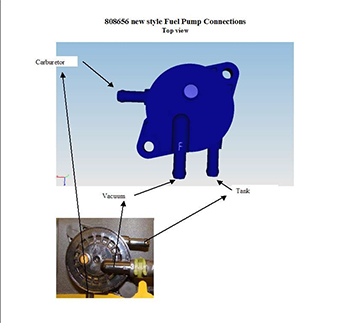
Briggs & Stratton: pulse fuel pump operation and service describes pumps operated by varying pressure associated with the engine's crankcase or intake arrangement. That variation is the important feature behind the word pulse. Vacuum describes pressure below the surrounding atmospheric pressure; pulse describes a pressure change over time. The terms can therefore appear in descriptions of the same application without proving that two different replacement parts are needed. Use the manufacturer's application listing rather than choosing between product names alone. Do not assume the signal spends its entire cycle below atmospheric pressure merely because a seller calls the unit a vacuum pump. The source and waveform belong to the engine design. Nor should a reader infer that any intake-manifold connection is suitable because it produces suction. The specified port, hose and pump must work together. A connection selected from an unrelated engine diagram can produce a misleading result even when the hose physically fits. Start a port-identification record with three functions: fuel entering from the supply, fuel leaving toward the receiving component and the engine signal connection. Record the markings or diagram evidence for each function. Do not assign them by hose position, color or diameter alone. If a housing arrow is unclear, a photograph and exact part number are more useful to the manufacturer than a guess that the upper fitting must be the outlet.
This record is especially valuable after someone has already disconnected the hoses. Trace the signal connection to its documented engine source without assuming that the nearest fitting is correct. Trace the fuel inlet toward the tank and the outlet toward the carburetor or other specified receiving component. A hose disappearing behind a cover does not prove its destination. On an unfamiliar installation, stop at that uncertainty and obtain the service illustration. Reconnecting everything according to a similar internet photo can turn an identification problem into an operating hazard. A dry signal hose can still be defective. A split, loose connection or obstructed route can interfere with the pressure signal without releasing liquid fuel externally. Consequently, the observation that no gasoline is dripping does not establish that the signal circuit is sound. With the engine stopped and cool, accessible condition and routing checks can reveal a useful lead. They cannot establish the size or timing of the pressure changes inside the hose. Conversely, liquid fuel in a connection documented as the air-signal route is not normal evidence of successful pumping. Briggs specifically includes checking the pulse line for leakage in its troubleshooting guidance. Stop operation and identify whether there is internal leakage or a connection error.
Simply draining the hose and restarting leaves the cause unresolved. The engine manufacturer's procedure should determine whether connected areas, including the crankcase where applicable, need additional inspection before operation resumes. Consider a first diagnostic case: the machine stopped delivering fuel immediately after pump replacement. The timing makes identification and installation evidence particularly valuable. Compare the old and new part numbers, verify the application, then check the three documented functions against the installed hose routes. Do not immediately interpret the failure as insufficient vacuum. Incorrect routing or a disturbed hose may explain the change, although an unsuitable or faulty new pump remains possible until checks resolve it. Consider a second case: the engine starts but loses power under load, and the owner says the vacuum pump is weak. The symptom describes engine behavior, not a measurement of the signal. The technician still needs to distinguish fuel availability, signal delivery, pump output and the receiving component's operation. A pulse-hose fault is one candidate, not a conclusion. Record the load and operating conditions so the chosen test addresses the actual complaint rather than only an easy idle demonstration. A third case involves a fuel hose that contains no visible fuel after a stall. That observation does not locate the fault.
It does not establish whether the tank supplied fuel during the event, whether the pump received its signal or whether downstream conditions affected delivery. Avoid using a transparent section of improvised hose as proof of diagnosis; suitable fuel materials and the specified installation still matter. The next useful step is the model's controlled supply and delivery checks, not replacing the component whose name appears in the search query. A fourth case involves a gauge showing some vacuum during cranking. The number is useful only with its context: connection point, instrument, engine condition and the applicable acceptance criterion. A reading at the engine source does not automatically prove that the same signal reaches the pump through its installed hose. An average reading also does not describe every feature of a changing signal. Do not invent a universal minimum reading for all small-engine pumps from one successful repair. This distinction is why a hand-operated vacuum tool is not automatically a functional test for the complete pump. A manufacturer may specify such equipment for a particular check, but holding one pressure does not by itself reproduce the changing engine input. A result obtained through an improvised setup cannot be compared confidently with an unspecified standard. Ask which exact property the procedure checks: connection integrity, signal behavior or delivered fuel. Those are related questions with different evidence requirements. Engine turning and test conditions also matter.
An engine-driven pump does not need to make an electric priming buzz when the key is switched on. Absence of that sound is therefore irrelevant for a purely pulse-operated design. Likewise, delivery observed during cranking must be judged against the manufacturer's cranking procedure, not an assumed running specification. This avoids importing familiar electric-pump expectations into a mechanism that receives its input another way. Keep observations and interpretations in separate columns when preparing a service note. Hose cracked at the pump connection is an observation; insufficient vacuum caused the stall is a proposed explanation. Fuel visible in the documented pulse hose is an observation; failed diaphragm is a possibility that still requires the appropriate checks. This small distinction keeps a plausible story from hardening into a repair decision before the system has been identified. Finally, recognize when the word vacuum points to the wrong component entirely. A fuel-pressure regulator may have a reference connection without being the device that supplies fuel. A vacuum-generating pump may serve a different system. If the service diagram names a component differently from an online listing, reconcile the part identity first. Neither a vacuum-hose check nor this small-engine explanation establishes that a road vehicle's injection pump, electrical control or brake-assist system is working correctly.
Credit: www.briggsandstratton.com
Turn the observations into a useful diagnostic decision
A useful work order identifies the equipment, engine model, pump number and exact complaint before it asks for a vacuum test. Add whether the problem followed a repair, whether the pump is original to the application and which connections have been positively identified. Include photographs of accessible markings and routing taken with the equipment stopped. This gives a technician enough context to select the correct manual rather than reconstructing the installation from an owner's description of three similar hoses. Then state the unresolved question precisely. If the ports cannot be identified, obtain the installation information before testing.
If the signal hose is visibly damaged, restore the specified connection and verify the complaint under the proper procedure. If the signal is verified but delivery fails its specified check, investigate the remaining supply and pump possibilities. If delivery passes, that result redirects attention; it does not certify every downstream component or explain every engine fault. Testing around gasoline requires the manufacturer's equipment, containment and ignition precautions. Do not use mouth suction to identify a hose or judge pump strength. Do not connect arbitrary compressed air, route expelled fuel into an unsuitable container or defeat the tank's venting arrangement to make a symptom disappear.
Where an owner lacks the procedure or equipment, the useful contribution is a clear identification and symptom record, followed by professional testing. An uncontrolled experiment does not provide stronger evidence merely because liquid moves. After the repair, record which finding changed and whether the original operating complaint was reproduced successfully without leaks. A signal-hose repair should be documented as such, rather than described as a pump replacement. If replacement was necessary, keep the application and diagnostic evidence with the part details. The practical meaning of vacuum in this system is an operating input; proving that input, interpreting it correctly and distinguishing it from fuel delivery is what turns the terminology into a reliable diagnostic conversation.


Automotive reference information. Confirm specifications in the manual for your exact vehicle. Original replacement guides link to their research sources. About us


