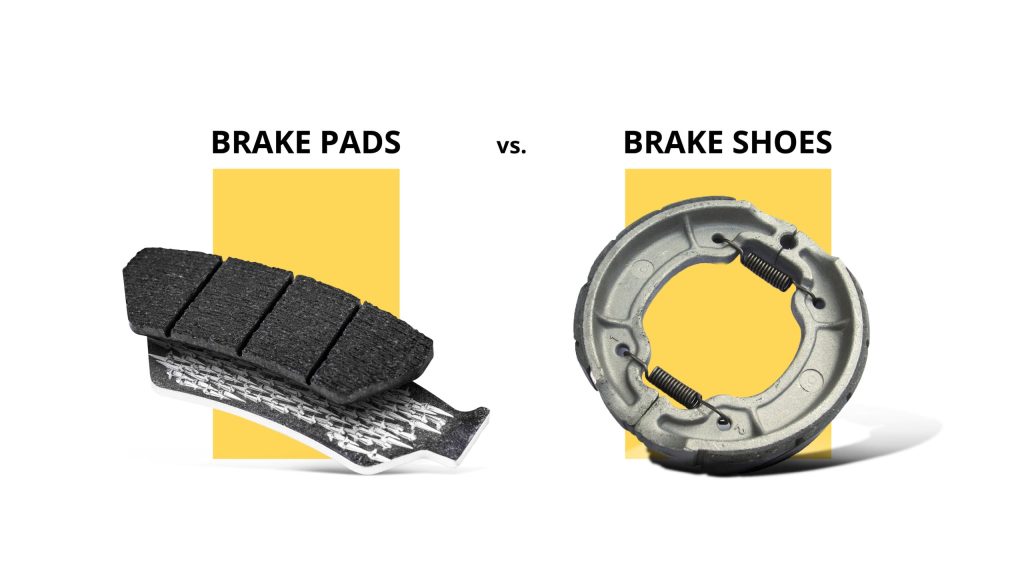

Brake pads squeeze the two faces of a brake disc, also called a rotor. Brake shoes carry curved friction linings that press against the inside of a brake drum. Both create friction to slow a wheel, but they belong to different mechanisms and cannot replace one another. A car can use pads at the front and shoes at the rear, or disc brakes at all four wheels with separate shoes operating a rear parking brake. Identify the axle and the brake's function before ordering anything.
A useful question for a repair shop is therefore, “Are you quoting for my service brakes, my parking brake, or both?” The service brakes are the system normally applied by the pedal while driving. The parking brake holds a parked vehicle using its specified mechanism. The answer can explain why an estimate lists rear pads and rear shoes together without necessarily charging twice for the same component. Ask the technician to identify each assembly on your particular car.
This guide separates component names from replacement decisions. It does not rank one design as suitable for every vehicle or supply a conversion procedure. If you already know that you need disc pads, use our brake-pad fitment checklist to establish the exact application. A registration lookup is a starting point; brake package, build details and catalog qualifications still matter when several alternatives appear.
What a brake pad does inside a disc brake
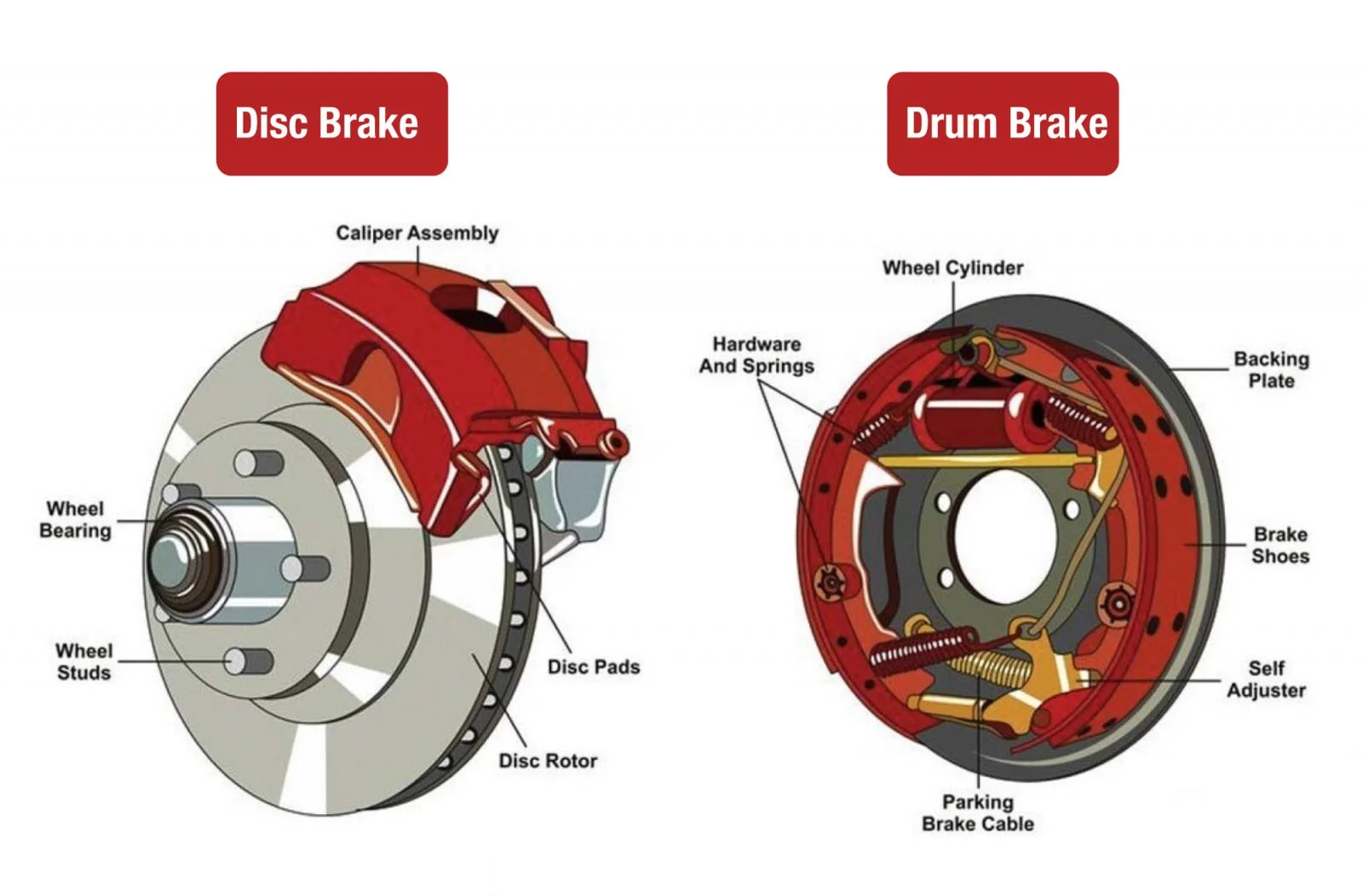
A disc pad is an assembly, not just a loose piece of abrasive material. Its friction lining is supported by a backing plate, with application-specific features that locate it in the brake assembly. The caliper applies the pads against the rotating disc. Akebono's disc-brake explanation describes the relationship between hydraulic pressure, caliper and rotor. Pads that look similar can still have different dimensions, hardware or friction specifications; appearance alone does not establish compatibility.
For an owner, the practical distinction is between the replaceable friction lining and the parts that support and actuate it. A quotation for pads does not automatically mean the caliper or rotor also needs replacement. Equally, installing pads cannot correct every fault in those other components. Ask what inspection or measurement supports each additional item. Separating the parts this way makes a repair estimate easier to assess without trying to diagnose the entire brake system from a noise description.
Some pad material may be visible through a wheel opening, but that view can hide the inner pad or part of its working surface. Do not treat a quick glance at one outer pad as an inspection of the whole axle. Our guide to checking pad thickness explains why the lining must be distinguished from the backing plate. The acceptable wear limit still comes from the applicable vehicle or component specification.
What a brake shoe does inside a drum brake
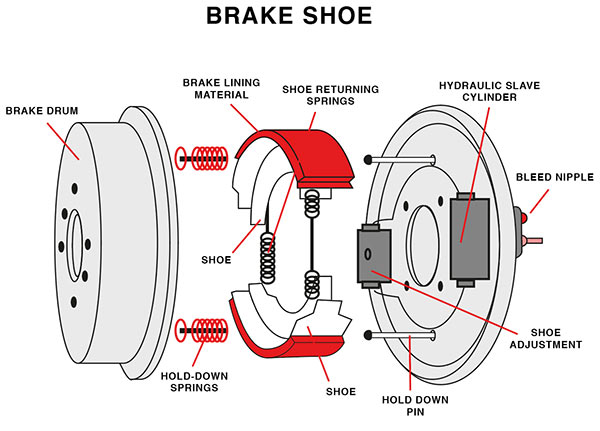
A brake shoe provides a curved support for a friction lining. In a drum service brake, the shoe assembly is located inside the rotating drum; the lining contacts its internal braking surface when the mechanism applies. Akebono's drum-brake guide illustrates hydraulic wheel-cylinder operation and several shoe arrangements. Their names describe specific designs, so a drawing of one drum brake should not be assumed to show the springs, adjuster or shoe orientation of another.
The enclosure means much of a drum brake's condition is not visible from outside. An assessment may need access to the linings, drum surface, hardware and actuator. That is a different job from simply looking at a disc through a wheel. A workshop should explain whether it has inspected those components or is giving a provisional estimate before opening the assembly. “Rear brakes need checking” is an observation request, not yet a confirmed parts list.
Shoes are also sold as part of different service packages. Brembo's shoe range includes individual components and preassembled kits. This matters when comparing prices: two listings labeled brake shoes may not contain the same hardware. Ask for the exact part number and package contents. Paying for a complete kit can be reasonable when its additional parts are required, but its higher price should not be confused with a higher price for the friction lining alone.
Compare the mechanism, then compare the repair
The contact surfaces provide the clearest identification: pads act on disc faces, while shoe linings act on a drum's internal circumference. That distinction is more reliable than saying pads are always front parts and shoes are always rear parts. Axle location alone cannot tell you which system your car has. For a vehicle with unfamiliar brakes, find its parts diagram or have a technician identify the assembly before accepting a generic shopping recommendation.
Heat management is one reason brake systems have different designs. An exposed disc and an enclosed drum do not exchange heat in the same way. Drum layouts can also use drum rotation to help apply the shoe, an effect described in Akebono's technical guide. Neither observation proves that one unidentified car will stop in a shorter distance than another. Tires, load, road surface, control systems and the complete brake specification prevent a meaningful stopping-distance ranking based only on the words pad and shoe.
There is no reliable universal rule that shoes cost less or pads last longer. Compare the complete work on the same vehicle and axle: friction parts, mating surfaces, hardware, corrective repairs and labor. An inexpensive set of shoes does not tell you the total drum-service price. A premium pad price does not establish longer service life. Treat fixed mileage promises cautiously unless they describe your actual application and include the conditions behind the claim.
Credit: natrad.com.au
Reading an estimate for disc-pad replacement
Ask the shop to record the measured lining thickness and the reason for service. If rotors are included, ask about their measured condition and the relevant limits. If a caliper is included, ask what defect was found. These questions produce separate, reviewable explanations for separate parts. They also help distinguish normal wear from a problem that would damage new pads again. A photo can support the explanation, but a close-up without scale is not a substitute for the stated measurement.
Specify the axle when discussing a pad set. Then check whether the estimate includes the required clips, sensors or other application-specific items. Avoid comparing a parts-only online price with an installed quotation that includes inspection and corrective work. Record both quotes using the same scope first. If the seller cannot identify the brake package or explain a catalog restriction, resolve that uncertainty before purchasing, even if the advertised price is attractive.
Reading an estimate for drum-shoe replacement
For drum service, ask about the shoes, drum condition and the associated mechanism as separate inspection findings. Brembo's shoe-fitting instructions require the correct vehicle reference and axle-wide shoe replacement, while directing installers to the vehicle manufacturer's special instructions. That is a useful boundary for evaluating advice: a generic shoe guide cannot supply every adjustment method or assembly detail. The shop should work from the instructions applicable to your specific braking system.
A shoe estimate can change after the drum is removed if previously hidden damage becomes visible. Ask whether the initial amount is provisional and how additional work will be documented. Request the findings before authorizing optional work, but do not equate a hidden defect with an unnecessary repair merely because it was absent from the first quote. The important distinction is whether the additional component has an identified defect or is simply being suggested without an explanation.
Why a car with rear discs may still have brake shoes
Some disc-brake vehicles use a separate small drum arrangement for the parking brake. Others apply their parking brake through the caliper mechanism. Confirm the actual design rather than assuming that a rear disc rules out shoes. As a concrete catalog example, Brembo S 28 517 is identified as a rear parking-brake shoe. That product listing demonstrates why a shoe can appear in a parts search even when the owner is expecting disc-pad service.
Now consider a hypothetical estimate listing rear pads, rotors and parking-brake shoes. First establish whether the car actually has that separate shoe assembly. Next ask which symptoms or measurements justify each item. Worn service pads and a parking brake that does not hold are two distinct findings. Replacing one does not establish that the other has been corrected. Keep the diagnosis and the final functional checks tied to the appropriate mechanism.
Questions that prevent the wrong purchase
Start a parts inquiry with the vehicle identification details, market, axle and brake package. Then say whether the work concerns service braking or parking-brake operation. Include a previous verified part number if available, but ask the supplier to check that it still cross-references correctly. Brembo's advice on multiple catalog matches reinforces the need to resolve application qualifications instead of choosing arbitrarily from several plausible products.
Keep a short record of the answer: part number, quantity, included hardware and any fitting qualification. That record is useful if the box arrives with a different number or the installer finds a mismatch. Resolve the discrepancy while the part is unused. Filing, drilling or otherwise modifying a wrong friction assembly to make it fit is not an acceptable substitute for identifying the proper part.
Can pads replace shoes as an upgrade?
No. They are not alternative inserts for the same mechanism. Changing a drum system to a disc system would involve a vehicle-specific engineered conversion and its effects on the complete braking system. A conversation about routine worn friction parts should therefore remain a replacement discussion. If someone proposes a conversion, ask for a separately specified and appropriately approved solution; do not treat a pad purchase as the conversion itself.
Does noise reveal which part has failed?
Not reliably. A driver may notice squealing, scraping or a change in pedal behavior, but the sound alone does not establish which component requires replacement. Record when it happens, whether it changes with pedal application and whether warnings are present. Arrange inspection rather than ordering pads or shoes from the noise alone. Reduced braking, a sinking pedal or a suspected fluid leak requires prompt professional attention; do not continue driving to compare noises.

Credit: www.youtube.com
Credit: www.championautoparts.com
The information to take to your repair appointment
Bring the vehicle details and the symptom description, then ask the technician to identify the affected axle and mechanism. Have the estimate name the friction parts precisely and distinguish them from rotors, drums, calipers, wheel cylinders and parking-brake hardware. A clear parts list prevents the ambiguous phrase “new rear brakes” from hiding differences between quotations.
Request the inspection findings that justify replacement and the applicable wear limits. After the repair, keep the invoice with the actual part numbers and service date. These records are more useful for future maintenance than a generalized expectation that pads or shoes should last a particular number of miles.
The decisive difference is the surface each part works against. Once you establish disc pads, drum shoes or separate parking-brake shoes, the next step is exact fitment and a documented condition assessment. You can then compare repair options using the system your car actually has.


Automotive reference information. Confirm specifications in the manual for your exact vehicle. Original replacement guides link to their research sources. About us