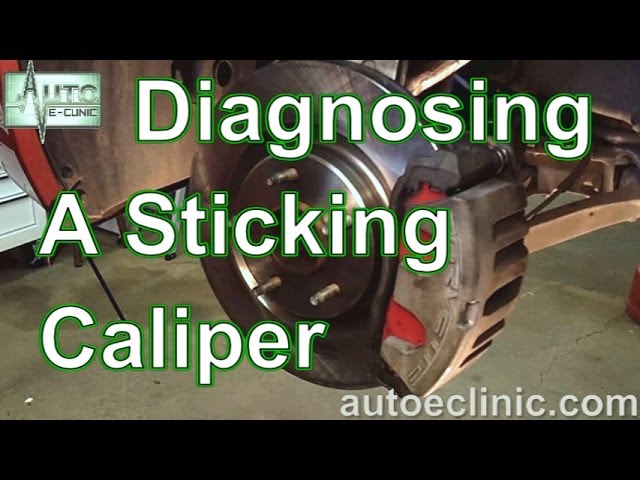

A brake caliper can appear to stick because something in the brake cannot move freely or because hydraulic pressure continues to apply it after the pedal is released. Those are different failure paths, and neither can be identified reliably from heat or pulling alone. The most useful question is what is keeping this particular wheel braked. The answer may involve the caliper piston, guides, pad fit, parking-brake mechanism or another part of the hydraulic system.
This article focuses on causes and recurrence, including a brake that still drags after a new caliper is installed. For identifying the initial warning signs, use our sticking brake symptoms guide. If there is smoke, severe drag, a sudden pedal change, reduced braking or a strong pull, stop safely and arrange recovery rather than driving to reproduce the problem. A cause is an explanation supported by a check, not simply the name of the hottest part.
Consider a wheel that becomes hot after ordinary travel: this establishes a complaint to investigate, but does not establish whether the pad is trapped, the piston binds or the system retains pressure. Replacing the part nearest the heat may happen to fix it, but it can also leave the original fault in place. A sound investigation records the conditions, identifies the affected components and distinguishes competing explanations.
That approach matters particularly when several repairs have already been attempted. Keep the old invoices and describe what changed after each intervention. The repair history is useful evidence even if a previous diagnosis was incomplete.

Credit: www.repairsmith.com
Mechanical binding and hydraulic holding: different causes
Mechanical binding means a component cannot make the movement required for normal application or release. In a floating caliper, the guides must allow the assembly to move as designed. A fixed caliper has a different arrangement, so a guide-pin diagnosis cannot simply be transferred to every vehicle. The pads also need correct support and movement within their intended hardware. The hydraulic piston has its own working surfaces and seals. A defect in any one of those areas can produce a sticking complaint, but the appropriate correction depends on which movement is restricted. Identifying the brake design is therefore part of the diagnosis rather than an administrative detail before ordering parts. Contamination, corrosion or damage can affect guide hardware. HELLA’s guide-pin guidance also warns that an unsuitable lubricant can swell rubber components. That is why a record of the product used matters after recent servicing. Fresh grease is not proof of correct service, and adding more of the same product cannot establish compatibility. The condition of sleeves and moving surfaces needs checking with the correct component instructions. A visible dust boot defect is a reason for inspection; it does not reveal the full internal condition on its own. Pads can be restricted by their installation or by the condition of the carrier. Wagner’s inspection checklist specifically calls attention to rust under abutment clips.
A new caliper does not automatically renew that interface, especially when an existing carrier and hardware are reused. The workshop should also verify the correct pad application and installation. A pad that was made to fit by uncontrolled grinding is not reassuring evidence that the original fitment was correct. The acceptable clearances and service treatment come from the component and vehicle guidance. A piston-related problem needs its own assessment. External appearance is insufficient because a clean housing does not reveal the condition of the piston and its sealing arrangement. Resistance during a retraction attempt is also inconclusive if the wrong method is being used. Rear assemblies may have integrated parking-brake mechanisms or electronic service requirements. Before declaring a piston seized, the technician must establish the procedure that applies to it. Applying ever more force to an unidentified mechanism risks creating damage that was not present at the start. Hydraulic holding is different: the brake may be mechanically capable of moving but still be applied by retained pressure. A restricted hose is one possible contributor. Other hydraulic causes require investigation appropriate to the vehicle and the pattern of affected brakes. Do not interpret temporary release during a pressure test as a completed repair or as proof of every upstream component’s condition.
The technician must locate the fault, restore the circuit and verify the system. Our brake-hose and caliper-sticking explanation discusses the diagnostic distinction in more detail. Hose condition also includes installation. HELLA’s brake hose and line guidance calls for routing that avoids twisting and mechanical strain. A hose can be damaged during previous work or fitted in a way that creates a problem as the suspension and steering move. A stationary glance at a single wheel position is not a complete installation assessment. Equally, absence of visible cracking does not prove that a hose is unrestricted internally. Exterior inspection and hydraulic evaluation answer different questions. A parking-brake fault can complicate a rear-wheel complaint. The mechanism may be integrated into the caliper or may use a separate arrangement. The diagnosis should identify the actual design and establish whether it releases correctly. Disconnecting or disabling it to make the wheel turn does not restore a roadworthy braking system. More than one fault may coexist, particularly when components have overheated. Finding one defect should lead to assessment of its consequences, not an assumption that every other part is sound.
Why a replacement caliper may still seem to stick
A new caliper changes only the components actually supplied and installed. The carrier, guide hardware, pads, hose or parking-brake parts may have been reused, depending on the product and repair scope. Start a comeback investigation by listing what changed and what stayed. Ask for the part number and confirm the application against the vehicle’s brake specification. The word new describes purchase condition; it does not establish correct fit, installation or operation. A defective replacement is possible, but it should not become the default explanation before the surrounding system is checked. Timing helps organize the investigation without proving a cause. A problem present immediately after work raises questions about application, assembly, hose routing, hardware and the service procedure. A problem that returns after repeated use needs assessment under safely controlled conditions relevant to its recurrence.
A complaint after parking-brake use makes that mechanism worth examining. Symptoms at several wheels deserve a different diagnostic plan from an isolated corner. These are directions for testing, not shortcuts that identify a failed part solely from when the driver noticed it. An incomplete repair may also leave heat damage behind. A functioning replacement caliper cannot reverse damage to friction components. A continued vibration, noise or braking concern may therefore be related to the earlier event without meaning the new caliper sticks. The workshop needs to establish whether drag is still present or whether a different consequence remains. Ask for separate findings on pad condition, disc condition and actual brake release.
This prevents every post-repair symptom from being folded into the same unverified label. Consider two hypothetical cases. In the first, the piston assembly is replaced but the pads remain tight in the retained carrier. The continuing complaint is consistent with an unresolved pad-movement problem, so another piston assembly is not a logical first response. In the second, a guide-hardware repair restores easy mechanical movement but the wheel still becomes applied after pedal use. That calls for further diagnosis of the operating system rather than assuming that more lubricant is needed. These examples illustrate how evidence changes a repair decision; they are not instructions for opening lines or testing brakes on the road. A useful workshop report separates four things: the driver’s complaint, the reproduced condition, the test findings and the chosen correction.
Request plain wording for each. For instance, an observed temperature difference belongs in the findings, while a confirmed restriction belongs in the diagnosis. If the cause remains uncertain, the report should state the next check and its purpose. Ask whether the old parts can be retained or photographed where practical. Documentation is especially valuable when warranty work and additional paid diagnosis are being discussed at the same time. Before approving further replacement, ask how the proposed work addresses the confirmed failure and what will verify the result. The answer should include restoration of any disturbed hydraulic or parking-brake functions, appropriate static checks and safe verification by a qualified person. There is no universal home test based on a fixed number of wheel rotations or a single temperature limit.
Vehicle design and operating conditions matter. Our repair-decision guide covers evaluating the proposed correction once the cause has been established. Repeated sticking should prompt a review of the complete chain rather than an assumption that the owner simply needs another caliper. That review can include the original failure, parts retained, installation details, consequential damage and the conditions used to verify the previous repair. It should not become permission to replace every related part without findings. A careful explanation may support a small targeted repair, a larger repair or more diagnostic time. What makes the recommendation credible is the connection between evidence and action. Until abnormal braking has been resolved and checked, temporary improvement after cooling or adjustment is not a reliable basis for continued use.


Automotive reference information. Confirm specifications in the manual for your exact vehicle. Original replacement guides link to their research sources. About us