
Brake pads are not universal. A replacement must be specified for the vehicle’s brake system and axle. A matching outline or a similar thickness does not establish that its friction material, hardware, sensor arrangement and caliper fit are correct.
Some part numbers cover several vehicles, but that is a documented shared application—not permission to interchange any pads that look alike. Confirm the manufacturer’s fitment record before installation.
The model name is only a starting point

Credit: www.youtube.com
Identify the model year, market and relevant brake option. Where the catalogue requests the VIN, engine, production date or another identifier, use it rather than choosing the first result for the model name. Front and rear pads are separate application questions.
A vehicle that has had a brake conversion needs identification of the installed system as well as the original VIN. The factory listing alone may not describe an aftermarket caliper. Keep the conversion documentation and obtain its specified replacement components.
Read the full specification, not one dimension
Brembo’s P 23 109 catalogue record lists dimensions, axle, brake-system identification and wear-indicator information together. Its P 85 020 record has a different dimensional and application set. Those records demonstrate the type of information needed; neither is a recommendation for an unspecified vehicle.
Width and height affect where the pad sits, while backing-plate features and hardware affect retention and movement. A dimension that happens to match does not cancel another mismatch. Do not grind a pad into a bracket to make an uncertain application fit.
Check sensor and hardware provisions
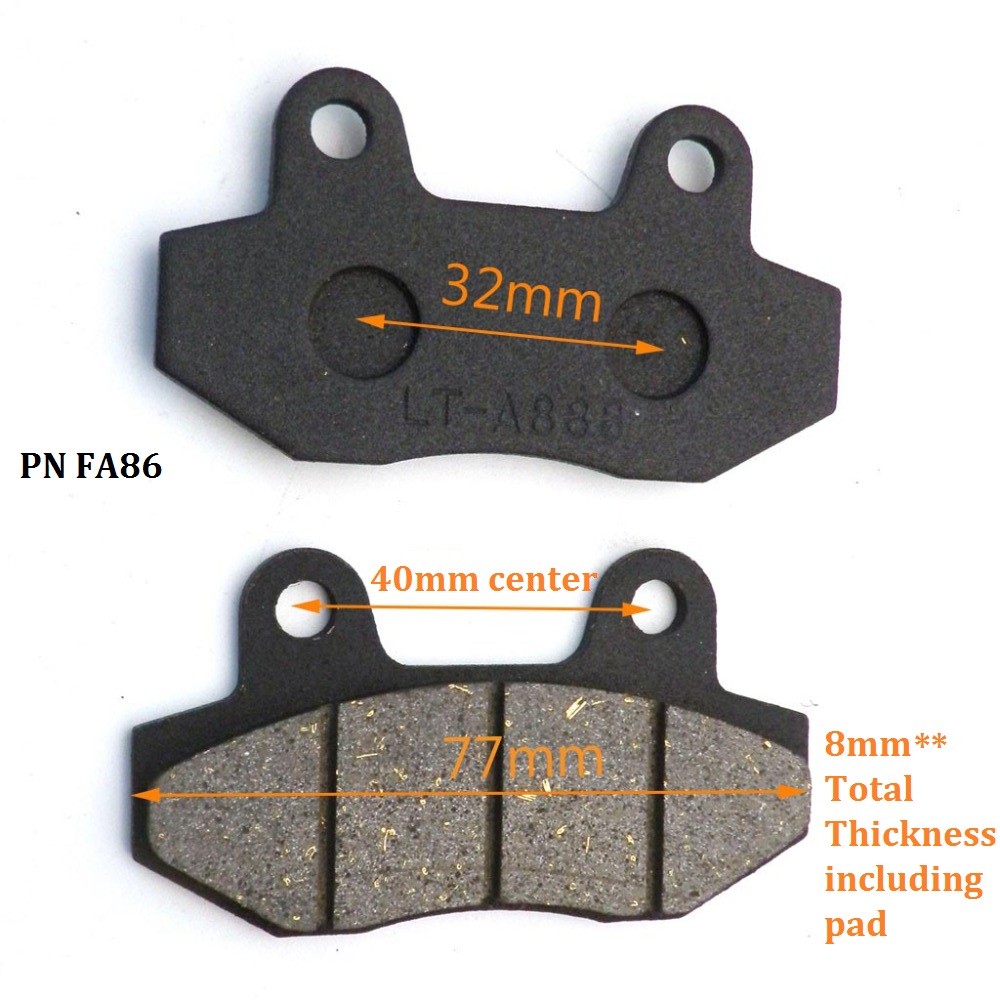
Credit: ebikepros.com
Some pads use a wear-warning contact; others use an acoustic tab or a different arrangement. The kit may also require specific shims, clips or bolts. Confirm what the vehicle requires and what the box actually contains.
A sensor connector that is absent or incompatible is not an inconvenience to bypass. Similarly, omitting a clip to gain clearance can leave the assembly incorrect. The hardware installation guide explains why these parts need application-specific placement.
A material label does not make a pad interchangeable
Ceramic and semi-metallic describe formulation families. They do not define the backing-plate shape or prove suitability for a particular vehicle and use. Choose among products already confirmed for the application rather than using a material preference to override fitment.
The ceramic-versus-metallic comparison addresses the selection question after compatibility is established. It cannot turn an incorrectly sized or specified pad into an appropriate replacement.
Inspect the supplied parts before the car is dismantled
Compare the box part number and catalogue listing, then check the contents for the expected pads and hardware. If the packaging includes several possible applications, confirm the exact one rather than assuming every supplied piece belongs on your vehicle.
Keep the receipt and packaging until the repair has been verified. If there is a mismatch, contact the supplier with the vehicle details, part number and clear photographs. Do not alter the parts while trying to resolve a return or fitment question.
Use cross-references as evidence to verify
A manufacturer cross-reference can identify a possible equivalent, but it should lead to a confirmed application and specification. Avoid treating a marketplace suggestion or a seller’s generic “universal” label as equivalent to an engineering fitment record.

Credit: www.youtube.com
The right outcome is an identified pad set for an identified brake system. Once that is established, installation still requires the correct service procedure, inspection of the rest of the brakes and post-repair verification.


Automotive reference information. Confirm specifications in the manual for your exact vehicle. Original replacement guides link to their research sources. About us


