
New brake pads do not have one universal thickness in millimetres. Use the specification for the exact part, and first establish whether a quoted number describes the complete pad assembly or only the friction material. Confusing those measurements makes both fitment comparisons and wear estimates unreliable.
A pad’s backing plate, shims, friction shape and intended brake system all matter. A number from another vehicle or from a different pad position should not be treated as the standard your replacement must meet.
Start with the manufacturer’s part number
Identify the vehicle, axle and brake option, then find the pad manufacturer’s dimensional drawing or specification table. Confirm that the part number on the box matches the record. A listing for a broadly similar model can still describe a different pad.
For illustration, Brembo lists a thickness of 18 mm for P23109 and 17 mm for P85020. These are two specific catalog examples, not a recommended thickness range for every new pad or a statement about how much friction material each contains.

Credit: community.cartalk.com
Find out what the dimension includes
A catalog thickness dimension is not automatically the usable friction thickness that a technician records during a wear inspection. Check the drawing or manufacturer explanation for the measurement points. Do not subtract a guessed backing-plate thickness to produce a supposed wear reading.
For a worn pad, the inspection normally needs the remaining friction material evaluated against the applicable service criterion. The pad-thickness inspection guide helps distinguish a proper measurement from a glance through a wheel.
Compare like with like
Compare the same pad position, measurement method and part specification. An inner pad, outer pad or pad from the opposite axle may have a different construction. A chamfer or slot also changes what a visual edge appears to show without necessarily indicating wear.

Credit: www.velotricbike.com
If a new set looks unexpectedly thin, pause before installing it. Verify the application, the complete supplied set and the dimensions at the specified points. Photograph the packaging and parts for the seller rather than opening the hydraulic system to force an uncertain fit.
Thickness alone cannot prove compatibility
Correct width, height, backing-plate shape, hardware and sensor provisions are also necessary. Even a pad that slides into the bracket may be wrong for the system. See why brake pads are not universal before treating matching thickness as proof of fitment.
Conversely, a new pad that will not fit over the rotor is not automatically too thick. The cause might be incorrect parts, piston preparation, hardware placement or another assembly problem. Diagnose the reason instead of grinding friction material or forcing the caliper into position.
Do not convert a new-pad number directly into mileage
Knowing the starting thickness does not establish how long a pad will last. Wear rate depends on use and condition, and severe uneven wear can invalidate a prediction based on an average. Record individual readings rather than a single rounded figure for the whole vehicle.
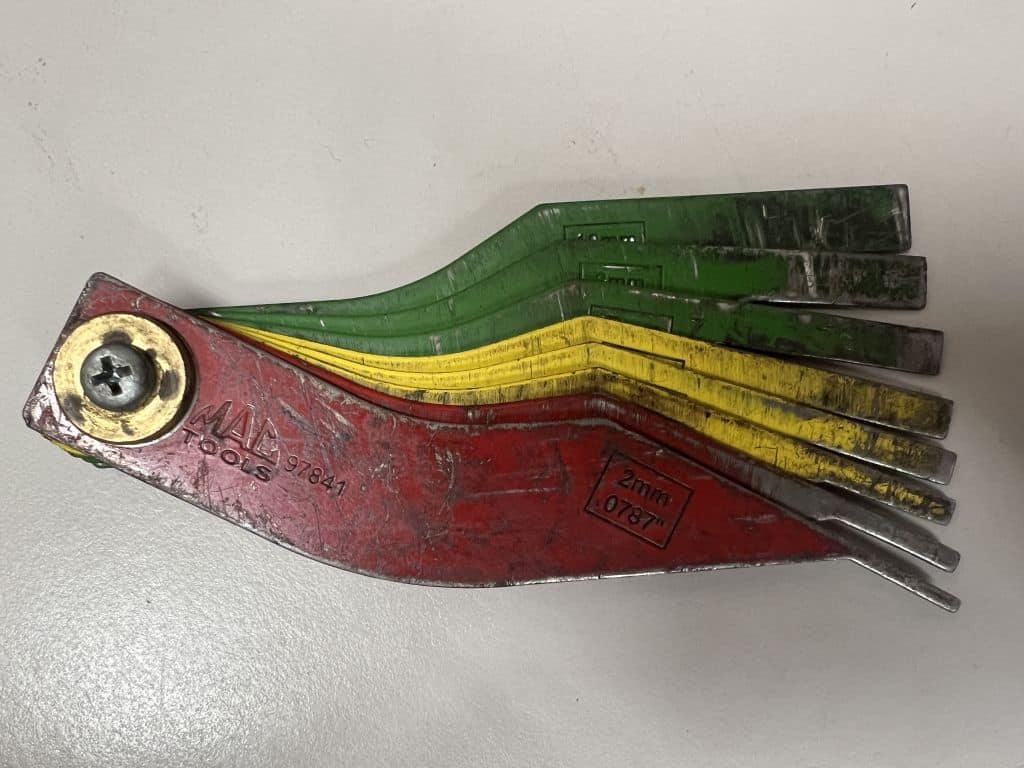
Credit: artsautomotive.com
The useful comparison is a documented current measurement, the correct limit and inspection findings. A remaining-life estimate should guide reinspection, not guarantee that a vehicle can travel a fixed distance before the next check.
What to ask when a measurement is unclear
Ask for the exact part number, which surface-to-surface distance was measured, which pad positions were checked and the specification used. Those details usually resolve more uncertainty than arguing over a generic “new pads should be X mm” rule.
If the manufacturer’s drawing or seller information is ambiguous, obtain clarification before installation. An accurate specification is more valuable than a precise-looking number borrowed from an unrelated brake pad.


Automotive reference information. Confirm specifications in the manual for your exact vehicle. Original replacement guides link to their research sources. About us


