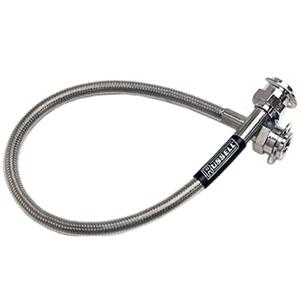

Stainless steel brake lines can be worth considering for a specific repair, but the term describes two different products. Rigid stainless tubing replaces a fixed metal line, while a stainless-braided flexible hose replaces a hose that accommodates movement.
Their benefits, installation needs and failure concerns are different.
Identify which part is being discussed before comparing cost or performance.
Neither product makes a leaking or incorrectly assembled braking system safe by itself.
This guide evaluates the purchase and repair scope without claiming that every car needs an upgrade or that a particular material guarantees shorter stopping distances.
Identify rigid tubing and flexible hose separately
A fixed metal line follows a supported route along the vehicle. A flexible hose allows specified movement at locations such as a wheel assembly. They are not interchangeable simply because both carry brake fluid.
A quote should name the actual product and location. Ask whether stainless describes the tube itself, an outer braid or only the fittings. That clarification prevents a hose upgrade discussion from being mistaken for replacement of corroded underbody tubing.
Understand what stainless braid actually surrounds
Goodridge’s 600-series description identifies a PTFE liner wrapped in stainless braid. That is a flexible hose construction, not a solid stainless pipe.
Its specific application and pressure variant still require identification.
Do not purchase an arbitrary length of braided hose on the assumption that every product in a broad range is a complete approved automotive brake-hose assembly.
- End fittings, manufacture and the intended vehicle application matter as well as the material visible outside.
Define the problem before selecting an upgrade
A corroded rigid line needs a supported replacement plan. An aged or damaged flexible hose needs the correct hose assembly.
- A soft pedal needs diagnosis rather than an automatic material upgrade.
- Air, leakage and other faults are not excluded because a braided product has been installed.
- State the complaint and ask which finding the proposed part corrects.
A useful upgrade decision begins with a sound braking system or a clearly diagnosed repair, not an unexplained symptom and a promise of better feel.

Credit: www.amazon.com
What a material choice can and cannot deliver
A material can offer useful properties, but the installed assembly determines whether those properties serve this vehicle. Correct dimensions, supported routing and suitable connections remain necessary. A product that is difficult to form or connect correctly may create more installation work than expected. The relevant comparison is between compatible, properly installed alternatives, not between an ideal new part and a defective old one.
Pedal feel is not a stopping-distance test
A change in pedal feel after hose replacement does not isolate the effect of the braid. The work may also remove air, renew fluid or replace a damaged hose. Describe the full repair before attributing the result to one material. A firmer subjective feel is not independent evidence of shorter stopping distance, better tire grip or increased brake torque. No controlled comparative test is claimed here.
Durability depends on the complete assembly
The liner, ends, protective covering, mounting and installation all contribute to serviceability. A durable outer braid does not establish the condition of hidden portions or the suitability of every fitting. Ask what inspection and replacement guidance applies to the actual product. Do not translate a warranty headline into a maintenance-free lifetime. Retain the part identifier so future inspections can use the right instructions.
Corrosion resistance is useful but not a complete specification
- Corrosion resistance can be relevant when choosing replacement rigid tubing. However, the material must still be specified for automotive brake use and accepted for the application. Inspect adjoining fittings and supports rather than assuming a stainless section renews the entire route. A new corrosion-resistant part cannot repair a damaged port or compensate for an unsuitable retained connection.
Compare performance claims with the intended use
Ask what evidence supports a claimed benefit and whether it concerns your application. A motorsport product description does not automatically establish suitability for road use. A general pressure rating does not verify fitting compatibility, hose travel or regulatory requirements. Product selection needs the complete assembly information. Treat unsupported claims of universal improvement as questions to investigate, not as repair instructions.
Pressure capability is only one part of compatibility
A component's pressure specification belongs to its defined construction and operating conditions. It is not permission to combine unrelated fittings or reuse damaged attachment parts. Ask whether the supplied assembly is intended for the vehicle and whether its required seals and hardware are included.
Do not substitute a hose merely because a seller lists a high pressure figure. The hydraulic connection must also match the braking system it joins.
Temperature claims need application context
The product's temperature limits must be read with its fluid compatibility and installation instructions. An impressive range does not mean the hose can touch a hot component or bypass the intended routing. Consider the complete vehicle environment rather than one laboratory property.
If the proposed route differs from the original, obtain the supported installation information before approving it. Material selection does not remove clearance requirements.
Safety comes from a verified repair
HELLA’s hose and line guidance identifies corrosion, hose damage and installation concerns as inspection areas. That supports checking the existing system before selecting parts.
It does not establish that every factory-style hose is unsafe or that stainless braid is necessary for every car. Ask the repairer to document actual defects.
- Replace components because the inspection and procedure require it, and evaluate optional changes separately.

Credit: www.z1motorsports.com
Installation requirements can decide the value
Rigid stainless tubing may require tooling specifically suitable for its material and the required flare. A tool that handles a softer tube is not automatically suitable. The finished line must fit its route and connections without forced alignment.
Flexible assemblies have their own requirements for length, orientation and retention. Compare those installation demands before treating the purchase price as the full cost.
Check the vehicle and the installed hardware
Provide the exact model, year, brake option and relevant modifications. A hose kit for a similar trim can have different end arrangements or routing needs.
A previous repair may also have changed the component now installed. Confirm the actual application through the supplier and repair information.
- Do not choose by appearance or thread engagement alone.
Our line and fitting identification guide explains why tube size is only one of several matching dimensions.
Decide who can complete and verify the work
Opening the hydraulic system requires a complete restoration plan.
- Identify the correct fluid, bleeding procedure and any vehicle-specific equipment before disassembly.
The line or hose must be secured and inspected under the prescribed conditions.
Nearby components must not be left strained or obstructed.
A clear pedal at one moment is not the entire completion check.
- If the installer cannot identify the product requirements, pause the job.
Professional installation is appropriate when the necessary tooling, instructions or verification cannot be provided reliably.
Compare the complete installed options
Request separate quotations for compatible alternatives with the same repair scope. Include the line or hose, fittings, required hardware, labor, fluid service and verification. Ask whether a preformed assembly is available and whether it reduces fabrication work.
AGS’s fitted-line information emphasizes matching flare, thread and service length. That is a useful comparison framework rather than evidence that one material is best for every repair.
Do not assume future savings without a basis
A higher initial price may or may not reduce later costs. The answer depends on the vehicle's remaining use, local exposure, inspection needs and the alternatives being compared.
There is no universal payback period. Avoid assigning a guaranteed service life to either option.
Ask what warranty remedy actually covers and whether removal or installation labor is excluded.
- A free replacement part would not necessarily make a future repair cost-free.
Compare rigid lines with rigid lines and hoses with hoses
A rubber hose price is not a direct substitute for the cost of a rigid stainless line. Compare assemblies performing the same job and fitting the same application.
| For a hose comparison, include supplied end fittings and brackets. For rigid tubing, include forming and flaring requirements. |
Identify which components remain original after each option.
A lower estimate may simply renew less of the system rather than offer equivalent work more cheaply.
Use scenarios to clarify the choice
Consider a vehicle with one damaged flexible hose and sound rigid tubing. The immediate task is a suitable hose repair, not automatic replacement of every metal line. Now consider extensive corrosion along a fixed route.
A braided wheel hose would not address that defect. These examples show why naming the failed component changes the buying decision before material preferences become relevant.
Read owner reports as questions rather than controlled evidence
An owner may report a firmer pedal after a complete brake service. Another may describe a difficult fitting installation.
Both accounts can suggest questions for a supplier, but neither establishes a universal result.
- Vehicle condition and the work performed may differ.
- Ask whether the reported product number matches the proposed part.
- Avoid treating enthusiasm or disappointment without diagnosis as a measured comparison of materials.
A practical decision record for your repair
Write down the component being replaced. Identify the confirmed defect or optional objective.
Record the compatible part number and supplier. Confirm the required hardware and installation method.
| Establish the applicable inspection and maintenance requirements. Compare the complete installed cost with a supported alternative. |
Keep warranty terms separate from performance claims. Ask how the finished installation will be verified.
Preserve the invoice and product instructions for later service. For a daily-driven vehicle, a correct factory-style replacement may be entirely appropriate.

Credit: www.cquence.net
A supported stainless option may also make sense where its properties and installation requirements fit the job. The decision does not require claiming that one choice is universally superior.
If the system currently leaks, prioritize diagnosis and a complete repair, as discussed in our brake-line leak guide.
A material upgrade is useful only when it belongs to a compatible, safely installed and verified assembly.
That is the standard against which its cost should be judged.


Automotive reference information. Confirm specifications in the manual for your exact vehicle. Original replacement guides link to their research sources. About us


